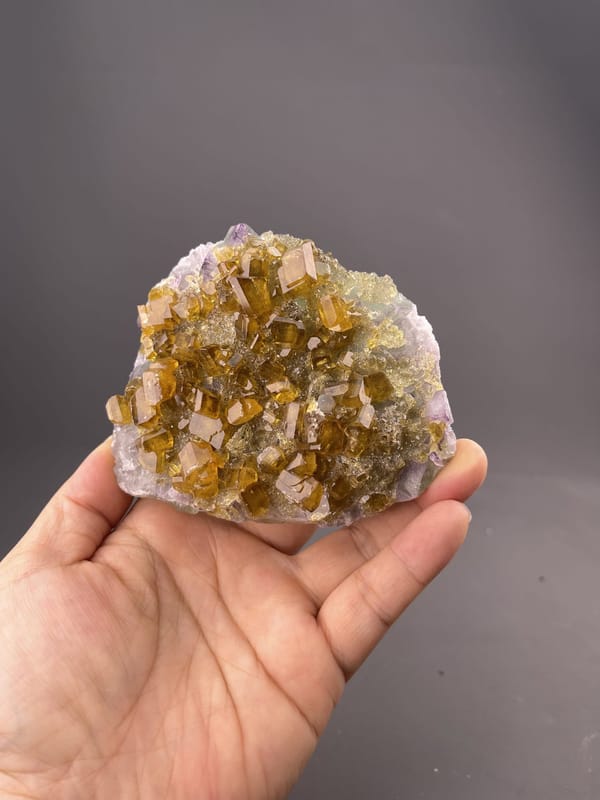
德兴铜矿
Jiangxi, China
江西的德兴铜矿是中国最大的斑岩型铜–钼矿床之一。在收藏界,它以蜜金色重晶石最为知名,并伴生黄铜矿、黄铁矿与石英。
One of China's great porphyry copper mines
The Dexing deposit in northeastern Jiangxi Province is a Jurassic porphyry copper–molybdenum system and one of the largest open-pit copper operations in China. The Tongchang, Fujiabu, and Zhushahong ore bodies are mined together at very large scale, making Dexing a cornerstone of Chinese copper production.
What Dexing is known for
- Golden, honey-amber, and yellow-brown barite — the locality's specimen signature
- Chalcopyrite in clusters and spheroidal aggregates
- Pyrite and associated quartz
Late-stage hydrothermal activity in the porphyry system produced the saturated barite that has made Dexing a recognised name among barite collectors.
Collector value
Specimens with strong colour saturation, undamaged crystal edges, and intact matrix command the largest premiums. The finest honey-barite came from pockets worked in the 2010s and is now in declining supply.
Scale and history
Dexing was developed from the late 1950s and has been in production since the 1960s. Operated today by Jiangxi Copper, it is one of the largest open-pit copper operations in China — and among the largest in Asia — supplying a substantial share of the country's mined copper. The very large, long-lived open pit is what keeps well-crystallised specimens reaching collectors: barite, chalcopyrite, and pyrite are recovered as the ore body is worked.