
BUYING GUIDE
The Most Commonly Faked Chinese Minerals
Synthetic quartz, glued matrix pieces and dyed stones are the Chinese minerals faked most often — here are the simple checks that spot each one before you buy.
The short answer
The Chinese specimens most often faked or misrepresented are synthetic (lab-grown) quartz clusters sold as natural, glued or assembled matrix pieces — cinnabar on dolomite is the classic example — and dyed, oiled, or coated stones. Lab-grown bismuth and mislabelled localities round out the list. A quick look at the base of a specimen, an ultraviolet light, and an acetone swab will catch the great majority of problems.
Synthetic quartz sold as natural
Perhaps the most talked-about fakes linked to China are lab-grown quartz clusters passed off as natural finds. Using a hydrothermal autoclave — the same industrial process that grows quartz for electronics — broken natural points are cemented into a cluster and then overgrown with synthetic quartz until they look like a single natural specimen. The results circulate under trade names such as "ghost" or "phantom" quartz, and as reworked "scepter" quartz, and are sometimes relabelled as "Tibetan" or "Himalayan" quartz or marketed as an exciting "new find."
These pieces are grown material, not naturally crystallised specimens, and the tells are fairly consistent:
- A flat, cemented base with no natural matrix, sometimes showing "rack marks" where the cluster was held in the autoclave. - Growth striations that run diagonally across a crystal face rather than horizontally. - Points that look unusually uniform in size and oddly, evenly spaced.
None of this makes synthetic quartz worthless as a curiosity — the problem is only when it is sold as a natural specimen without disclosure.
Glued and assembled specimens
The second big category is assembly: taking loose crystals and gluing them onto a matrix, or building a "cluster" out of separate pieces. The best-known Chinese example is cinnabar on dolomite. A good loose cinnabar crystal is lifted from a cheap, damaged piece and carefully glued onto a clean dolomite matrix, with small dolomite crystals or crushed mineral packed around the base to hide the join. Done well, an inexpensive crystal becomes a convincing — and much pricier — display specimen.
The same trick appears with other species: crystals stood upright in a pan of epoxy, then dusted with fine mica or crushed matrix so the glue disappears. A few checks expose most of them:
- Examine the underside and the base under magnification for glue lines, air bubbles, or a suspiciously tidy join. - Use an ultraviolet light: most glues and resins fluoresce differently from the natural mineral and matrix. - Where appropriate, a careful acetone soak will soften many glues — though this is a test to use with caution, and never on soluble or delicate material.
Repair and assembly are not always fraud; disclosed repair is a normal part of the trade. The problem is an assembled piece sold as a single natural specimen.
Dyed, oiled, and coated stones
Colour is the easiest thing to fake, so it is faked often. Cheap pale quartz is dyed to imitate amethyst or rose quartz; fluorite sometimes has oil rubbed into it to deepen and "wet" its colour; and clear quartz is given an iridescent metallic sheen by coating it with a vaporised metal — the familiar "aura" quartz. Aura coatings are genuine quartz with a man-made finish, so they are fine when described honestly and misleading when they are not.
What to look for:
- Colour that is unnaturally uniform and saturated. Natural crystals show zoning, tonal shifts, and inclusions; perfectly even colour is a warning sign. - Dye pooling in cracks and cleavage, or colour that appears to sit on the surface rather than within the crystal. - An acetone swab test: rub a hidden spot with acetone on a cotton bud, and many dyes will transfer onto the swab. - A metallic, oil-slick rainbow sheen, which does not occur naturally on quartz and signals a coating.
Lab-grown materials that were never mined
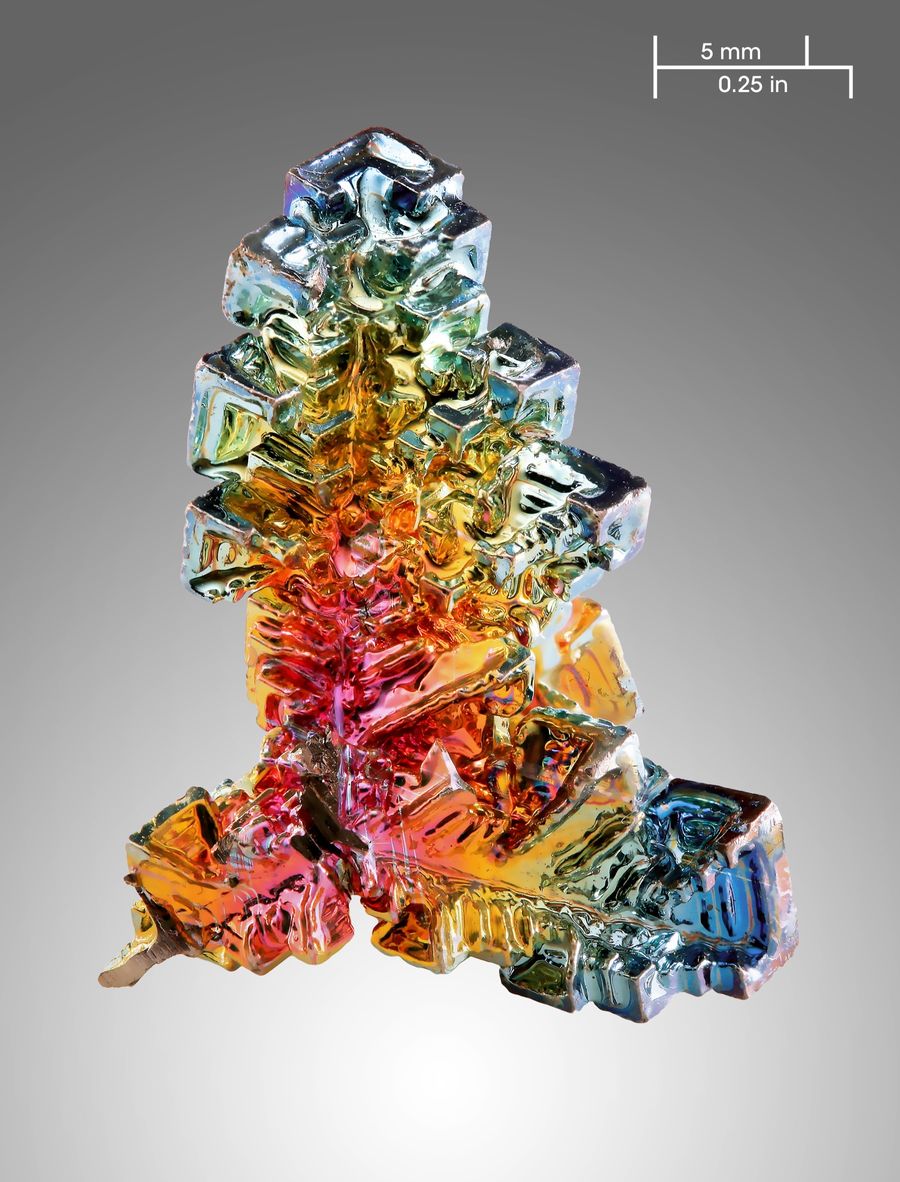
Some things sold at mineral shows and online were never dug out of the ground at all. Rainbow bismuth — the stair-stepped, iridescent "hopper" crystals you see everywhere — is grown from melted bismuth metal in a workshop. It is real bismuth, but it is a manufactured product, not a natural mineral specimen. The same goes for much of the brightly coloured "lab quartz," and for glass sold as "obsidian" or, in lurid colours, as "green obsidian."
There is nothing wrong with owning any of these. The only issue is disclosure: a lab-grown bismuth or synthetic quartz becomes a fake the moment it is presented as a naturally occurring specimen. If a listing is upfront that a piece is grown or man-made, you can buy it happily for exactly what it is.
Mislabelled localities and "laundered" origins
Not every misrepresentation is about the mineral itself — sometimes it is about where it supposedly came from. Because a famous locality can add a premium, Chinese material is occasionally relabelled with a more marketable origin, or routed through dealers in other countries so that its Chinese source is obscured. A specimen's locality is part of what you are paying for, so a vague, shifting, or implausible locality claim deserves as much scrutiny as the crystal itself.
This cuts both ways: China produces genuinely world-class localities — Yaogangxian, Xuebaoding, Shangbao, Xikuangshan — and "made in China" is not itself a red flag. The red flag is a locality that the seller cannot or will not stand behind.
A simple kit for spotting fakes
You do not need a laboratory to protect yourself. A few habits and inexpensive tools catch the large majority of fakes:
- Ask for photographs of the actual specimen from several angles, including the base. - Carry a 10x loupe to inspect joins, glue lines, and growth striations. - Keep a small ultraviolet light for spotting glue and resin. - Use an acetone swab, carefully, to check for surface dye. - For dense species such as cinnabar, remember that genuine material feels strikingly heavy for its size. - Sanity-check the price: a piece priced far below the going rate for its claimed quality is telling you something. - Above all, ask the seller directly about repair, treatment, coating, and locality — and judge the clarity of the answer.
As we note in our guide to natural versus treated material, evasiveness is a bigger warning sign than the mere existence of treatment. A dealer who answers plainly, and admits uncertainty where it exists, is giving you exactly what you need.
How we handle this at MyMineralBox
We photograph the actual specimen you will receive rather than using stock images, tie each piece to a locality page so you can read its regional context, and describe condition in plain language. Where we know a specimen has been cleaned, trimmed, or repaired, we aim to say so, and we avoid colour or treatment claims we cannot support. Our goal is not to convince you that fakes are everywhere — they are not — but to give you enough honest information to judge any specimen, from us or anyone else, on its merits.
الأسئلة الشائعة
Are most Chinese mineral specimens fake?
No. The large majority of Chinese mineral specimens on the collector market are genuine, naturally formed pieces. Fakes and misrepresentations exist, but they are a minority and tend to fall into a few predictable categories — synthetic quartz, glued or assembled matrix pieces, and dyed or coated stones — that a few simple checks will catch.
How can I tell if a mineral specimen has been glued together?
Examine the base and underside under a 10x loupe for glue lines, air bubbles, or a too-tidy join, and shine an ultraviolet light over it, since most glues and resins fluoresce differently from the natural mineral. A careful acetone soak will soften many adhesives, but use it only on suitable, non-delicate material.
What is "ghost" or "phantom" quartz, and is it natural?
In this context, "ghost" or "phantom" quartz is a trade name for lab-grown quartz clusters, made by cementing broken natural points together and overgrowing them with synthetic quartz in a hydrothermal autoclave. It is not a naturally crystallised specimen, though it is sometimes sold as one, so look for a flat cemented base, rack marks, and diagonal growth striations.
Is rainbow bismuth a real mineral?
Rainbow bismuth is real bismuth, but it is grown from melted metal in a workshop rather than mined, so it is a manufactured product rather than a natural mineral specimen. It is perfectly fine to collect when it is described honestly as lab-grown; it only becomes a fake when it is presented as naturally occurring.