
COLLECTOR GUIDE
Chinese Cassiterite: Tin's Black Diamonds
Why China's cassiterite — jet-black twinned crystals from Xuebaoding, Yaogangxian and beyond — leads the world, and how to judge a specimen before buying.
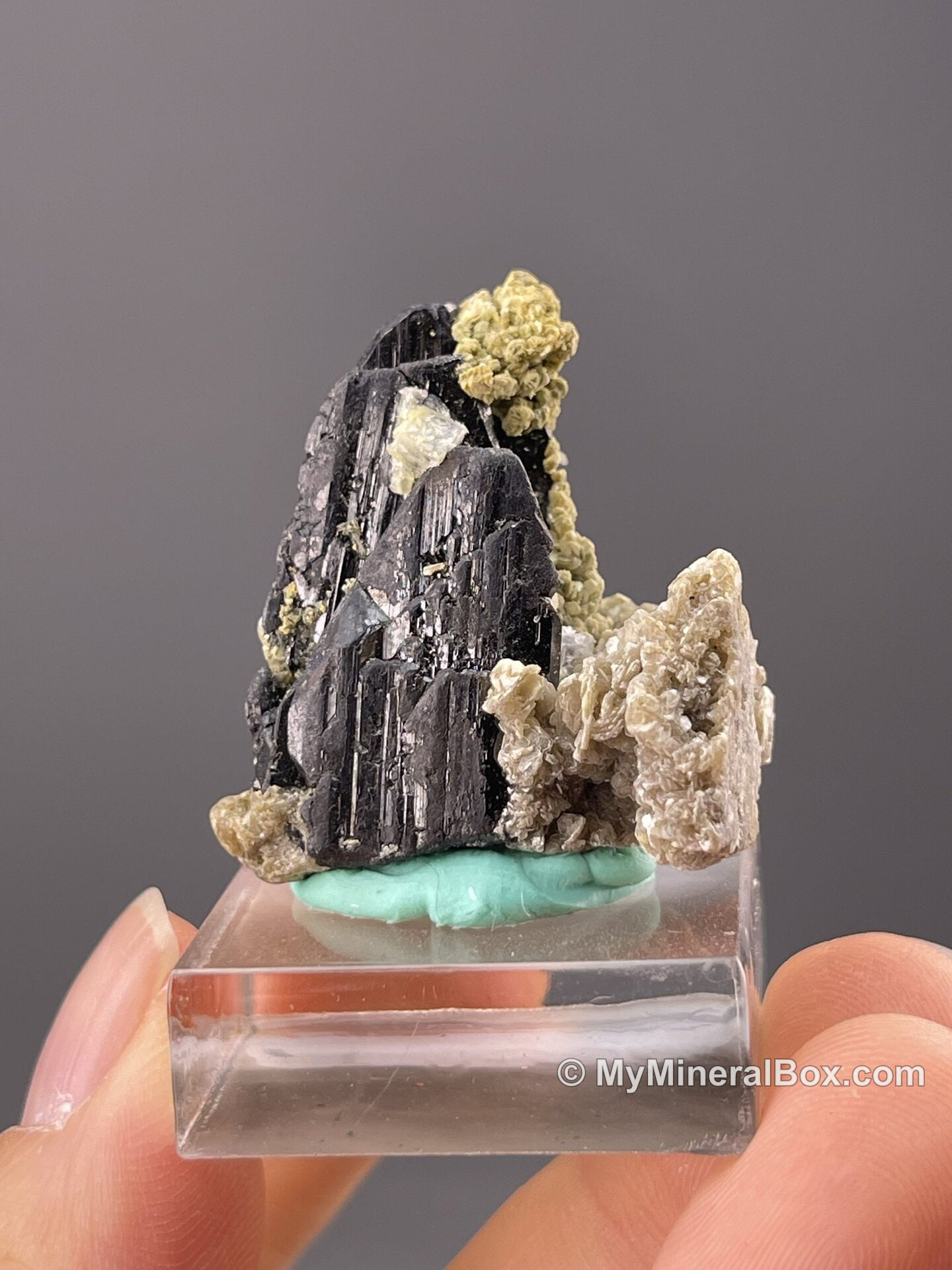
What cassiterite is
Cassiterite is tin oxide, SnO2 — the mineral that made Bronze Age metallurgy possible and still supplies most of the world's tin. For collectors, three physical traits define it: exceptional density (it feels far heavier than it looks — nearly seven times water), hardness of 6–7, and an adamantine, almost gemstone-grade sparkle on fresh crystal faces.
The Chinese localities that matter
Mount Xuebaoding, Sichuan is the modern benchmark. High on this mountain, tungsten-tin veins produce glassy jet-black cassiterite in complex multiple twins — crystals folded back on themselves into accordion-like forms. Individual crystals reach several centimeters and twinned groups approach ten, typically perched on blades of cream-to-tan muscovite. The supporting cast makes these specimens famous: colorless goshenite, pink morganite, honey scheelite and fluorapatite share the same matrix, and a balanced multi-species Xuebaoding plate is one of the trophies of Chinese mineralogy.
Yaogangxian, Hunan — the great tungsten mine — delivers sharp black cassiterite in classic form with glassy quartz, a more austere, old-school look.
Xianghualing, Hunan casts cassiterite in a supporting role, accenting the locality's famous green fluorite.
The historic tin fields of Gejiu (Yunnan) and Dachang (Guangxi) round out the story: specimen production is sparser than their ore output suggests, but both names carry deep mining history.
How to judge a cassiterite specimen
Luster first: the line between a good and a great cassiterite is the light coming off it. Fresh faces should flash like black glass; dull or abraded faces cost real value.
Twin drama second: elbow and multiple twins are cassiterite's signature. At Xuebaoding, the more improbable the geometry, the better — sharp re-entrant angles between twin segments are what you're paying for.
Heft third: density is your friend at purchase time. A cassiterite that doesn't feel surprisingly heavy for its size deserves a second look — black tourmaline is the usual innocent mix-up in bulk lots.
Then terminations and contacts: complete crystals command a premium; check where crystal meets matrix for repairs, which are common and acceptable only when disclosed. Finally association: muscovite, beryl, scheelite, apatite or fluorite company raises the piece.
Why now
Xuebaoding sits inside a protected high-mountain area and its specimen supply has tightened markedly; the market today runs substantially on material mined years ago. The same story — richer demand, thinner new supply — has already played out with Tongbei spessartine and Daoping pyromorphite.
Cassiterite remains, for the moment, modestly priced relative to its quality ceiling: fine miniatures are still attainable in the low hundreds of dollars, where equivalent-quality pieces of more fashionable species run multiples of that.
Häufige Fragen
What is cassiterite used for?
Industrially, it is the primary ore of tin — from Bronze Age alloys to modern solder. For collectors, it is a display species prized for black adamantine crystals and dramatic twinning.
Is cassiterite rare?
As an ore, no. As sharp, lustrous, well-twinned display crystals, yes — a handful of localities worldwide produce fine specimens, and China's Xuebaoding is the modern standard.
How can I tell cassiterite from black tourmaline?
Weight. Cassiterite is roughly twice as dense as tourmaline — a same-sized piece feels dramatically heavier. Its luster is also brighter and more adamantine than tourmaline's vitreous black.
Is cassiterite safe to handle?
Yes. Tin oxide is stable and insoluble; wash-and-brush care is all it needs. At hardness 6–7 it is one of the more forgiving display minerals.
Where in China does cassiterite come from?
Specimen-grade material comes mainly from Mount Xuebaoding (Sichuan), Yaogangxian and Xianghualing (Hunan), with historic tin-field material from Gejiu (Yunnan) and Dachang (Guangxi).