Overview
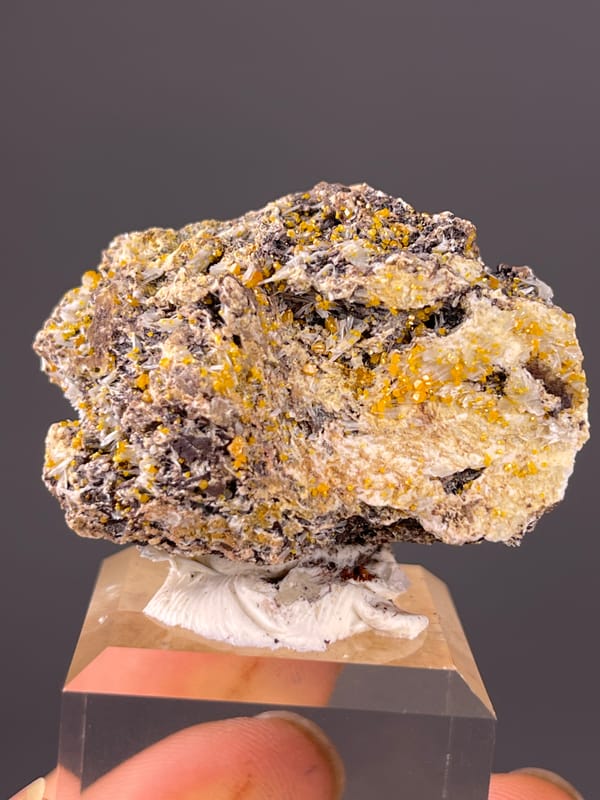
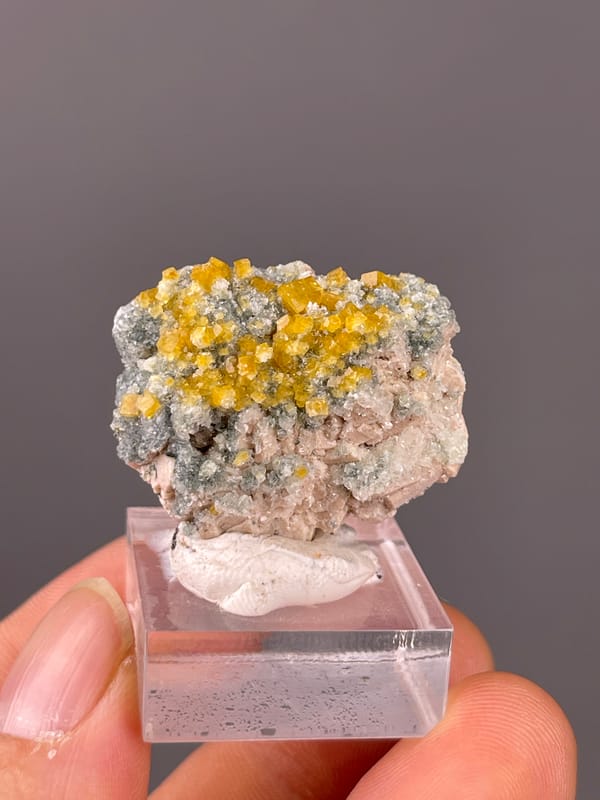
Chabazite is a popular zeolite-group mineral, well known to collectors for its glassy, near-cubic rhombohedral crystals that line cavities in volcanic rock. It is not a single species but a series — including chabazite-Ca, chabazite-Na, chabazite-K and chabazite-Sr — named for whichever cation dominates. Like other zeolites, chabazite has an open, water-bearing framework that gives it useful molecular-sieve and ion-exchange properties, and it has been studied and used industrially as well as admired as a mineral specimen.
Composition & structure
Chabazite is a hydrated aluminosilicate of the tectosilicate (framework silicate) class, with a representative composition often written as (Ca,Na2,K2)[Al2Si4O12]·6H2O, where the exact cations vary between members of the series. Its three-dimensional framework of linked silicon-oxygen and aluminium-oxygen tetrahedra encloses wide channels and cages occupied by exchangeable cations and loosely held water molecules. This open architecture is what allows zeolites to take up and release water and to swap cations, and it underlies chabazite’s value as a natural molecular sieve.
| Formula | (Ca,Na2,K2)[Al2Si4O12]·6H2O (series; cation varies) |
| Crystal system | Trigonal |
| Mohs hardness | 3 to 5 |
| Lustre | Vitreous |
| Colour | Colourless, white, yellow, pink to reddish or orange |
| Type locality | Originally described from Aussig (Ústí nad Labem), Bohemia, Czech Republic |
Formation & occurrence
Chabazite is most characteristically a low-temperature mineral that crystallises in the gas cavities (vesicles and amygdules) of basaltic and other volcanic rocks, where it is deposited from circulating waters reacting with the surrounding lava. It commonly occurs with other zeolites such as heulandite, stilbite and natrolite, and with minerals like calcite. Beyond volcanic vugs, chabazite can form in altered tuffs, in some sedimentary and hydrothermal settings, and in hot-spring deposits. Its presence is a useful indicator of the relatively mild temperatures of zeolite-forming alteration.
Identification & similar species
Chabazite is recognised by its distinctive rhombohedral crystals, which are nearly cube-shaped but with rhomb faces rather than true squares, giving a pseudo-cubic look. Crystals are often glassy and sometimes form penetration twins. Its modest hardness, vitreous lustre and occurrence in volcanic cavities alongside other zeolites are strong clues. It can be confused with other zeolites and with calcite, but calcite is softer in the relevant directions and effervesces strongly in acid, whereas chabazite does not react in the same way. Precise assignment to a specific series member depends on determining the dominant cation.
Notable localities & collecting
Classic specimens come from the basalt districts of the Deccan Traps in India, famous worldwide for superb zeolite cabinet pieces, as well as from Iceland, the Faroe Islands, Northern Ireland (the Antrim basalts) and many other volcanic regions. Historic European localities in Bohemia and Italy provided early described material. Collectors prize chabazite for its clean rhombohedral crystals, attractive twins and pastel colours, often perched on contrasting matrix with companion zeolites. Because the crystals are relatively soft and can be fragile, specimens are best handled gently and protected from abrasion.