Elemental Composition (by mass)
| Element | Mass % | Visual |
|---|---|---|
| S Sulfur | 53.45% | |
| Fe Iron | 46.55% |
Computed from simplified end-member formula. Solid-solution series, water content, and trace substitutions cause real-world variation.
IMA Abbreviation (Whitney-Evans 2010)
Mrc
→ Marcasite
Orthorhombic FeS₂
Standard symbol from American Mineralogist (Whitney & Evans, 2010). Used in thin-section labeling, phase diagrams, and IMA-style species records.
⏳ Long-term Aging & Care Timeline
pyrite disease (aggressive)months to years
Trigger: humidity > 50%
Intervention: Faster than pyrite. Crystal disintegrates to yellow powder + acidic residue. Dry storage essential.
Pseudomorph Relationships
Replaced by — this mineral commonly becomes:
→ Limonite replacement
Marcasite oxidizes faster than pyrite due to crystal structure — friable limonite results.
Worldwide; storage problem for collectors.
A pseudomorph (Greek "false form") is a mineral with the external shape of another species — the chemistry has changed but the crystal habit is inherited.
Care notesSame as pyrite — humidity-sensitive. Full cleaning guide →
Mohs 6–6.5
Vickers (~) 820 HV
Knoop (~) 870 HK
Geological setting
Sedimentary
Element composition by mass
Formula: FeS₂ · molar mass: 119.97 g/mol
| S | 53.45% | |
| Fe | 46.55% |
Computed from atomic weights (IUPAC 2021). Site-occupancy groups (Fe,Mn) split equally.
Mohs Hardness
6–6.5
Marcasite sits at 6–6.5 on the Mohs scale — just hard enough to scratch glass.
Colors:
Streak
Greenish-black
Greenish-black
Crystal system
Orthorhombic
Orthorhombic
Sulfides & SulfosaltsSulfides
TL;DR · 1 min read
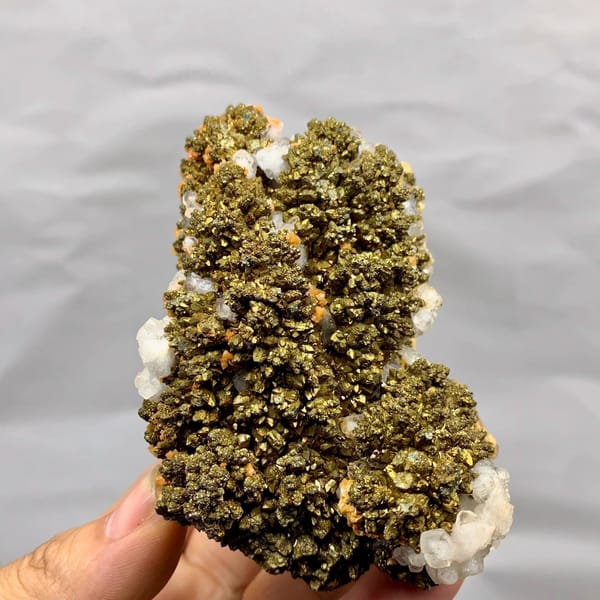
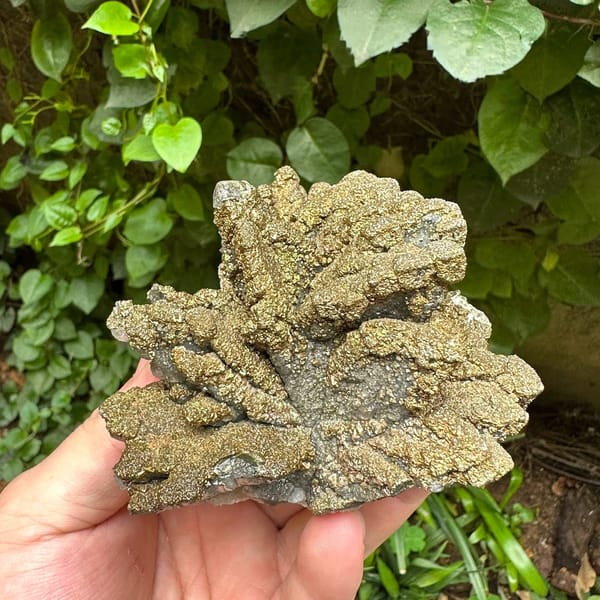
Marcasite (FeS₂) is the orthorhombic dimorph of pyrite (cubic FeS₂) — same chemistry, different crystal structure. It forms in sedimentary low-temperature environments (coal seams, organic-rich shales) and oxidizes more readily than pyrite, producing characteristic "pyrite disease" disintegration in collections.
Marcasite (FeS₂) is the orthorhombic dimorph of pyrite (cubic FeS₂) — same chemistry, different crystal structure. It forms in sedimentary low-temperature environments (coal seams, organic-rich shales) and oxidizes more readily than pyrite, producing characteristic “pyrite disease” disintegration in collections. Cockscomb spear-cluster habits are diagnostic.