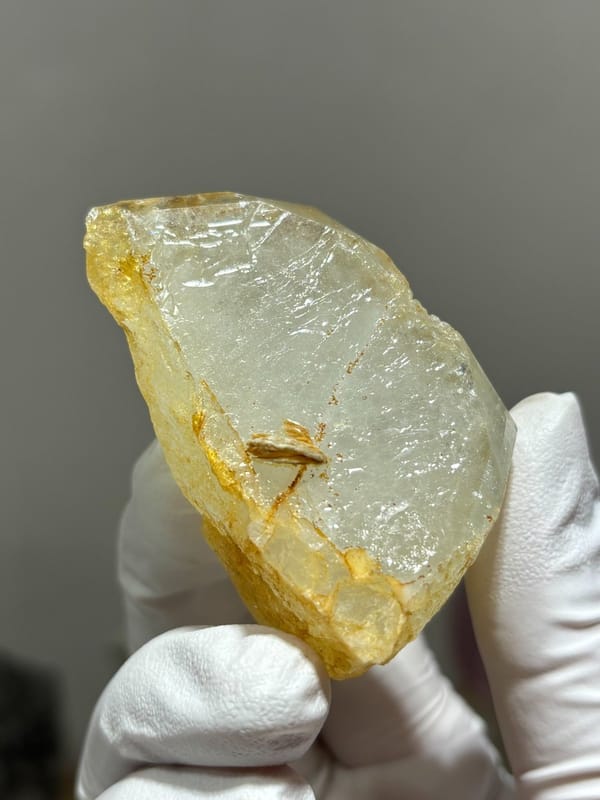
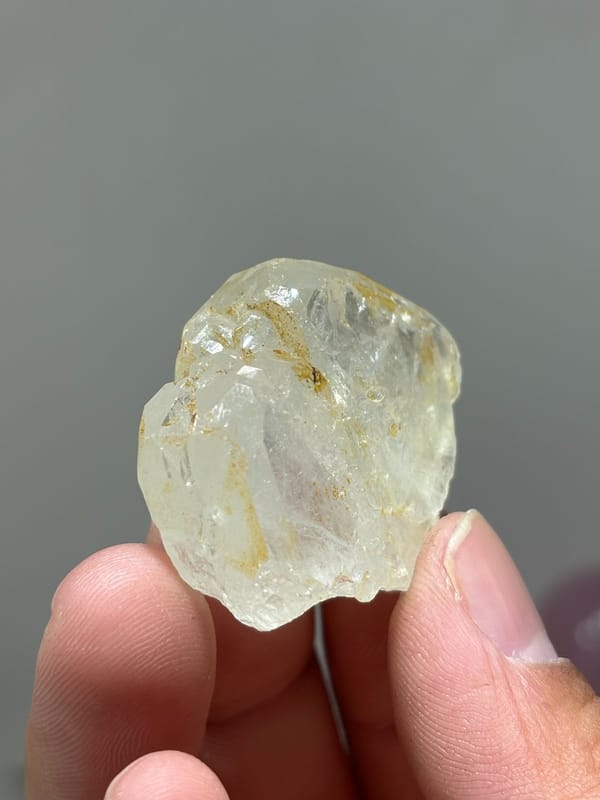
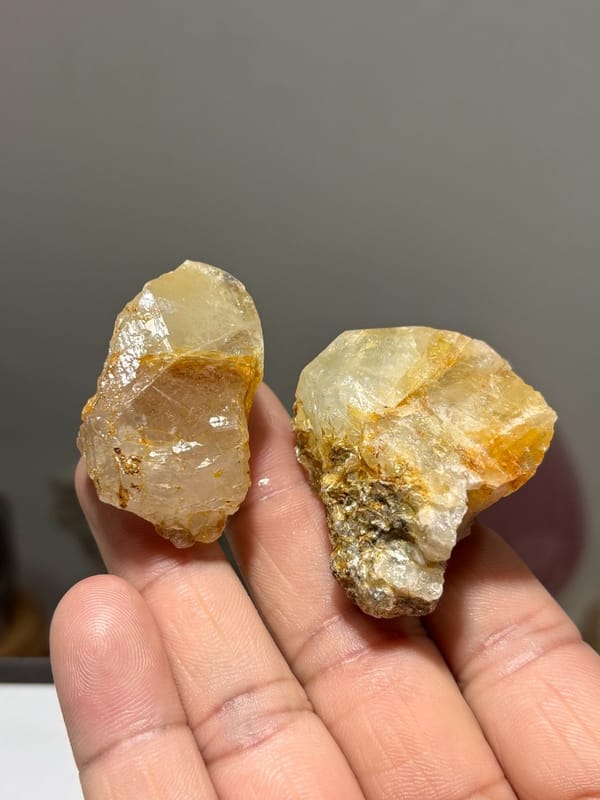
綠柱石

Be3Al2Si6O18

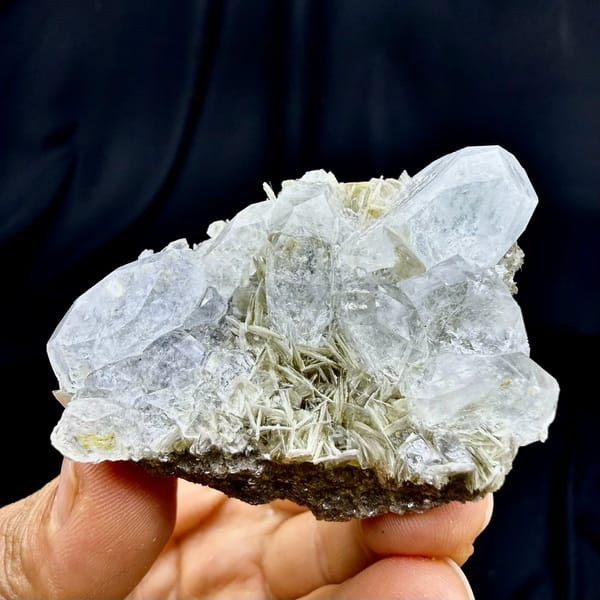
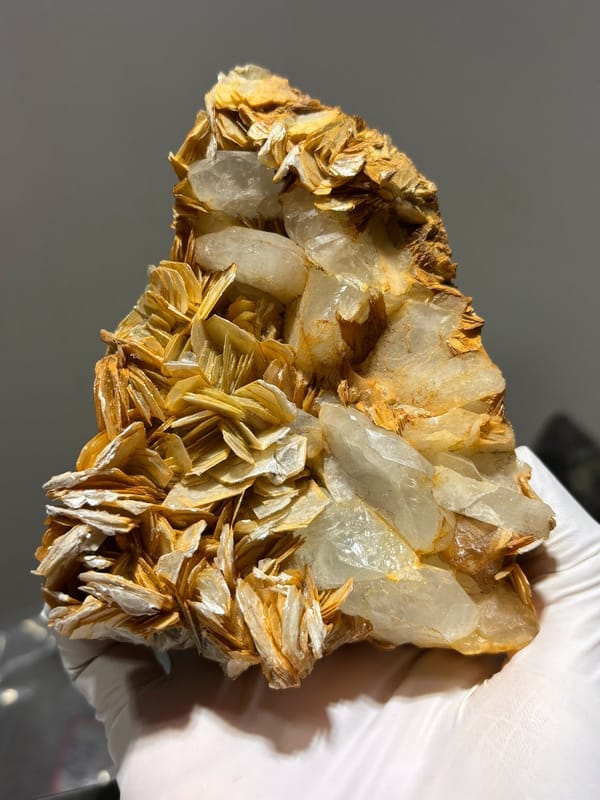
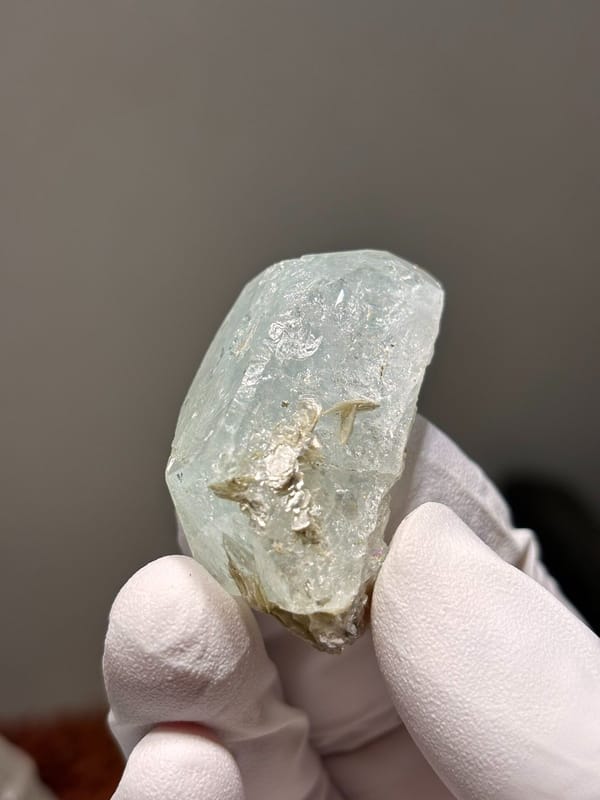
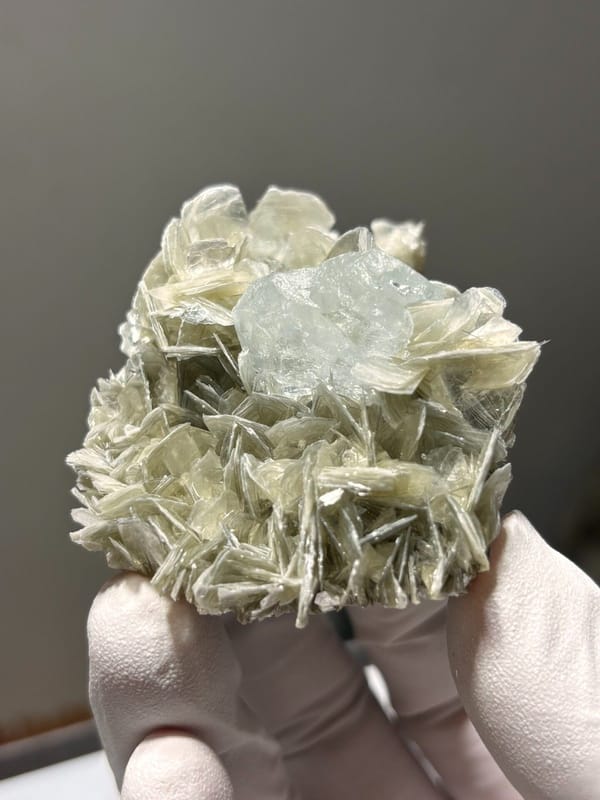
Beryl is a silicate mineral prized by collectors for its exceptional color range, with several world-class Chinese localities.

Crystal Structure
Cyclosilicate — Si₆O₁₈ rings stacked; channels along c-axis host trace cations + H₂O.
Elemental Composition (by mass)
ElementMass %Visual
O Oxygen53.58%
Si Silicon31.35%
Al Aluminum10.04%
Be Beryllium5.03%
Computed from simplified end-member formula. Solid-solution series, water content, and trace substitutions cause real-world variation.
IMA Abbreviation (Whitney-Evans 2010)
Brl
→ Beryl
Pegmatite assemblages
Standard symbol from American Mineralogist (Whitney & Evans, 2010). Used in thin-section labeling, phase diagrams, and IMA-style species records.
Pronunciation
/ˈbɛrəl/
BEH-ril
two syllables (Greek)
Lapidary & Faceting Recommendations
Recommended cut:
step / oval
Also seen:
cushion, emerald
Typical yield:
35% of rough
General beryl group — see species (emerald/aquamarine etc.).
UV Fluorescence
SW (254 nm)
none
LW (365 nm)
none
Pure beryl inert; Cr/V-bearing emerald may show weak red.
SW = shortwave (germicidal lamp). LW = longwave (blacklight). Response varies with locality, trace impurities, and treatment.
Tenacity
Behavior:
brittle
Under stress:
Conchoidal fracture
Hard but brittle — emerald especially fragile due to "jardin".
Luster
vitreous
Standard glass-like.
Diaphaneity (Transparency)
transparent-to-translucent
Gem-quality transparent.
Type Locality
(ancient term — Greek "beryllos") — Worldwide
Source: Pliny
› Browse all type localities
Magnetism
Category:
diamagnetic
Test result:
Slight repulsion
Be₃Al₂(SiO₃)₆; pure form diamagnetic.
Test with rare-earth magnet (N42 or N52 neodymium). Suspend specimen on thread for sensitive paramagnetic detection. Diamagnetic minerals are weakly repelled (visible only with strong magnets like bismuth).
Specific Gravity
2.66–2.92
g/cm³
light
Higher SG in Fe-rich (heliodor) and Cs-rich pegmatitic material.
For comparison: water = 1.00, glass ≈ 2.5, quartz = 2.65, corundum ≈ 4.00, galena ≈ 7.50, gold ≈ 19.3.
Geological Setting
Environment:
pegmatite
Host rock:
granitic pegmatite, mica schist (emerald)
Companions:
Quartz · Feldspar · Mica · Tourmaline
Pegmatitic for most varieties; emerald is the exception — forms in metasomatized mica schist.
Characteristic Inclusions
Two-phase / three-phasethree-phase
Pegmatitic beryl commonly hosts multi-phase fluid inclusions.
Diagnostic inclusions are characteristic enough to help identify origin or species under 10× loupe.
Care notesStable. Gem-clarity pieces should not be ultrasonic-cleaned (filled inclusions). Full cleaning guide →
Formation eraGranite pegmatite; Brazilian pegmatites Precambrian (Eastern Brazilian Province ~500 Ma).
Cleavage & Fracture
Cleavage:
indistinct 1 indistinct {0001} — basal
Fracture:
conchoidal / uneven
Mostly fractures conchoidally; very poor basal cleavage.
Market availability: Uncommon
Found at major shows and select dealers. Quality varies by locality.
Collector tier: Cabinet Classic
Display species collected for cabinet presentation, with specimens recorded from named localities.
Often found withQuartz · Feldspar · Tourmaline · Mica · Spodumene
Mohs 7.5–8
Vickers (~) 1650 HV
Knoop (~) 1340 HK
Nickel–Strunz 9.CJ.05
Dana 61.01.01.01
Geological setting
PegmatiteMetamorphicHydrothermal
Element composition by mass

Formula: Be₃Al₂Si₆O₁₈ · molar mass: 537.49 g/mol

O 53.58%
Si 31.35%
Al 10.04%
Be 5.03%

Computed from atomic weights (IUPAC 2021). Site-occupancy groups (Fe,Mn) split equally.

GroupBeryl Group
Mohs Hardness 7.5–8

Beryl sits at 7.5–8 on the Mohs scale — very hard; only diamond or corundum scratches it.

Colors:
Streak
White
Crystal system
Hexagonal
Pronunciation/ˈbɛrɪl/
Type localityLimoges region, France (classical)
Discovery First described 1798 by Louis-Nicolas Vauquelin (France)
SilicatesSilicates (Cyclosilicates)
TL;DR · 1 min read
Beryl (Be₃Al₂Si₆O₁₈) is a beryllium aluminum cyclosilicate famous for its gem-variety daughters: aquamarine (blue), emerald (green from Cr/V), morganite (pink from Mn), heliodor (yellow from Fe), and goshenite (colorless). All are the same species — only trace-element coloration differs.

Beryl (Be₃Al₂Si₆O₁₈) is a beryllium aluminum cyclosilicate famous for its gem-variety daughters: aquamarine (blue), emerald (green from Cr/V), morganite (pink from Mn), heliodor (yellow from Fe), and goshenite (colorless). All are the same species — only trace-element coloration differs. Beryl forms in granitic pegmatites, hydrothermal veins, and metamorphic rocks; well-formed hexagonal prisms are the signature crystal habit.

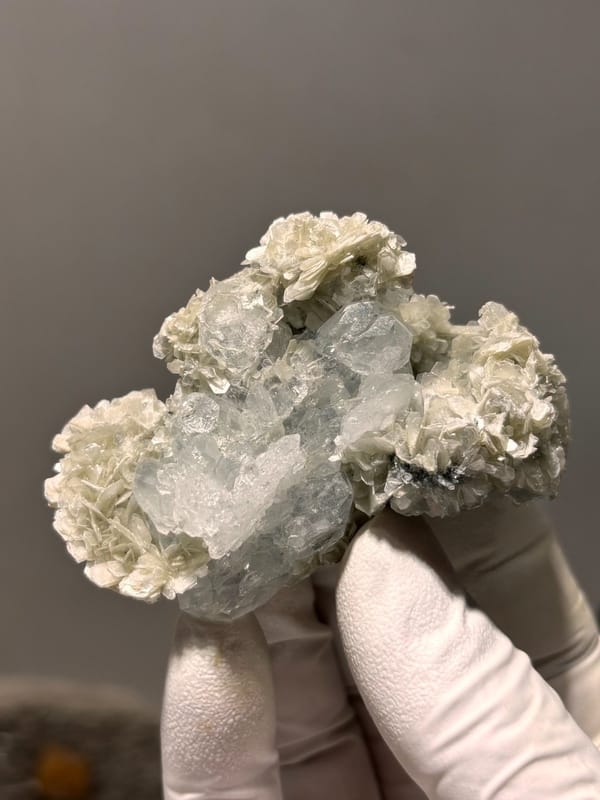
More minerals to explore

Varieties of Beryl

Beryl is a parent species — the following named varieties differ in color or chemistry but share the same fundamental mineralogy.

  • Aquamarine (u6d77u84ddu5b9du77f3)
    sky-blue to seawater-blue
    Iron-bearing blue/blue-green beryl variety, named for sea water.
  • Emerald (u7956u6bcdu7eff)
    rich green
    Chromium- and vanadium-bearing green beryl variety; one of the four cardinal gems.
  • Morganite (u6469u6839u77f3)
    pink to peach
    Manganese-bearing pink to peach beryl variety, named for J.P. Morgan.
  • Heliodor (u91d1u7effu67f1u77f3)
    golden-yellow
    Iron-bearing golden-yellow beryl variety.
  • Goshenite (u900fu7effu67f1u77f3)
    colorless
    Pure colorless beryl variety, used for facetable gems.
  • Red Beryl (u7ea2u7effu67f1u77f3)
    raspberry-red
    Manganese-rich red beryl variety, extremely rare; almost exclusively from Utah USA.