Crystal Structure
Fe end-member of tourmaline group.
Elemental Composition (by mass)
| Element | Mass % | Visual |
|---|---|---|
| O Oxygen | 42.84% | |
| Si Silicon | 16.71% | |
| Fe Iron | 16.61% | |
| Al Aluminum | 16.05% | |
| B Boron | 3.22% | |
| Na Sodium | 2.28% | |
| F Fluorine | 1.88% | |
| H Hydrogen | 0.40% |
Computed from simplified end-member formula. Solid-solution series, water content, and trace substitutions cause real-world variation.
IMA Abbreviation (Whitney-Evans 2010)
Srl
→ Schorl
Fe-tourmaline
Standard symbol from American Mineralogist (Whitney & Evans, 2010). Used in thin-section labeling, phase diagrams, and IMA-style species records.
Pronunciation
/ʃɔːrl/
↔ shorl
one syllable (German)
Color Cause (Chromophore)
Chromophore:
Fe²⁺ + Fe³⁺
Mechanism:
intervalent charge transfer; saturated
Color produced:
black
Iron-rich, color saturated to black.
Diaphaneity (Transparency)
opaque
Black Fe-rich tourmaline; opaque except in thin sections.
Type Locality
Zschorlau / Schorl — Germany
Described 1505 by Old German mining term
› Browse all type localities
Magnetism
Category:
weakly paramagnetic
Test result:
Strongest tourmaline response
Fe-rich black tourmaline.
Test with rare-earth magnet (N42 or N52 neodymium). Suspend specimen on thread for sensitive paramagnetic detection. Diamagnetic minerals are weakly repelled (visible only with strong magnets like bismuth).
Specific Gravity
3.10–3.26
g/cm³
medium
Fe-rich; heaviest tourmaline.
For comparison: water = 1.00, glass ≈ 2.5, quartz = 2.65, corundum ≈ 4.00, galena ≈ 7.50, gold ≈ 19.3.
Market availability: Common
Widely available in most dealer stocks. Specimens span all price tiers.
Mohs 7–7.5
Vickers (~) 1400 HV
Knoop (~) 1100 HK
Geological setting
Pegmatite
Element composition by mass
Formula: NaFe₃Al₆(BO₃)₃Si₆O₁₈(OH)₄ · molar mass: 1053.36 g/mol
| O | 47.08% | |
| Si | 16% | |
| Fe | 15.9% | |
| Al | 15.37% | |
| B | 3.08% | |
| Na | 2.18% | |
| H | 0.38% |
Computed from atomic weights (IUPAC 2021). Site-occupancy groups (Fe,Mn) split equally.
Mohs Hardness
7–7.5
Schorl sits at 7–7.5 on the Mohs scale — harder than glass; scratches steel.
Colors:
Streak
White to pale gray
White to pale gray
Crystal system
Trigonal
Trigonal
SilicatesSilicates (Cyclosilicates)
TL;DR · 1 min read
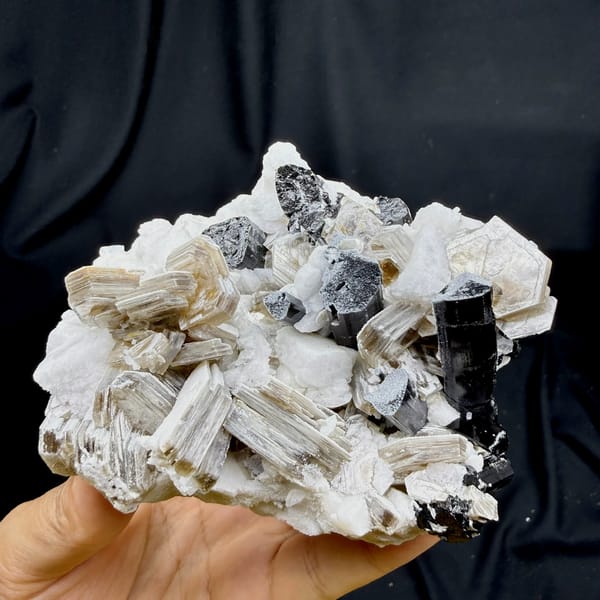
Schorl (NaFe₃Al₆(BO₃)₃Si₆O₁₈(OH)₄) is the iron-rich end-member of the tourmaline group and by far the most abundant tourmaline species. Its jet-black trigonal prisms, often striated lengthwise, are common in granitic pegmatites and are the most familiar collector form of tourmaline globally.
Schorl (NaFe₃Al₆(BO₃)₃Si₆O₁₈(OH)₄) is the iron-rich end-member of the tourmaline group and by far the most abundant tourmaline species. Its jet-black trigonal prisms, often striated lengthwise, are common in granitic pegmatites and are the most familiar collector form of tourmaline globally. While the colorful elbaite varieties (rubellite, indicolite, watermelon) capture gem markets, Schorl dominates specimen-grade tourmaline output by sheer volume.
More minerals to explore
Benitoite (蓝锥矿)
Hexagonal
Sugilite (舒俱徕石)
Hexagonal
Beryl (绿柱石)
Hexagonal
Dravite (镁电气石)
Trigonal
Uvite (钙镁电气石)
Trigonal
Elbaite (锂电气石)
Trigonal
Other Members of the Tourmaline Group
电气石族