Crystal Structure
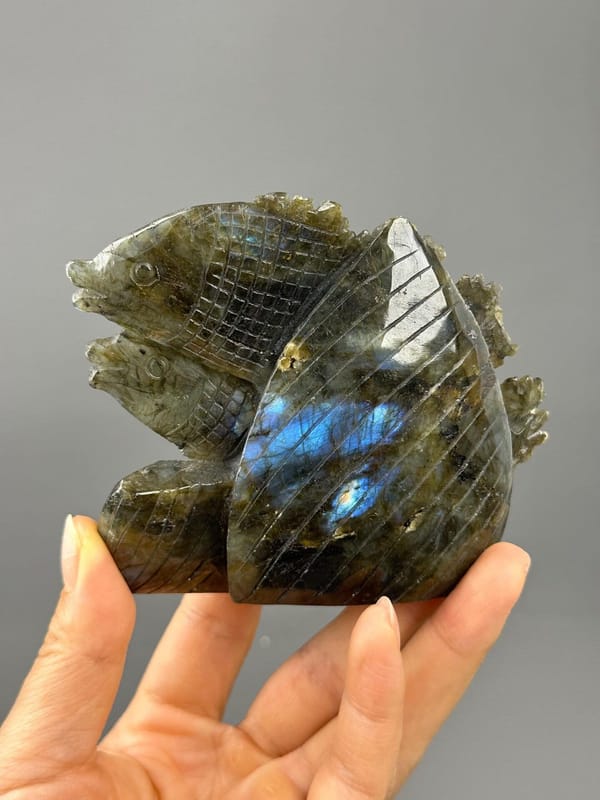
Intermediate plagioclase showing exsolution lamellae.
Elemental Composition (by mass)
| Element | Mass % | Visual |
|---|---|---|
| O Oxygen | 48.81% | |
| Si Silicon | 32.13% | |
| Al Aluminum | 10.29% | |
| Na Sodium | 8.77% |
Computed from simplified end-member formula. Solid-solution series, water content, and trace substitutions cause real-world variation.
IMA Abbreviation (Whitney-Evans 2010)
Lab
→ Labradorite
Intermediate plagioclase
Standard symbol from American Mineralogist (Whitney & Evans, 2010). Used in thin-section labeling, phase diagrams, and IMA-style species records.
Pronunciation
/ˈlæbrədɔːraɪt/
↔ LAB-ruh-dor-ite
from Labrador
Tenacity
Behavior:
brittle
Under stress:
Cleaves
Plagioclase.
Luster
vitreous→iridescent
Labradorescence is a separate phenomenon from base luster.
Color Cause (Chromophore)
Chromophore:
lamellar interference
Mechanism:
physical optical effect
Color produced:
iridescent
Body color often gray; labradorescence from thin albite-anorthite exsolution lamellae.
Diaphaneity (Transparency)
translucent
Schiller layers create labradorescence.
Type Locality
Paul Island, Labrador — Canada
Described 1770 by Werner
› Browse all type localities
Specific Gravity
2.68–2.72
g/cm³
light
Intermediate plagioclase; labradorescence.
For comparison: water = 1.00, glass ≈ 2.5, quartz = 2.65, corundum ≈ 4.00, galena ≈ 7.50, gold ≈ 19.3.
Twinning Laws
Albite lawlamellar
Polysynthetic twin lamellae produce the optical conditions for labradorescence.
Cleavage & Fracture
Cleavage:
good 2 directions ~86°
Fracture:
uneven
Albite-law twinning produces fine striations.
Market availability: Uncommon
Found at major shows and select dealers. Quality varies by locality.
Collector tier: Cabinet Classic
Display species collected for cabinet presentation, with specimens recorded from named localities.
Mohs 6–6.5
Vickers (~) 820 HV
Knoop (~) 870 HK
Nickel–Strunz
9.FA.35Dana
76.01.03.06Element composition by mass
Formula: (Ca,Na)(Al,Si)₄O₈ · molar mass: 269.66 g/mol
| O | 47.46% | |
| Si | 20.83% | |
| Al | 20.01% | |
| Ca | 7.43% | |
| Na | 4.26% |
Computed from atomic weights (IUPAC 2021). Site-occupancy groups (Fe,Mn) split equally.
GroupFeldspar Group
Optical Effects
Labradorescence
Mohs Hardness
6–6.5
Labradorite sits at 6–6.5 on the Mohs scale — just hard enough to scratch glass.
Colors:
Streak
White
White
Crystal system
Triclinic
Triclinic
Pronunciation/ˈlæbrədərˌaɪt/
Type localityTabor Island, Labrador, Newfoundland and Labrador, Canada (1770)
SilicatesSilicates (Tectosilicates — Feldspars)
TL;DR · 1 min read
Labradorite (Ca,Na)(Al,Si)₄O₈ is a calcium-rich plagioclase feldspar famous for its iridescent labradorescence — a vivid blue, green, gold, and purple flash from light interference within microscopic exsolution lamellae. Discovered in 1770 in Labrador, Canada, and now sourced primarily from Madagascar (Tulear) and Finland (spectrolite variety).
Labradorite (Ca,Na)(Al,Si)₄O₈ is a calcium-rich plagioclase feldspar famous for its iridescent labradorescence — a vivid blue, green, gold, and purple flash from light interference within microscopic exsolution lamellae. Discovered in 1770 in Labrador, Canada, and now sourced primarily from Madagascar (Tulear) and Finland (spectrolite variety).