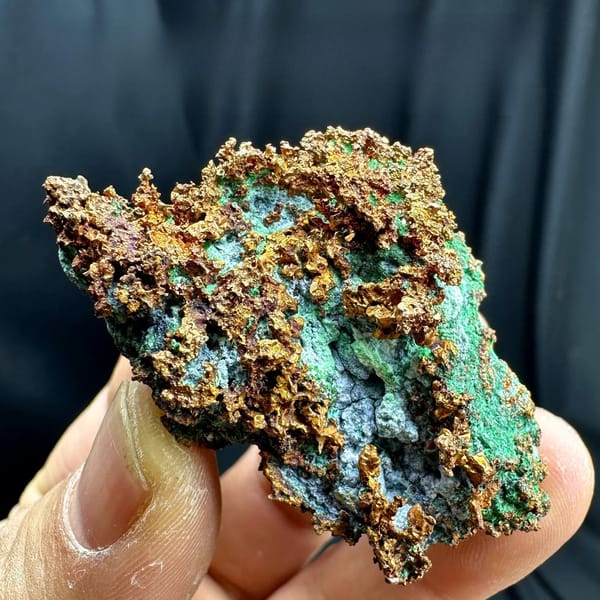
Crystal Structure
FCC packing — Cu.
Elemental Composition (by mass)
| Element | Mass % | Visual |
|---|---|---|
| Cu Copper | 100.00% |
Computed from simplified end-member formula. Solid-solution series, water content, and trace substitutions cause real-world variation.
IMA Abbreviation (Whitney-Evans 2010)
Cu
→ Copper
Symbol = element
Standard symbol from American Mineralogist (Whitney & Evans, 2010). Used in thin-section labeling, phase diagrams, and IMA-style species records.
⏳ Long-term Aging & Care Timeline
oxidation patinayears
Trigger: air + humidity
Intervention: Copper-red surface becomes green/brown. Some collectors prefer natural patina; others use micro-crystalline wax to preserve.
Pronunciation
/ˈkɒpər/
↔ KOP-er
Latin cuprum
Tenacity
Behavior:
malleable + ductile
Under stress:
Bends and flattens
Native copper can be hammered into shapes; coins.
Luster
metallic
Bright copper-red metallic; tarnishes to green-brown.
Color Cause (Chromophore)
Chromophore:
d-electron transitions
Mechanism:
band transitions in Cu
Color produced:
orange-red
Same general mechanism as gold; different absorption energy.
Diaphaneity (Transparency)
opaque
Native metal.
Magnetism
Category:
diamagnetic
Test result:
Slight repulsion
Native Cu.
Test with rare-earth magnet (N42 or N52 neodymium). Suspend specimen on thread for sensitive paramagnetic detection. Diamagnetic minerals are weakly repelled (visible only with strong magnets like bismuth).
Specific Gravity
8.94
g/cm³
very heavy
Native copper.
For comparison: water = 1.00, glass ≈ 2.5, quartz = 2.65, corundum ≈ 4.00, galena ≈ 7.50, gold ≈ 19.3.
Streak Test
copper red
Native copper — bright metallic streak.
Streak = color of the powdered mineral. Drag specimen across unglazed white porcelain plate (Mohs 6.5). For minerals harder than the plate, crush a small flake into powder and observe color.
Mohs 2.5–3
Vickers (~) 170 HV
Knoop (~) 185 HK
Geological setting
VolcanicHydrothermal
Mohs Hardness
2.5–3
Copper (Native) sits at 2.5–3 on the Mohs scale — can be scratched by a steel knife.
Colors:
Streak
Copper-red
Copper-red
Crystal system
Isometric (Cubic)
Isometric (Cubic)
Discovery Known since antiquity
Native ElementsNative Elements
TL;DR · 1 min read
Native copper (Cu) is metallic copper in pure crystalline form. The Keweenaw Peninsula (Michigan) supplied the world's largest historical native-copper bonanza, including the famous "Ontonagon Boulder" weighing 1,680 kg.
Native copper (Cu) is metallic copper in pure crystalline form. The Keweenaw Peninsula (Michigan) supplied the world’s largest historical native-copper bonanza, including the famous “Ontonagon Boulder” weighing 1,680 kg. Native copper forms in basaltic lava flows, oxidized cap zones of copper deposits, and hydrothermal veins.
More minerals to explore
Bismuth (Native) (自然铋)
Trigonal
Silver (Native) (自然银)
Isometric (Cubic)
Diamond (金刚石)
Isometric (Cubic)
Graphite (石墨)
Hexagonal
Sulfur (自然硫)
Orthorhombic
Gold (Native) (自然金)
Isometric (Cubic)
Available Copper (Native) specimens
Current MyMineralBox stock matching this species:
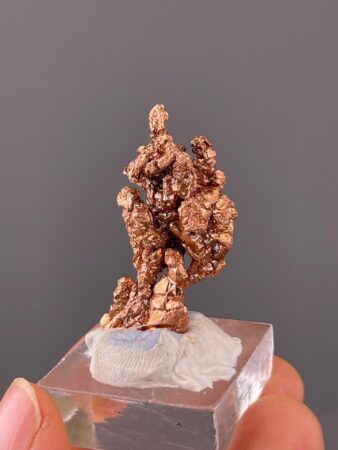
Native Copper Nugget – Natural Mineral Sculpture – Jiangxi
$34.55
Native Copper Cluster – Yichun Mine, Jiangxi Province, China
Original price was: $35.00.$31.50Current price is: $31.50.
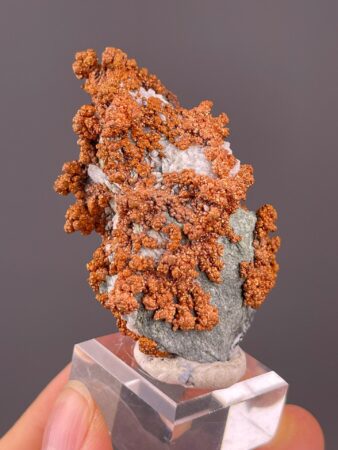
Native Copper Crystal Cluster – Jiangxi, China
$388.00
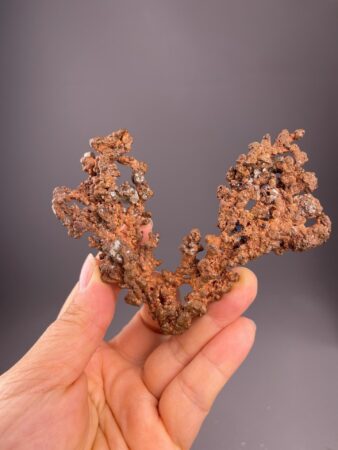
Native Copper Arborescent Specimen, Jiangxi
$125.00
Specimens are inspected and described individually; pieces may sell quickly.
Spotted an error or have something to add?
Name in other languages
deKupfer
frCuivre
esCobre
itRame
ja銅