Diopside sits at 5.5–6.5 on the Mohs scale —
just hard enough to scratch glass.
Colors:
Streak White
Crystal system Monoclinic
SilicatesSilicates (Inosilicates — Pyroxenes)
TL;DR · 1 min read
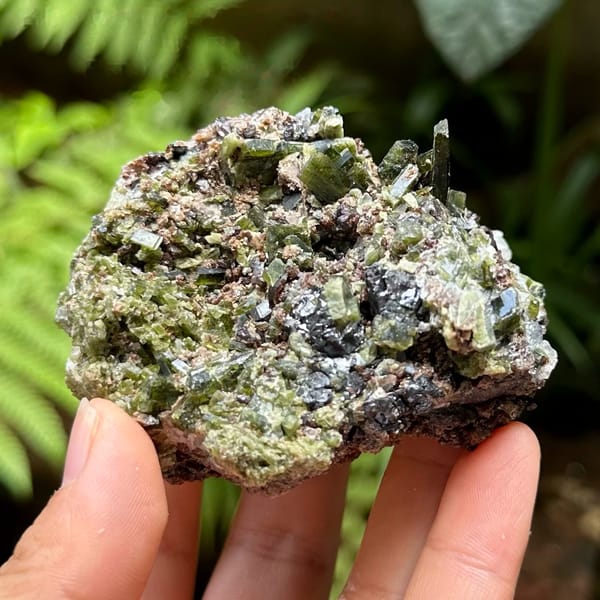
Diopside (CaMgSi₂O₆) is the calcium-magnesium end-member of the pyroxene group, one of the most abundant mineral families in Earth's crust and mantle. It forms in contact-metamorphic skarns, regional metamorphic rocks, and peridotite xenoliths brought up by volcanic eruptions.
Diopside (CaMgSi₂O₆) is the calcium-magnesium end-member of the pyroxene group, one of the most abundant mineral families in Earth’s crust and mantle. It forms in contact-metamorphic skarns, regional metamorphic rocks, and peridotite xenoliths brought up by volcanic eruptions. Crystallographic-quality Diopside specimens favor sharp prismatic crystals on white calcite-marble matrix; chrome diopside (with Cr³⁺) yields brilliant emerald-green gem material from Siberia and East Africa. China hosts notable skarn-type Diopside in Sichuan and Liaoning.
Notable Chinese Localities
Sichuan skarn deposits and Liaoning contact-metamorphic zones produce collector specimens. Outokumpu (Finland) yields chrome diopside; De Kalb (NY) supplies American material.
Cite this entry
APA
MyMineralBox Editorial Team. (2026). Diopside. My Mineral Box. Retrieved May 23, 2026, from https://mymineralbox.com/mineral-encyclopedia/minerals/diopside/
MLA
MyMineralBox Editorial Team. "Diopside." My Mineral Box, 2026, https://mymineralbox.com/mineral-encyclopedia/minerals/diopside/. Accessed May 23, 2026.
Chicago
MyMineralBox Editorial Team. "Diopside." My Mineral Box. Last modified May 5, 2026. https://mymineralbox.com/mineral-encyclopedia/minerals/diopside/.
BibTeX
@misc{mmb_diopside,
 author = {{MyMineralBox Editorial Team}},
 title = {{Diopside}},
 year = {2026},
 publisher = {My Mineral Box},
 url = {https://mymineralbox.com/mineral-encyclopedia/minerals/diopside/},
 urldate = {2026-05-23}
}