Elemental Composition (by mass)
| Element | Mass % | Visual |
|---|---|---|
| Pb Lead | 77.54% | |
| O Oxygen | 17.96% | |
| C Carbon | 4.50% |
Computed from simplified end-member formula. Solid-solution series, water content, and trace substitutions cause real-world variation.
IMA Abbreviation (Whitney-Evans 2010)
Cer
→ Cerussite
Pb carbonate
Standard symbol from American Mineralogist (Whitney & Evans, 2010). Used in thin-section labeling, phase diagrams, and IMA-style species records.
Pronunciation
/sɪˈrʌsaɪt/
↔ suh-RUS-site
Latin cerussa (white lead)
Lapidary & Faceting Recommendations
Recommended cut:
oval / cushion
Also seen:
cushion, pear
Typical yield:
20% of rough
High RI + dispersion give bright stones but too soft (Mohs 3.5) and brittle for jewelry.
⚠ Safety & Handling
☠toxicmoderate
Lead carbonate.
Handling: Same as galena.
Information provided in good faith. Consult local hazmat regulations for transport and disposal. Severely hazardous specimens may require special storage cabinets.
UV Fluorescence
SW (254 nm)
Yellow
moderate
LW (365 nm)
Yellow
weak
Pb carbonate; UV-active.
SW = shortwave (germicidal lamp). LW = longwave (blacklight). Response varies with locality, trace impurities, and treatment.
Pseudomorph Relationships
Replaces — this mineral is often a pseudomorph after:
← Galena replacement
Common galena oxidation product — preserves cubic outline.
Mibladen, Morocco; Tsumeb.
A pseudomorph (Greek "false form") is a mineral with the external shape of another species — the chemistry has changed but the crystal habit is inherited.
Tenacity
Behavior:
brittle
Under stress:
Cleaves; cracks easily
Very brittle for a Pb carbonate.
Luster
adamantine
Diamond-like brilliance; high RI for a carbonate.
Diaphaneity (Transparency)
transparent-to-translucent
Adamantine luster; gem-grade transparent.
Type Locality
Tarnowitz — Poland
Described 1845 by Haidinger
› Browse all type localities
Diagnostic Field Tests
HCl test→ Fizzes; white milky PbCl precipitate
Lead carbonate; high SG also confirms.
⚠ Use dilute HCl (~10%) only on inconspicuous spots; rinse promptly. Smell-tests should be brief and ventilated. Taste-test ONLY halite/sylvite — never lead, arsenic, or sulfur minerals.
Specific Gravity
6.50–6.57
g/cm³
very heavy
PbCO₃; characteristic high SG for a carbonate.
For comparison: water = 1.00, glass ≈ 2.5, quartz = 2.65, corundum ≈ 4.00, galena ≈ 7.50, gold ≈ 19.3.
Streak Test
white / colorless
White streak; high SG ~6.5 confirms.
Streak = color of the powdered mineral. Drag specimen across unglazed white porcelain plate (Mohs 6.5). For minerals harder than the plate, crush a small flake into powder and observe color.
Twinning Laws
Cyclic / sixlingcontact
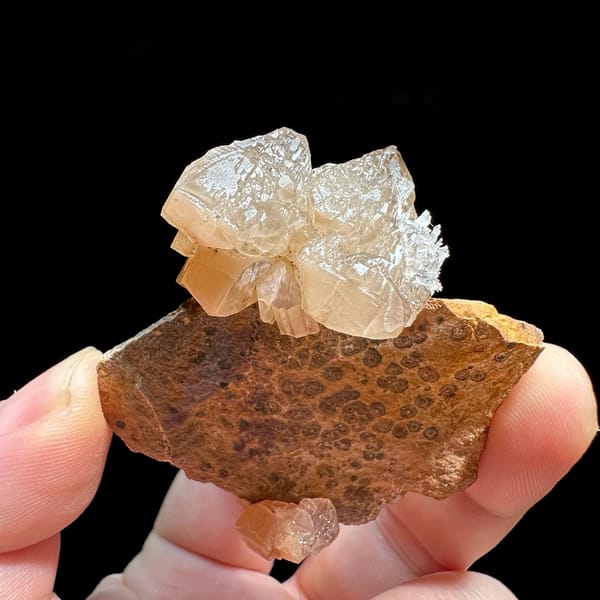
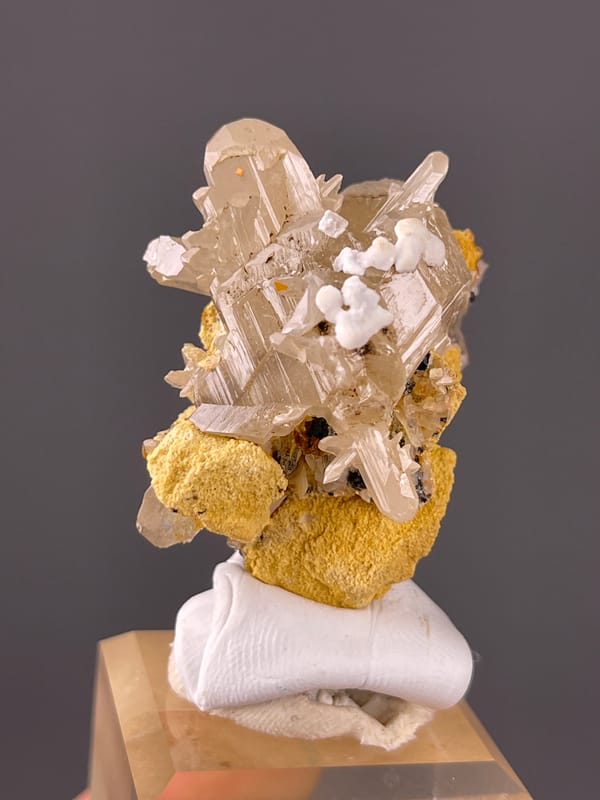
Pseudo-hexagonal star or wheel twin.
Market availability: Uncommon
Found at major shows and select dealers. Quality varies by locality.
Mohs 3–3.5
Vickers (~) 170 HV
Knoop (~) 185 HK
Nickel–Strunz
5.AB.15Dana
14.01.03.04Geological setting
Oxidation zone
Element composition by mass
Formula: PbCO₃ · molar mass: 267.21 g/mol
| Pb | 77.54% | |
| O | 17.96% | |
| C | 4.5% |
Computed from atomic weights (IUPAC 2021). Site-occupancy groups (Fe,Mn) split equally.
Mohs Hardness
3–3.5
Cerussite sits at 3–3.5 on the Mohs scale — can be scratched by a steel knife.
Colors:
Streak
White
White
Crystal system
Orthorhombic
Orthorhombic
Type localityTsumeb, Namibia (modern best)
CarbonatesCarbonates
TL;DR · 1 min read
Cerussite (PbCO₃) is lead carbonate, the aragonite-group analog where Pb replaces Ca. It is the iconic secondary lead mineral of the oxidized cap zones of lead-zinc deposits, where it forms transparent adamantine-luster crystals with extraordinarily heavy specific gravity (6.
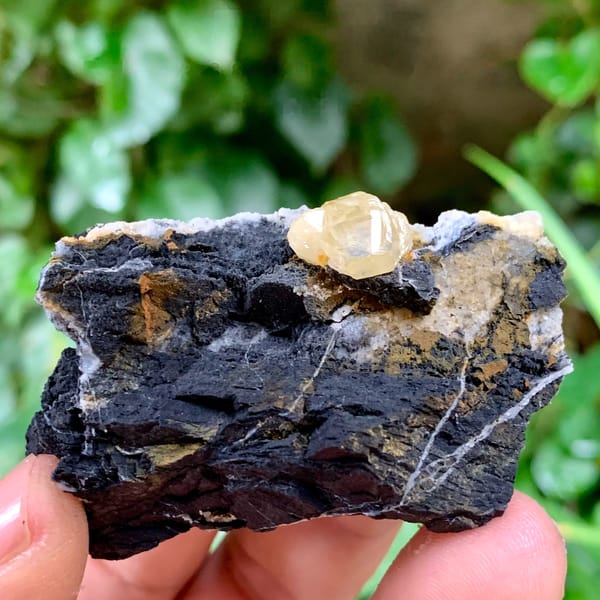
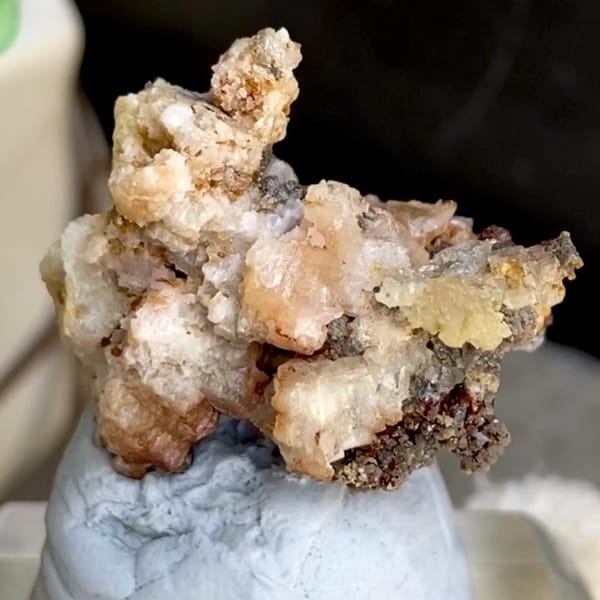
Cerussite (PbCO₃) is lead carbonate, the aragonite-group analog where Pb replaces Ca. It is the iconic secondary lead mineral of the oxidized cap zones of lead-zinc deposits, where it forms transparent adamantine-luster crystals with extraordinarily heavy specific gravity (6.5) for a transparent species. Tsumeb (Namibia) is the world standard, producing massive reticulated twin specimens, snowflake-pattern penetration twins, and gem-quality single crystals over 10 cm.
More minerals to explore
Rosasite (蓝绿铜锌矿)
Monoclinic
Witherite (碳酸钡矿)
Orthorhombic
Rhodochrosite (菱锰矿)
Trigonal
Magnesite (菱镁矿)
Trigonal
Siderite (菱铁矿)
Trigonal
Ankerite (铁白云石)
Trigonal