Handling: Wash hands after handling. No oral contact. Keep dust off food surfaces.
Information provided in good faith. Consult local hazmat regulations for transport and disposal. Severely hazardous specimens may require special storage cabinets.
Reverse — Pb chlorophosphate reduces to galena under sulfide-rich conditions. Rare.
Tsumeb.
A pseudomorph (Greek "false form") is a mineral with the external shape of another species — the chemistry has changed but the crystal habit is inherited.
Tenacity
Behavior:
brittle
Under stress:
Shatters into cubes
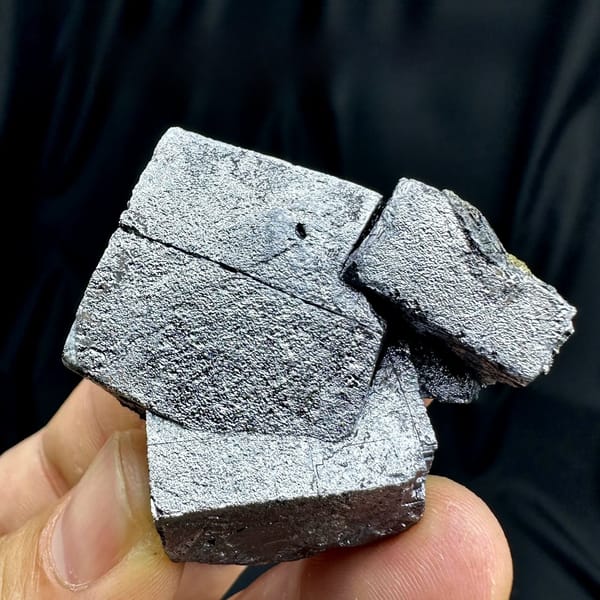
Cubic cleavage — taps produce small cubes; does not flatten.
Luster
metallic
Bright silvery on fresh cleavage; tarnishes dull lead-gray.
Diaphaneity (Transparency)
opaque
Metallic luster; lead gray opaque.
Type Locality
(ancient — Pliny)— Worldwide
Source: Pliny the Elder
› Browse all type localities
Magnetism
Category:
diamagnetic
Test result:
Slight repulsion
PbS; diamagnetic but very heavy.
Test with rare-earth magnet (N42 or N52 neodymium). Suspend specimen on thread for sensitive paramagnetic detection. Diamagnetic minerals are weakly repelled (visible only with strong magnets like bismuth).
Diagnostic Field Tests
Hardness→ Mohs 2.5 — knife scratches easily
Soft and heavy.
Streak→ Lead gray
Same color as the mineral; very heavy (SG 7.5).
⚠ Use dilute HCl (~10%) only on inconspicuous spots; rinse promptly. Smell-tests should be brief and ventilated. Taste-test ONLY halite/sylvite — never lead, arsenic, or sulfur minerals.
Specific Gravity
7.40–7.60
g/cm³
very heavy
PbS; classic "heavy" lead reference.
For comparison: water = 1.00, glass ≈ 2.5, quartz = 2.65, corundum ≈ 4.00, galena ≈ 7.50, gold ≈ 19.3.
Streak Test
lead gray
Soft, heavy, cubic cleavage — streak confirms.
Streak = color of the powdered mineral. Drag specimen across unglazed white porcelain plate (Mohs 6.5). For minerals harder than the plate, crush a small flake into powder and observe color.
Galena sits at 2.5 on the Mohs scale —
can be scratched by a steel knife.
Colors:
Streak Lead-gray
Crystal system Isometric (Cubic)
Pronunciation/ɡəˈliːnə/
Type localityFreiberg, Saxony, Germany (classical)
Discovery Known since antiquity
Sulfides & SulfosaltsSulfides
TL;DR · 1 min read
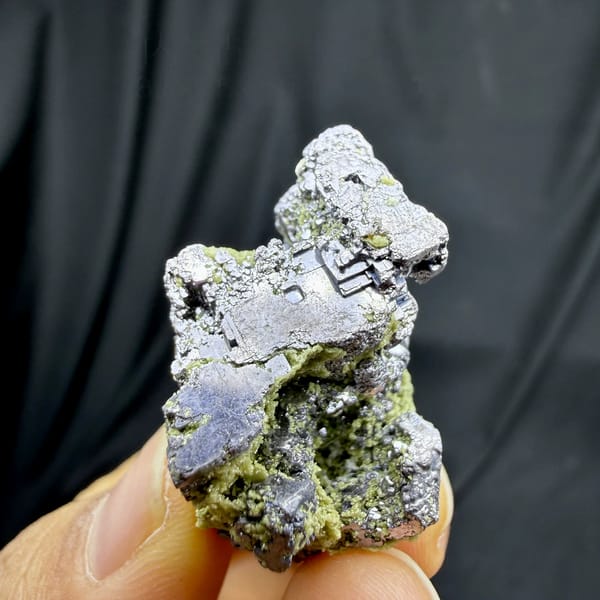
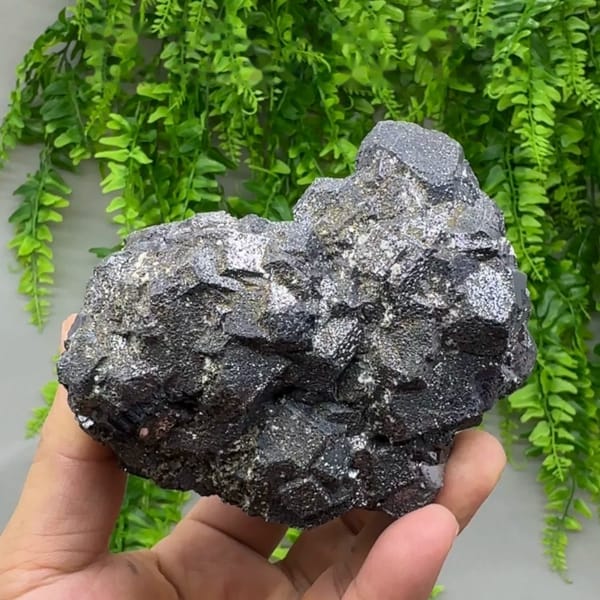
Galena is the principal ore of lead and the heaviest of common collector-class sulfides. Brilliant silver-gray cubes with mirror-bright cleavage faces define the species visually.
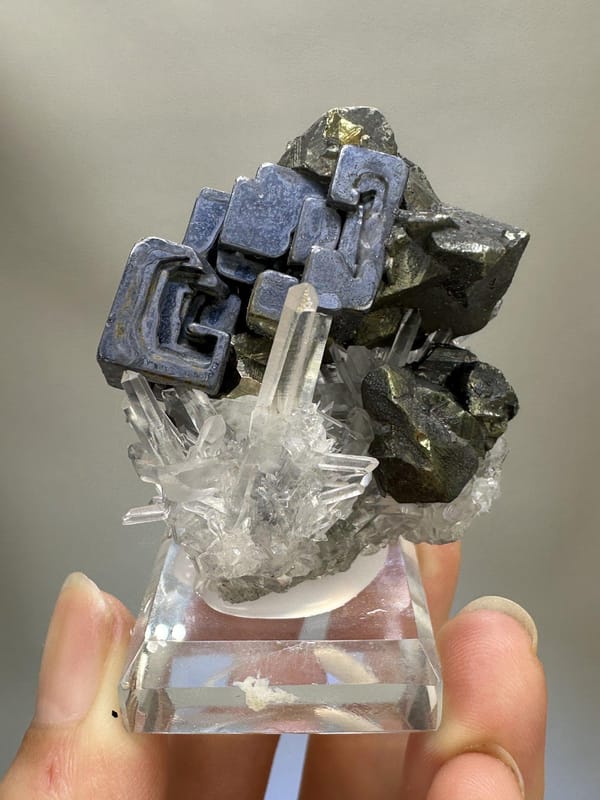
Galena is the principal ore of lead and the heaviest of common collector-class sulfides. Brilliant silver-gray cubes with mirror-bright cleavage faces define the species visually. Chinese galena from Daye, Hubei and Gejiu, Yunnan combines with sphalerite, calcite, and quartz in classic three-species matrix specimens.
The Chinese Angle
Daye District in Hubei and Gejiu Mine in Yunnan produce major collector galena. Daye galena often shows cubo-octahedral combinations with calcite and pyrite, while Gejiu galena tends toward octahedral habit and frequently associates with sphalerite, calcite scalenohedra, and rare supergene phosphates. Both districts are workhorse industrial sources turned premier specimen producers.
Cite this entry
APA
MyMineralBox Editorial Team. (2026). Galena. My Mineral Box. Retrieved May 23, 2026, from https://mymineralbox.com/mineral-encyclopedia/minerals/galena/
MLA
MyMineralBox Editorial Team. "Galena." My Mineral Box, 2026, https://mymineralbox.com/mineral-encyclopedia/minerals/galena/. Accessed May 23, 2026.
Chicago
MyMineralBox Editorial Team. "Galena." My Mineral Box. Last modified May 3, 2026. https://mymineralbox.com/mineral-encyclopedia/minerals/galena/.
BibTeX
@misc{mmb_galena,
 author = {{MyMineralBox Editorial Team}},
 title = {{Galena}},
 year = {2026},
 publisher = {My Mineral Box},
 url = {https://mymineralbox.com/mineral-encyclopedia/minerals/galena/},
 urldate = {2026-05-23}
}