Benitoite

Crystal system · Hexagonal

Benitoite is a silicate mineral recognized among collectors for its crystal form and distribution.

About Benitoiteextended article

Market availability: Rare
Sought after; limited supply. Major shows and specialist dealers only.
Geological setting
Hydrothermal
Optical Effects
FluorescentHigh dispersion
Crystal system
Hexagonal

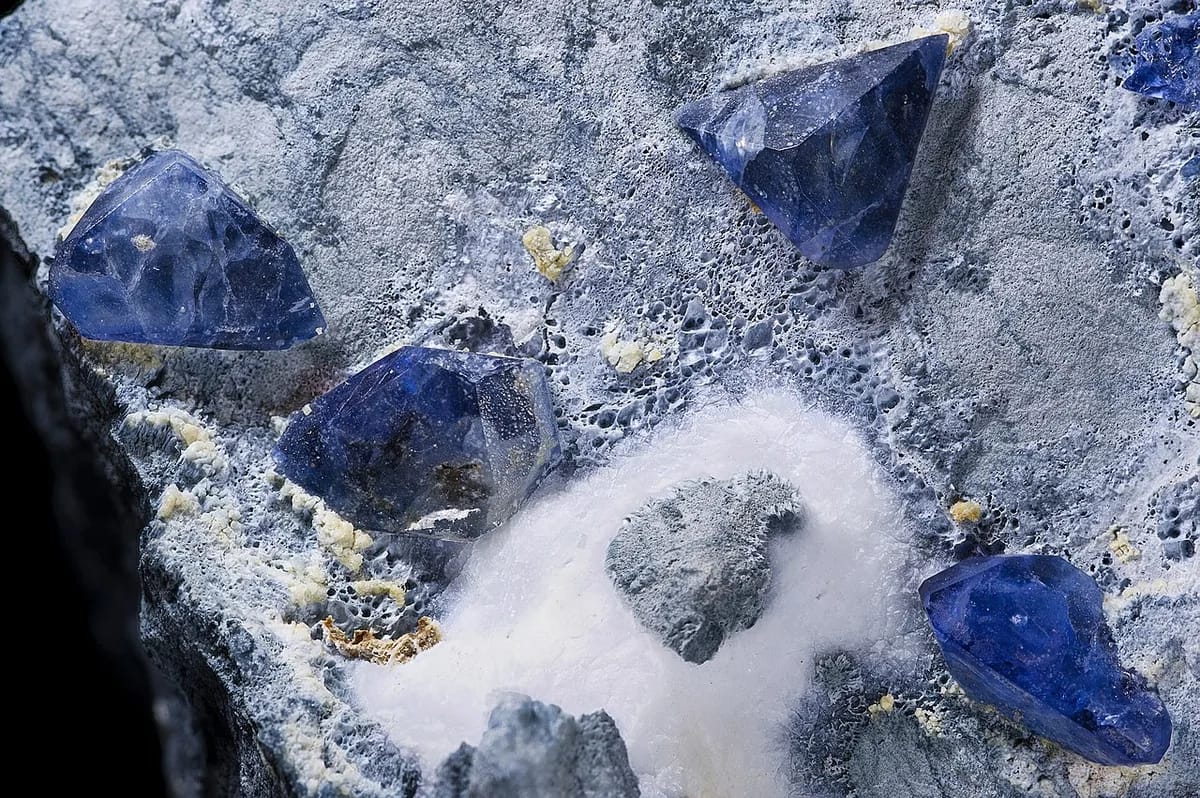
Benitoite is the rare barium-titanium cyclosilicate that became California’s state gem in 1985. Its sapphire-blue triangular dipyramidal crystals from a single deposit in San Benito County are unmistakable, and the species is essentially restricted to that locality in gem grade.

Occurrence

The Benitoite Gem Mine (Dallas Gem Mine), San Benito County, California, is the only commercial source — a serpentinite-hosted hydrothermal occurrence with benitoite, neptunite, joaquinite and natrolite. The mine ceased production in 2005, making material increasingly scarce.

Identification

Sapphire-blue triangular dipyramids + brilliant blue-white SW UV fluorescence + association with neptunite (black) and natrolite (white) on serpentine matrix. Distinguish from sapphire (corundum) by hexagonal habit and softness.

Collector Notes

Premier American collector gem; supply has dwindled since the mine closure. Faceted gem benitoite has the highest fire (dispersion) of any common gem species except diamond.

Export:BibTeXRIS
External research links for Benitoite
Gemological optical data
Refractive index
1.757–1.804
Birefringence
0.047
Dispersion
0.044
Published: May 6, 2026 · Last reviewed: May 6, 2026
Editorial standards & sources →

About Benitoite

Benitoite belongs to the silicate class in the benitoite group and has the chemical formula BaTiSi3O9. It crystallizes in the trigonal system and holds a steady position among silicate species. Its combination of structural character and global distribution make it a recognized species in both systematic and aesthetic collections.

Identification & care

Specimens usually show triangular dipyramidal crystals (unique and unmistakable — 3-fold triangular prism); tabular. Its color is typically sapphire blue, blue-violet and rarely colorless or pink. The luster is vitreous, adamantine, the streak is white, and specimens are typically transparent. The cleavage is imperfect on {10-11}. The fracture is conchoidal, which aids identification.

Collector context

How it forms

The geological setting for Benitoite is typically hydrothermally altered serpentinite; natrolite veins in blueschist terranes. It is commonly found in association with neptunite (black), natrolite (white), joaquinite-(ce), serpentine.

Why collectors care

Benitoite is a frequently-sought species in serious collections because its habit is recognizable, its color often strong, and its best examples unmistakable even at a distance. Chinese material has driven much of the recent visual shift in the species — sharper crystals, deeper colors, cleaner matrix.

What affects value

Value in Benitoite is assessed, in typical order of weight, against: (1) locality provenance; (2) size relative to the species norm; (3) crystal form and termination sharpness; (4) color saturation and zoning; (5) transparency and internal clarity; (6) matrix quality and aesthetic balance; (7) condition (absence of damage, chips, or repair). Cleaning quality and verified locality documentation act as multipliers across the above.

Naming history

The name Benitoite has a specific etymological and historical context — see Mindat's reference entry for provenance details. We have retained naming data at the record level; published prose is paraphrased from factual fields rather than copied from source.