Celestite
Curated by Maggie Liu · Updated:
Celestite is a sulfate mineral prized by collectors for its exceptional color range, with notable Chinese occurrences.
About Celestiteextended article
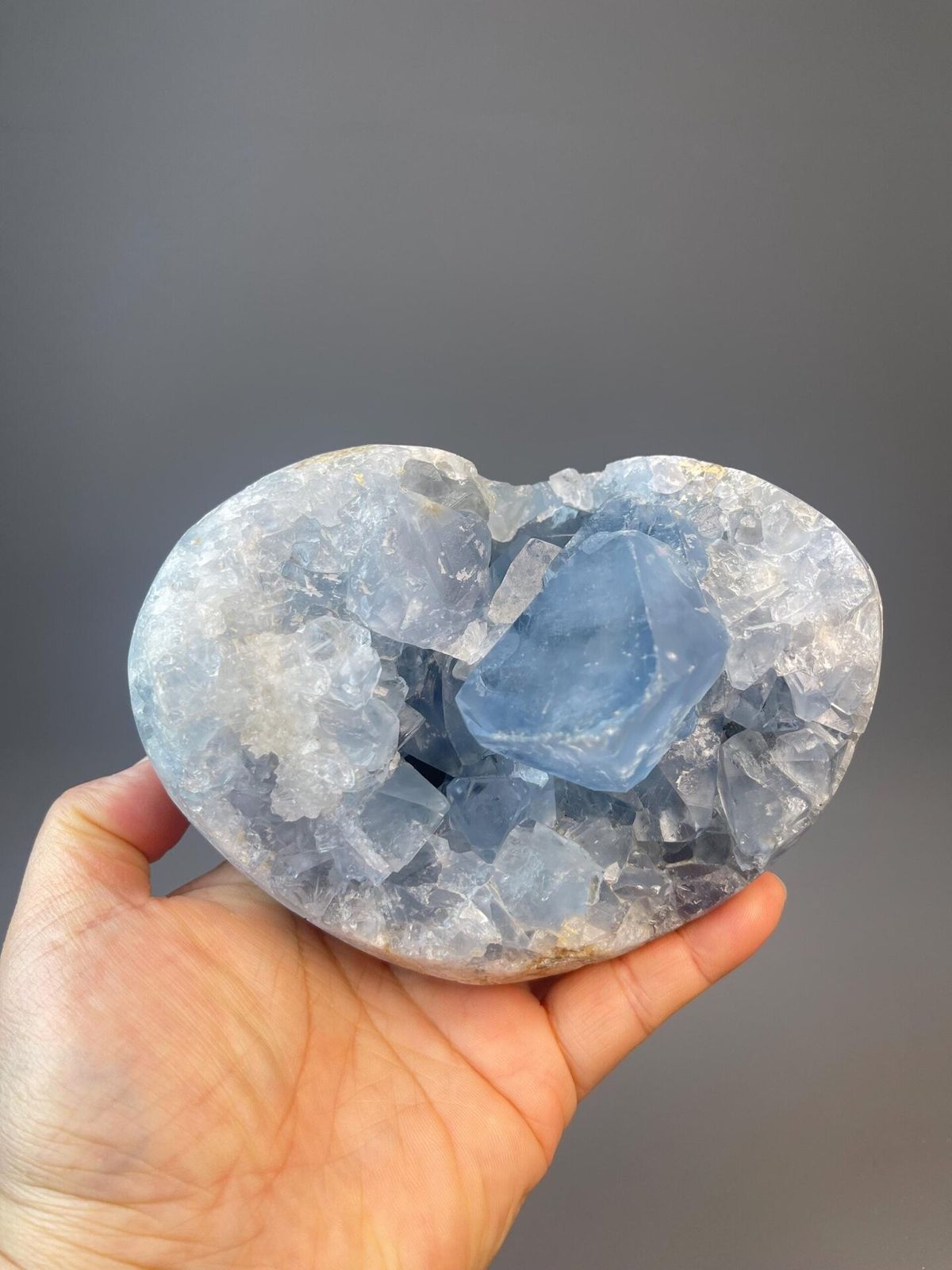
Celestite (SrSO₄) is strontium sulfate, isostructural with barite. Its name, from Latin “caelestis” (heavenly), references the iconic sky-blue color of the finest specimens — color that comes from natural radiation damage to its crystal lattice. Madagascar geode interiors lined with sky-blue tabular Celestite crystals are the world standard for the species, while Sicilian historical specimens preserve the type material.
Forms and colors
Celestite crystallizes as tabular to prismatic crystals, classically lining geode interiors in the pale sky-blue the species is named for; white and colorless crystals are common, and the blue can soften with long exposure to direct sun — display it away from strong light.
Our sources
Alongside Madagascar material, we stock celestite of Yunnan, China origin — a much less common provenance than the Madagascar standard, and a natural fit for a China-focused collection.
Collector notes
Celestite is the principal ore of strontium — the element behind crimson signal flares and fireworks — and its perfect cleavage makes intact crystal edges a mark of careful handling. Hardness 3–3.5: treat it as gently as calcite.
From our inventory
See the Yunnan locality page.
About Celestite
Celestite is classified as a sulfate mineral in the baryte group and has the chemical formula SrSO₄. It crystallizes in the orthorhombic system and is one of the most visually varied minerals in the collector market. Its combination of structural character and global distribution make it a recognized species in both systematic and aesthetic collections.
Identification & care
Specimens usually show tabular, prismatic; nodular; massive; geodes. Its color range is broad, including colorless, shades of light blue (sky to lavender), white, reddish, greenish, and brownish. The luster is vitreous, pearly, the streak is white, and specimens range from transparent to translucent. The cleavage is perfect on {001}, good on {210}. The fracture is uneven, which aids identification.
Collector context
How it forms
The geological setting for Celestite is typically sedimentary — evaporite deposits, limestone vugs; hydrothermal veins. It is commonly found in association with calcite, gypsum, halite, sulfur, dolomite.
Classic Chinese localities
Documented Chinese occurrences are recorded at Shangbao Mine, among others.
Why collectors care
Celestite is a frequently-sought species in serious collections because its habit is recognizable, its color often strong, and its best examples unmistakable even at a distance. Chinese material has driven much of the recent visual shift in the species — sharper crystals, deeper colors, cleaner matrix.
What affects value
Value in Celestite is assessed, in typical order of weight, against: (1) locality provenance; (2) size relative to the species norm; (3) crystal form and termination sharpness; (4) color saturation and zoning; (5) transparency and internal clarity; (6) matrix quality and aesthetic balance; (7) condition (absence of damage, chips, or repair). Cleaning quality and verified locality documentation act as multipliers across the above.
Naming history
Celestite (or celestine) is named from the Latin caelestis, "heavenly," for the pale sky-blue of the crystals first described in the early 19th century. The same root gives us celestial.
Frequently asked questions
What is Celestite?
Celestite has the chemical formula SrSO4, crystallises in the Orthorhombic system, has a Mohs hardness of 3–3.5. Celestite is a sulfate mineral prized by collectors for its exceptional color range, with notable Chinese occurrences.
What is the chemical formula of Celestite?
The chemical formula of Celestite is SrSO4.
What crystal system does Celestite belong to?
Celestite crystallises in the Orthorhombic crystal system.
Where is Celestite found?
Notable localities for Celestite include Yunnan Province, China.