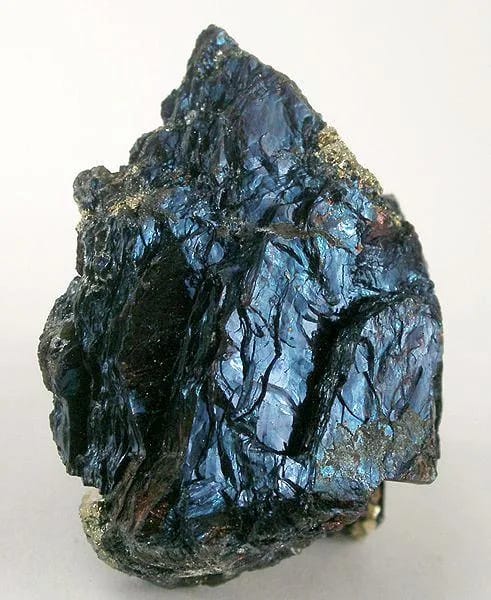
Covellite

Crystal system · Hexagonal

Covellite is a sulfide mineral recognized among collectors for its crystal form and distribution, with several world-class Chinese localities.

About Covelliteextended article

China-iconic

China is a defining locality for Covellite · 铜蓝. See the Chinese collector page →

PolymorphsShares the formula CuS with: High-temp-covellite — same chemistry, different crystal structure.
Optical Effects
Iridescent
Crystal system
Hexagonal

Covellite is a copper sulfide famous for its electric indigo-blue color and brilliant peacock iridescent tarnish — easily one of the most chromatically distinctive sulfides in nature. It is a common secondary mineral in the supergene-enriched zones of copper deposits.

Occurrence in China

Covellite is widespread in oxidized zones of Dexing (Jiangxi), Tonglushan (Hubei) and Pulang/Lanping (Yunnan) Cu deposits. The world’s largest crystals come from Butte (Montana), where covellite tabular plates reached several centimeters. Calabona (Sardinia) is the historic European source.

Identification

Indigo-blue + iridescent peacock tarnish + perfect basal cleavage producing flexible thin sheets + extreme softness. Distinguish from chalcocite (lead-gray, no iridescence) and bornite (which also tarnishes peacock but is purple-gold from fresh bronze and is harder).

Collector Notes

Butte covellite tablets remain the species archetype. Italian and Sardinian specimens with intense iridescence on quartz are also classic. Care: easily abraded due to softness.

Export:BibTeXRIS
External research links for Covellite
Published: May 6, 2026 · Last reviewed: May 6, 2026
Editorial standards & sources →

About Covellite

Covellite is a sulfide mineral in the covellite group and has the chemical formula CuS. It crystallizes in the hexagonal system and is relatively soft, requiring careful handling. Its combination of structural character and global distribution make it a recognized species in both systematic and aesthetic collections.

Identification & care

Specimens usually show hexagonal platy crystals; foliated; massive; pseudomorphs after chalcopyrite. Its color is typically indigo blue and deep blue (sometimes with purple and red iridescence). The luster is metallic, splendent, sub-metallic, the streak is lead gray to black, and specimens are typically opaque. The cleavage is perfect on {0001}. The fracture is subconchoidal, which aids identification.

Collector context

How it forms

Covellite forms in secondary enrichment (supergene) zone of copper deposits; less commonly primary hydrothermal; often replaces chalcopyrite. It is commonly found in association with chalcopyrite, chalcocite, bornite, pyrite, enargite, malachite.

Classic Chinese localities

Jiama Cu-polymetallic deposit and Dexing Cu-Mo-Au ore field are an important Chinese source for the species.

Why collectors care

Collectors pursue Covellite for the clarity of its crystal form and, in good material, saturated color that reads instantly across a display case. A well-terminated covellite on clean matrix photographs well, identifies quickly, and anchors a cabinet piece. Top Chinese specimens over the last two decades have reset the bar for what covellite looks like at collector grade.

What affects value

Value in Covellite is assessed, in typical order of weight, against: (1) locality provenance; (2) size relative to the species norm; (3) crystal form and termination sharpness; (4) color saturation and zoning; (5) transparency and internal clarity; (6) matrix quality and aesthetic balance; (7) condition (absence of damage, chips, or repair). Cleaning quality and verified locality documentation act as multipliers across the above.

Naming history

The name Covellite has a specific etymological and historical context — see Mindat's reference entry for provenance details. We have retained naming data at the record level; published prose is paraphrased from factual fields rather than copied from source.