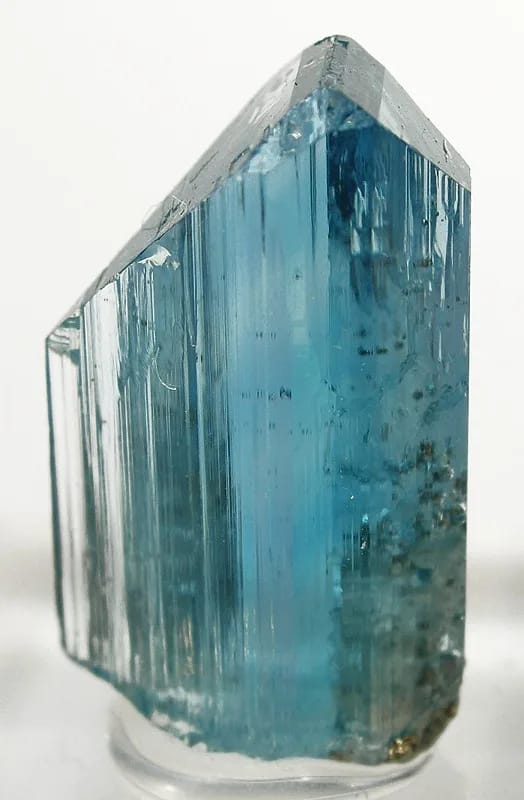
Euclase

Crystal system · Monoclinic

Euclase is a mineral recognized among collectors for its crystal form and distribution, with several world-class Chinese localities.

About Euclaseextended article

Save to favoritesview your list
Market availability: Rare
Sought after; limited supply. Major shows and specialist dealers only.
Geological setting
PegmatiteAlpine cleft
Crystal system
Monoclinic

📇 Print ID card

Euclase is a beryllium-aluminum nesosilicate prized for its rare gem-grade aquamarine-blue crystals. The name (Greek “eu-klasis”, easy to break) reflects its perfect prismatic cleavage that makes faceted euclase a connoisseur’s gem rarely seen outside specialist collections.

Occurrence #

Premier sources: Ouro Preto and Capão (Minas Gerais, Brazil) for sky-blue gem crystals; Last Hope Mine (Zimbabwe) for the deepest blue color; Russia and Pakistan for additional material.

Identification #

Sky-blue color + perfect lateral cleavage + monoclinic prismatic crystals + association with quartz/beryl in pegmatites or alpine clefts. Distinguish from aquamarine (beryl, hexagonal, no perfect cleavage).

Collector Notes #

Brazilian sky-blue euclase from Ouro Preto is among the most coveted of all gem rarities. The cleavage makes faceting tricky — euclase gems are connoisseur targets.

Export:BibTeXRIS
External research links for Euclase
Published: May 6, 2026 · Last reviewed: May 6, 2026
Editorial standards & sources →
Recently viewed
Nothing in your history yet — this is your first mineral.

Collector context

Classic Chinese localities

Documented Chinese occurrences are recorded at Xianghualing Sn-polymetallic ore field, Xihuashan ore field and Yaogangxian W-Sn ore field, among others.

Why collectors care

Euclase is a frequently-sought species in serious collections because its habit is recognizable, its color often strong, and its best examples unmistakable even at a distance. Chinese material has driven much of the recent visual shift in the species — sharper crystals, deeper colors, cleaner matrix.

What affects value

Value in Euclase is assessed, in typical order of weight, against: (1) locality provenance; (2) size relative to the species norm; (3) crystal form and termination sharpness; (4) color saturation and zoning; (5) transparency and internal clarity; (6) matrix quality and aesthetic balance; (7) condition (absence of damage, chips, or repair). Cleaning quality and verified locality documentation act as multipliers across the above.