
Nephrite
Curated by Maggie Liu · Updated:
Nephrite is a silicate mineral prized for its texture, translucency, and cultural significance, with notable Chinese occurrences.
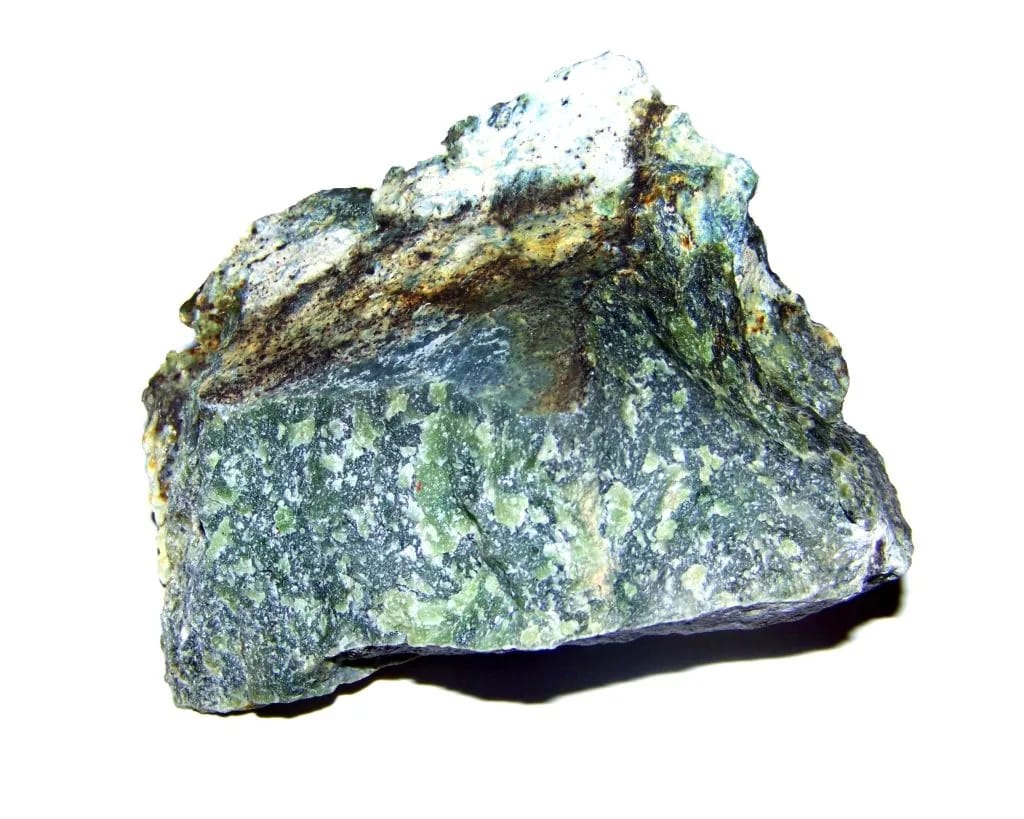
Nephrite is one of the two true jades — a tough, fine-grained variety of the amphibole minerals tremolite-actinolite, carved in China for thousands of years.
About Nephriteextended article
Nephrite is one of the two minerals that can be called true jade (the other being jadeite). It is a compact, fine-grained mass of interlocking amphibole fibres (tremolite to actinolite), and that felted structure makes it extraordinarily tough — historically used for tools and weapons as well as carvings.
Identifying nephrite
Nephrite ranges from creamy white ('mutton-fat' jade) through every shade of green to brown and black, with a smooth, slightly greasy lustre when polished. It is moderately hard (6–6.5) but, above all, exceptionally tough and resistant to breaking.
Where it is found
Nephrite has been treasured in China for millennia, with the classic source at Hetian (Khotan) in Xinjiang. It also occurs in Russia (Siberia), Canada (British Columbia), New Zealand (Maori pounamu) and elsewhere.
About Nephrite
Nephrite is classified as a silicate mineral in the actinolite-tremolite series (compact microcrystalline aggregate) and has the chemical formula Ca2(Mg,Fe)5Si8O22(OH)2 [compact actinolite-tremolite]. It crystallizes in the monoclinic system and is one of the most visually varied minerals in the collector market. Its combination of structural character and global distribution make it a recognized species in both systematic and aesthetic collections.
Identification & care
Specimens usually show massive, compact; no distinct crystals; boulder-like alluvial forms ('pebbles' in Chinese tradition); carved into objects. Its color range is broad, including white (mutton-fat jade), pale green to dark green (spinach-green), black, yellow, orange, red, and brown. The luster is waxy, greasy, sub-vitreous, the streak is white, and specimens range from translucent to opaque. The cleavage is not visible in massive form. The fracture is splintery, uneven; extremely tough due to interlocking fiber texture, which aids identification.
Collector context
How it forms
The geological setting for Nephrite is typically compact fibrous tremolite-actinolite aggregate formed in metamorphic zones; especially in serpentinite-associated metamorphic lenses in suture zones. It is commonly found in association with serpentine, chlorite, talc, chromite, magnetite, dolomite.
Classic Chinese localities
Yurungkash and Karakash Rivers is a benchmark source for nephrite.
Why collectors care
Nephrite is central to Chinese material culture and is judged as jade, not as a crystal specimen. Collectors value fine pieces for dense fibrous fabric, quiet translucency, greasy luster, and a tradition of carving and connoisseurship spanning thousands of years. A good piece of nephrite feels cool, dense, and slightly greasy in the hand, with a quiet glow no photograph fully captures.
What affects value
Value in Nephrite is assessed, in typical order of weight, against: (1) verified source and historical provenance; (2) size and carvable volume; (3) color tone and evenness; (4) texture and compactness; (5) translucency and greasy luster; (6) polish response and surface quality; (7) workmanship on carved pieces. For culturally significant material, verified Hetian / Khotan provenance can weigh heavily beyond any single physical factor.
Frequently asked questions
What is Nephrite?
Nephrite crystallises in the Monoclinic system, has a Mohs hardness of 6–6.5. Nephrite is a silicate mineral prized for its texture, translucency, and cultural significance, with notable Chinese occurrences.
What crystal system does Nephrite belong to?
Nephrite crystallises in the Monoclinic crystal system.
Where is Nephrite found?
Notable localities for Nephrite include Hetian (Khotan) Jade District, Xiuyan Jade District.
Related minerals
Looking for a Nephrite specimen?
Our inventory is one-of-a-kind and turns over quickly. Tell us what you're after — species, size, budget — and we'll notify you when a matching Nephrite arrives from our sourcing network.
Request this mineral