
Opal Fire
Curated by Maggie Liu · Updated:
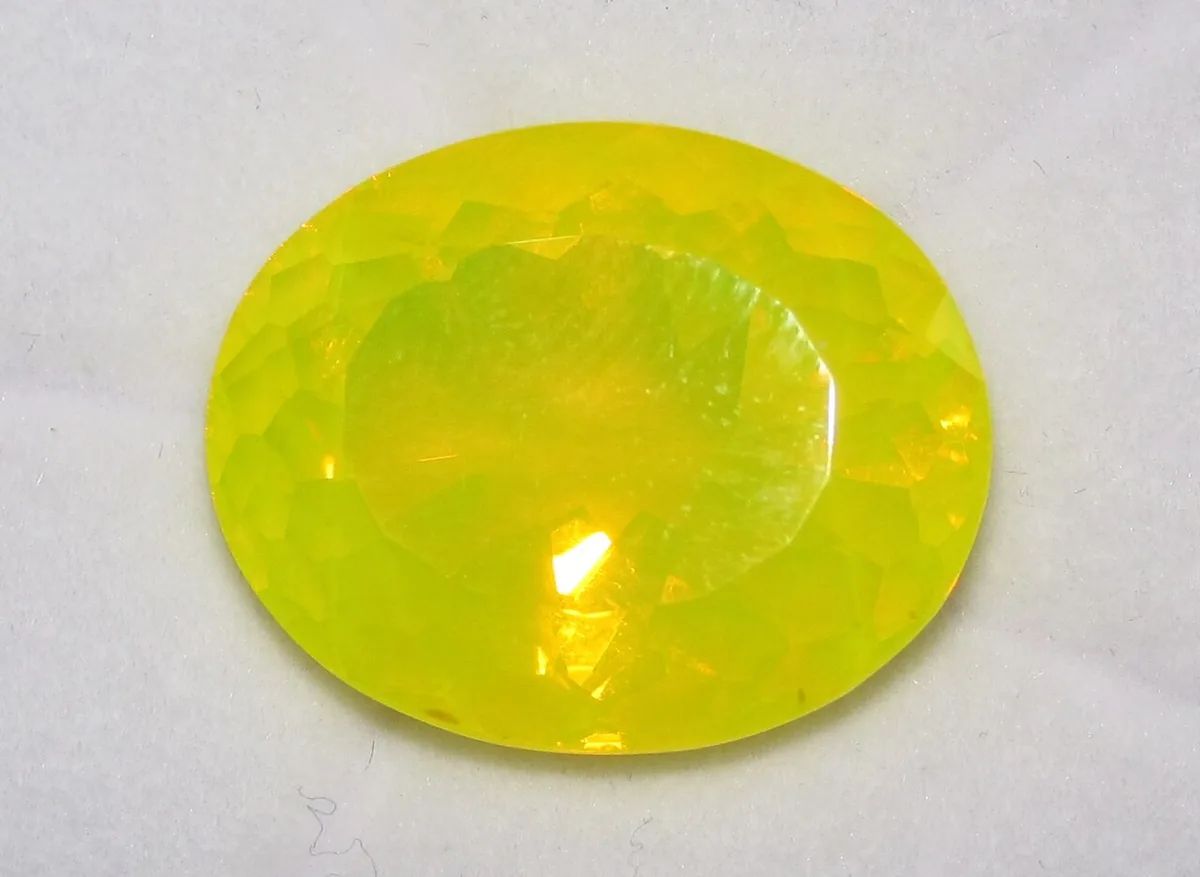
Fire opal is the orange-to-red transparent to translucent variety of opal, colored by iron oxide. Mexican fire opal from the Magdalena and Queretaro deposits is the historic source.
About Opal Fire
Fire opal is a non-crystalline hydrated silica (SiO2 nH2O) characterized by a vivid orange, red, or yellow body color. Unlike precious opal, fire opal can be entirely transparent and does not require play-of-color to be considered fire opal — though premium pieces show both fire body color AND play-of-color. The Mexican deposits in Queretaro and Jalisco have been worked since pre-Columbian times.
Identification & care
Fire opal has a Mohs hardness of 5.5 to 6.5 and specific gravity around 2.0 — notably lower than crystalline quartz. Luster is vitreous to resinous, fracture is conchoidal, no cleavage. The mineral is amorphous (no crystal form). Water content ranges from 3 to 10 percent. Body color is uniformly orange to red across the specimen, without the spectral flashes typical of black or white precious opal (though they may coexist).
Collector context
Collector notes
Fire opal sensitivity to dehydration is the key collector consideration. Mexican material is famously prone to crazing — fine network cracking that develops as the stone dries out over years. Stable specimens (or those kept in a humid environment) hold value much better. Premium pieces show deep red body color and at least faint play-of-color. The Cantera variety, found embedded in rhyolite matrix, is especially prized.
Related minerals
Looking for a Opal Fire specimen?
Our inventory is one-of-a-kind and turns over quickly. Tell us what you're after — species, size, budget — and we'll notify you when a matching Opal Fire arrives from our sourcing network.
Request this mineral