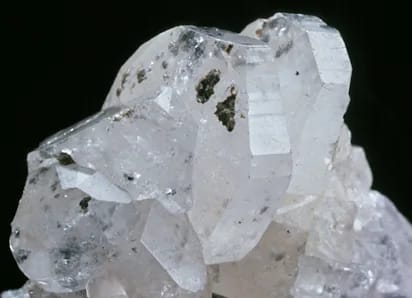
Phenakite

Crystal system · Trigonal

Phenakite is a silicate mineral prized by collectors for its exceptional color range, with several world-class Chinese localities.

About Phenakite

Phenakite is a silicate mineral in the phenakite group and has the chemical formula Be2SiO4. It crystallizes in the trigonal system and is one of the most visually varied minerals in the collector market. Its combination of structural character and global distribution make it a recognized species in both systematic and aesthetic collections.

Identification & care

Crystals commonly develop as rhombohedral to short prismatic crystals; often lenticular (lens-shaped); also horizontally striated prisms. Its color range is broad, including colorless, white, pale yellow, pale rose/pink, and rarely pale blue or pale green. The luster is vitreous, the streak is white, and specimens are typically transparent. The cleavage is indistinct on {1120}. The fracture is conchoidal, which aids identification.

Collector context

How it forms

Phenakite forms in granitic pegmatites and associated hydrothermal veins; also in metamorphic rocks and alpine veins; beryllium-bearing environments. It is commonly found in association with beryl (aquamarine, emerald), topaz, fluorite, quartz, chrysoberyl, apatite, columbite.

Classic Chinese localities

Documented Chinese occurrences are recorded at Xianghualing Sn-polymetallic ore field, Yaogangxian W-Sn ore field and Xianghuapu Mine, among others.

Why collectors care

Phenakite is a frequently-sought species in serious collections because its habit is recognizable, its color often strong, and its best examples unmistakable even at a distance. Chinese material has driven much of the recent visual shift in the species — sharper crystals, deeper colors, cleaner matrix.

What affects value

Value in Phenakite is assessed, in typical order of weight, against: (1) locality provenance; (2) size relative to the species norm; (3) crystal form and termination sharpness; (4) color saturation and zoning; (5) transparency and internal clarity; (6) matrix quality and aesthetic balance; (7) condition (absence of damage, chips, or repair). Cleaning quality and verified locality documentation act as multipliers across the above.

Naming history

The name Phenakite has a specific etymological and historical context — see Mindat's reference entry for provenance details. We have retained naming data at the record level; published prose is paraphrased from factual fields rather than copied from source.