
Tugtupite
Curated by Maggie Liu · Updated:
Tugtupite is a silicate mineral recognized among collectors for its crystal form and distribution.
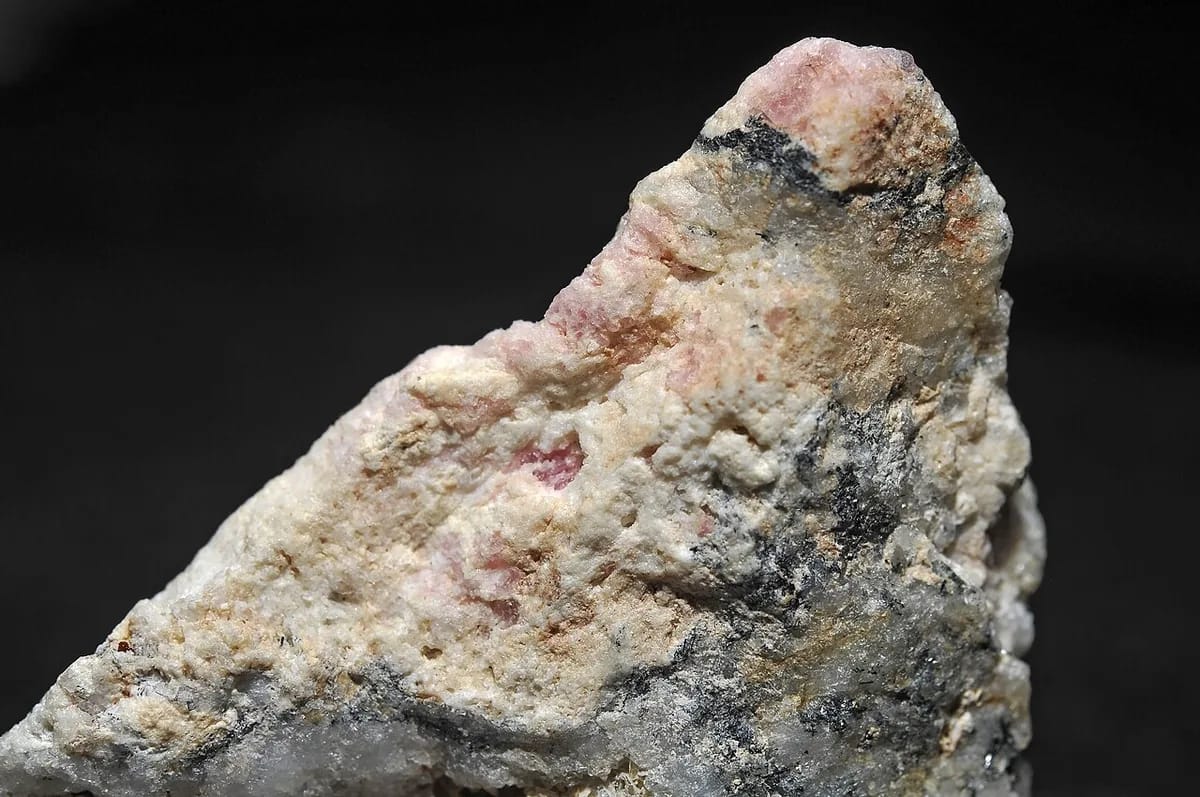
About Tugtupite
Tugtupite belongs to the silicate class in the sodalite group and has the chemical formula Na4AlBeSi4O12Cl. It crystallizes in the tetragonal system and holds a steady position among silicate species. Its combination of structural character and global distribution make it a recognized species in both systematic and aesthetic collections.
Identification & care
Specimens usually show massive; rarely distinct crystals; occurs as veinlets and masses in alkaline rock. Its color is typically pale pink to deep carmine-red and also white. The luster is vitreous, greasy, the streak is white, and specimens range from translucent to opaque. The cleavage is distinct {011}. The fracture is conchoidal to uneven, which aids identification.
Collector context
How it forms
Tugtupite forms in extremely alkaline, agpaitic igneous rocks (the ilimaussaq complex — one of the world's most mineralogically unusual igneous bodies); rare environment requiring extreme na-be-al-si-cl enrichment. It is commonly found in association with albite, aegirine, natrolite, analcime, sodalite, eudialyte.
Why collectors care
Collectors pursue Tugtupite for its patterns, color depth, and polish response rather than for pattern character. Good material has a surface that polishes cleanly, a visual character that holds up in direct light, and enough size to anchor a display on its own. Chinese sources, where present, supply much of the material currently cut and sold as decorative pieces.
What affects value
Value in Tugtupite is assessed, in typical order of weight, against: (1) source locality; (2) size; (3) pattern and visual character; (4) color depth and distribution; (5) polish response and surface finish; (6) piece integrity (absence of major cracks or chips). Uniqueness of pattern and verified source region add significantly to decorative pieces.
Frequently asked questions
What is Tugtupite?
Tugtupite crystallises in the Tetragonal system. Tugtupite is a silicate mineral recognized among collectors for its crystal form and distribution.
What crystal system does Tugtupite belong to?
Tugtupite crystallises in the Tetragonal crystal system.
Is Tugtupite rare?
As a collector mineral, Tugtupite is generally considered rare.
Related minerals
Looking for a Tugtupite specimen?
Our inventory is one-of-a-kind and turns over quickly. Tell us what you're after — species, size, budget — and we'll notify you when a matching Tugtupite arrives from our sourcing network.
Request this mineralExternal references
Tugtupite on Wikidata.