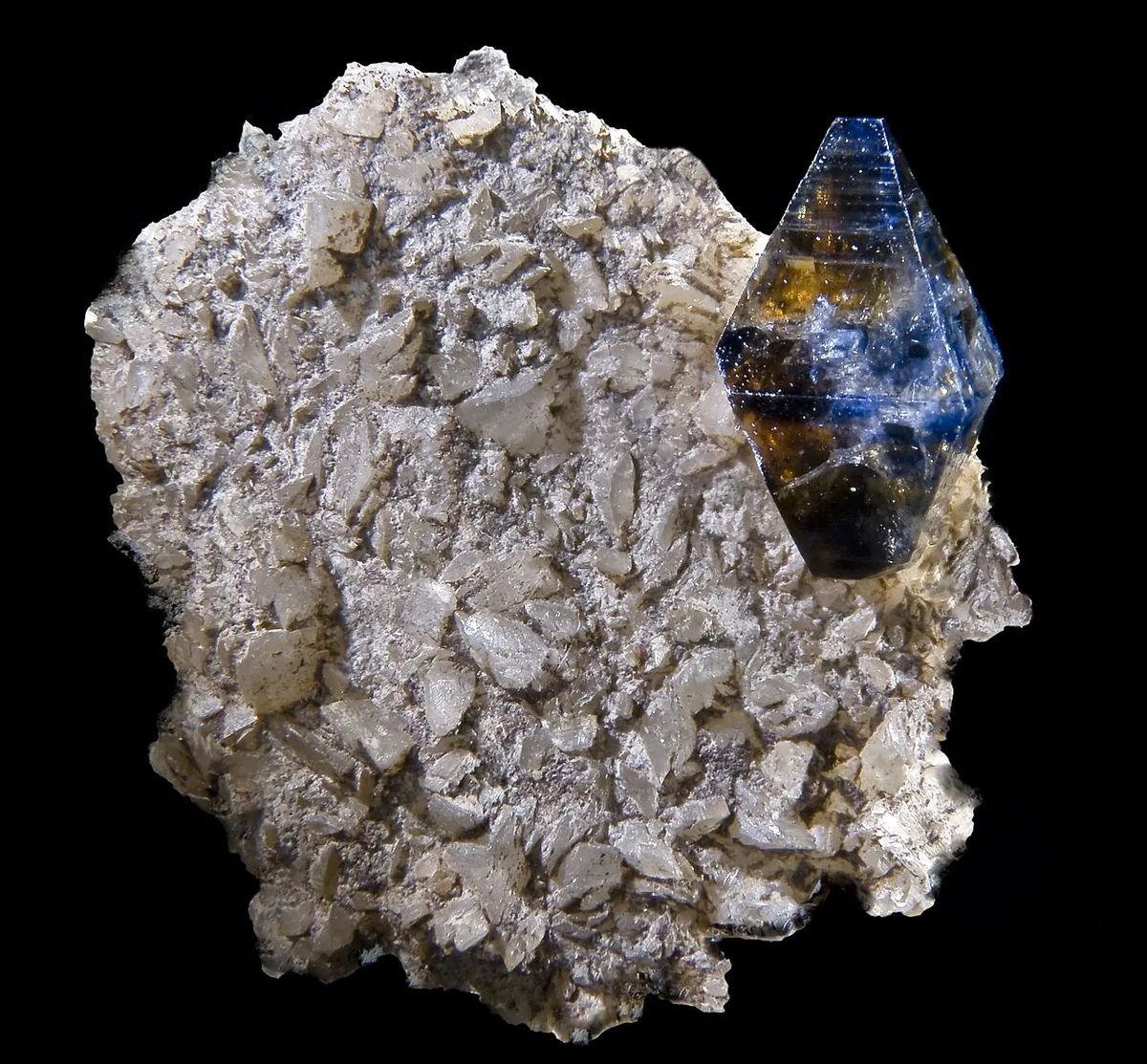
Anatase

Crystal system · Tetragonal

Anatase is an oxide mineral prized by collectors for its exceptional color range, with known Chinese sources.

About Anataseextended article

PolymorphsShares the formula TiO2 with: Rutile · Brookite — same chemistry, different crystal structure.
Geological setting
MetamorphicAlpine cleft
Crystal system
Tetragonal

Anatase is one of the three TiO2 polymorphs (alongside rutile and brookite) and is the lowest-temperature, most metastable of the three. It crystallizes in distinctive sharp tetragonal bipyramids with a brilliant near-adamantine luster.

Occurrence

Classic alpine-cleft anatase comes from the Binntal and Hardanger (Switzerland) and Cavradi gorge — sharp dark-blue bipyramids on chlorite or quartz. Modern Brazilian anatase from Diamantina (Minas Gerais) reaches gem grade. Hagdal (Norway) yields large dull-brown crystals. China hosts minor metamorphic anatase but no notable collector localities.

Identification

Tetragonal bipyramids with very sharp pyramidal terminations + dark indigo color in fresh material. Distinguish from rutile (more equant prismatic, often reddish) and brookite (orthorhombic, tabular).

Collector Notes

Alpine anatase from Cavradi gorge and Brazilian crystals are the genre standards. Anatase + brookite + rutile thumbnail set is a classic TiO2 polymorph display.

Export:BibTeXRIS
External research links for Anatase
Published: May 6, 2026 · Last reviewed: May 6, 2026
Editorial standards & sources →

About Anatase

Anatase is classified as an oxide mineral in the anatase group (tio2 polymorph) and has the chemical formula TiO2. It crystallizes in the tetragonal system and is one of the most visually varied minerals in the collector market.

Identification & care

Anatase typically forms bipyramidal (steep bi-pyramids), tabular. Its color range is broad, including indigo blue, black, brown, yellow, and gray. The luster is adamantine, the streak is white, and specimens range from transparent to opaque. The cleavage is perfect {001}, perfect {011}. The fracture is subconchoidal, which aids identification.

Collector context

Collector notes

Anatase holds a steady place in systematic mineral collections. Anatase is widely represented across Chinese provinces, including Fujian, Gansu, Anhui, Guangdong.