
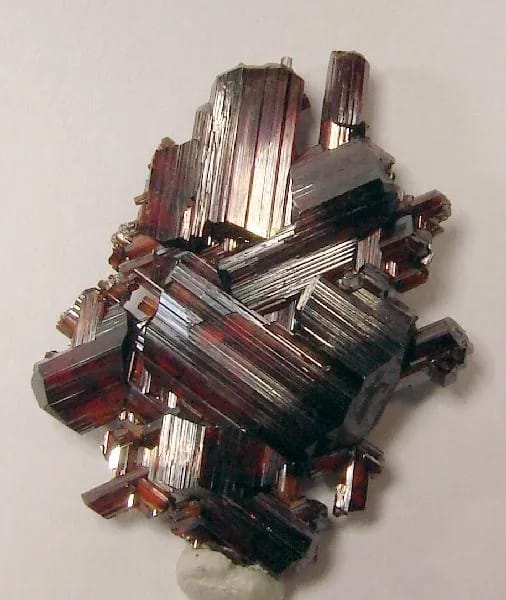
Crystal Structure
Tetragonal — Ti octahedrally coordinated, edge-sharing along c.
Elemental Composition (by mass)
| Element | Mass % | Visual |
|---|---|---|
| Ti Titanium | 59.93% | |
| O Oxygen | 40.07% |
Computed from simplified end-member formula. Solid-solution series, water content, and trace substitutions cause real-world variation.
IMA Abbreviation (Whitney-Evans 2010)
Rt
→ Rutile
TiO₂ tetragonal
Standard symbol from American Mineralogist (Whitney & Evans, 2010). Used in thin-section labeling, phase diagrams, and IMA-style species records.
Pronunciation
/ˈruːtiːl/
↔ roo-TEEL
Latin rutilus (reddish)
Pseudomorph Relationships
Replaces — this mineral is often a pseudomorph after:
← Ilmenite replacement
Ilmenite (FeTiO₃) weathers/exsolves to rutile (TiO₂) — important Ti ore process.
Heavy mineral sands.
A pseudomorph (Greek "false form") is a mineral with the external shape of another species — the chemistry has changed but the crystal habit is inherited.
Luster
adamantine
Very high RI; brilliant brown-red shine.
Diaphaneity (Transparency)
translucent-to-opaque
Thin needles transparent in quartz host.
Type Locality
Boinik, Hungary — Slovakia
Described 1803 by Werner
› Browse all type localities
Specific Gravity
4.20–4.30
g/cm³
heavy
TiO₂.
For comparison: water = 1.00, glass ≈ 2.5, quartz = 2.65, corundum ≈ 4.00, galena ≈ 7.50, gold ≈ 19.3.
Streak Test
pale brown
Tan streak from black-red crystals.
Streak = color of the powdered mineral. Drag specimen across unglazed white porcelain plate (Mohs 6.5). For minerals harder than the plate, crush a small flake into powder and observe color.
Twinning Laws
Knee twin (elbow)contact
Two prisms meeting at 114°36′ on {011}. Common in alpine cleft rutile.
Cyclic / sixlingcontact
Six crystals forming a star or wheel. Spectacular when complete.
Reticulated meshcontact
Lattice-like networks ("sagenite") in chlorite or in alpine quartz.
Collector tier: Solid Display
Reliable mid-tier display species. Easy to find in well-formed examples; broad locality diversity.
PolymorphsShares the formula
TiO2 with: Anatase · Brookite — same chemistry, different crystal structure.Mohs 6–6.5
Vickers (~) 820 HV
Knoop (~) 870 HK
Nickel–Strunz
4.DB.05Dana
04.04.01.01Geological setting
PegmatiteMetamorphic
Element composition by mass
Formula: TiO₂ · molar mass: 79.87 g/mol
| Ti | 59.93% | |
| O | 40.07% |
Computed from atomic weights (IUPAC 2021). Site-occupancy groups (Fe,Mn) split equally.
Mohs Hardness
6–6.5
Rutile sits at 6–6.5 on the Mohs scale — just hard enough to scratch glass.
Colors:
Streak
Pale brown
Pale brown
Crystal system
Tetragonal
Tetragonal
Type localityBoinik, Bohemia, Czech Republic
Discovery First described 1803 by Werner
Oxides & HydroxidesOxides
TL;DR · 1 min read
Rutile (TiO₂) is the highest-temperature TiO₂ polymorph (with anatase low-T and brookite intermediate). Its name from Latin "rutilus" (red) reflects its diagnostic blood-red translucent crystals.
Rutile (TiO₂) is the highest-temperature TiO₂ polymorph (with anatase low-T and brookite intermediate). Its name from Latin “rutilus” (red) reflects its diagnostic blood-red translucent crystals. Rutile is the principal industrial source of titanium and a common accessory mineral in metamorphic and igneous rocks. Acicular needles in quartz produce “rutilated quartz” — a major collector variety.