Ilmenite

Crystal system · Trigonal

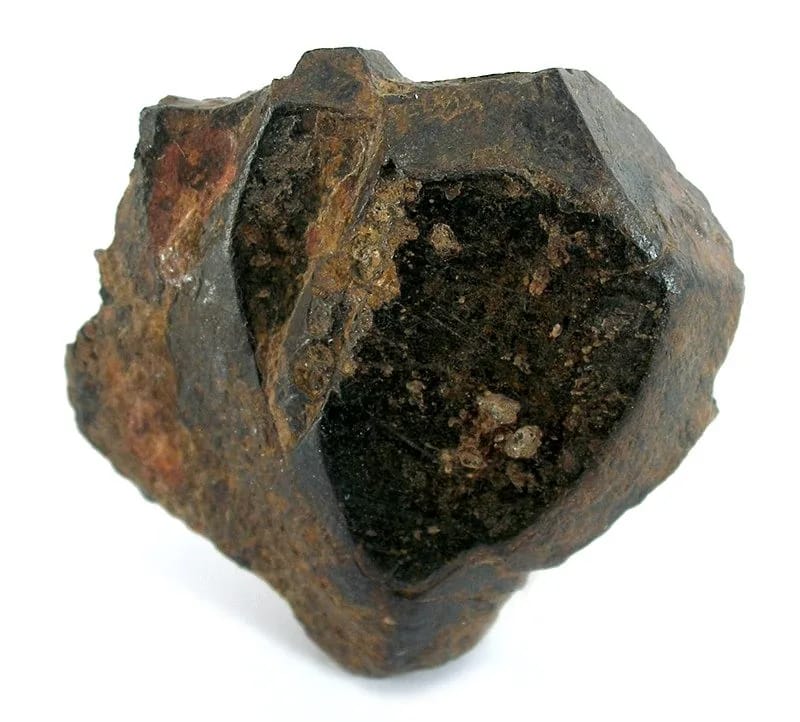
Ilmenite is an oxide mineral recognized among collectors for its crystal form and distribution, with several world-class Chinese localities.

About Ilmeniteextended article

IMA Abbreviation (Whitney-Evans 2010)
Ilm
→ Ilmenite
Fe-Ti oxide
Standard symbol from American Mineralogist (Whitney & Evans, 2010). Used in thin-section labeling, phase diagrams, and IMA-style species records.
Pseudomorph Relationships
Replaced by — this mineral commonly becomes:
Rutile replacement
Ilmenite (FeTiO₃) weathers/exsolves to rutile (TiO₂) — important Ti ore process.
Heavy mineral sands.
A pseudomorph (Greek "false form") is a mineral with the external shape of another species — the chemistry has changed but the crystal habit is inherited.
Magnetism
Category:
weakly paramagnetic
Test result:
Slight pull from rare-earth magnet
FeTiO₃; useful for separating from magnetite during sluicing.
Test with rare-earth magnet (N42 or N52 neodymium). Suspend specimen on thread for sensitive paramagnetic detection. Diamagnetic minerals are weakly repelled (visible only with strong magnets like bismuth).
Streak Test
black / brown-black
Distinguishes from magnetite (true black streak) — slightly browner.
Streak = color of the powdered mineral. Drag specimen across unglazed white porcelain plate (Mohs 6.5). For minerals harder than the plate, crush a small flake into powder and observe color.
Mohs 5–6
Vickers (~) 540 HV
Knoop (~) 620 HK
Geological setting
Plutonic igneousKimberlitePlacer
Diagnostic properties
Trace magnetism
Element composition by mass

Formula: FeTiO₃ · molar mass: 151.71 g/mol

Fe 36.81%
O 31.64%
Ti 31.55%

Computed from atomic weights (IUPAC 2021). Site-occupancy groups (Fe,Mn) split equally.

Mohs Hardness 5–6
1
Talc
2
Gypsum
3
Calcite
4
Fluorite
5
Apatite
6
Orthoclase
7
Quartz
8
Topaz
9
Corundum
10
Diamond

Ilmenite sits at 5–6 on the Mohs scale — just hard enough to scratch glass.

Colors:
Streak
Black to brown
Crystal system
Trigonal
Oxides & HydroxidesOxides
TL;DR · 1 min read
Ilmenite (FeTiO₃) is the iron-titanium oxide and the principal ore of titanium for paint pigments (TiO₂ "titanium white"). It forms in mafic igneous rocks (gabbros, anorthosites), as detrital placer beach sands (Australia, India), and as a kimberlite indicator mineral.

Ilmenite (FeTiO₃) is the iron-titanium oxide and the principal ore of titanium for paint pigments (TiO₂ “titanium white”). It forms in mafic igneous rocks (gabbros, anorthosites), as detrital placer beach sands (Australia, India), and as a kimberlite indicator mineral. Panzhihua (Sichuan) hosts massive layered ilmenite-magnetite ore.

More minerals to explore

About Ilmenite

Ilmenite belongs to the oxide class in the ilmenite group and has the chemical formula FeTiO3. It crystallizes in the trigonal system and has a distinctive metallic presence in any collection. Its combination of structural character and global distribution make it a recognized species in both systematic and aesthetic collections.

Identification & care

Ilmenite typically forms thick tabular rhombohedral crystals; massive; lamellar; granular; disseminated. Its color is typically black and iron-black. The luster is metallic, sub-metallic, the streak is black to brownish red, and specimens are typically opaque. The cleavage is none (basal parting on {0001}). The fracture is conchoidal to subconchoidal, which aids identification.

Collector context

How it forms

The geological setting for Ilmenite is typically accessory mineral in igneous rocks (gabbros, anorthosites, basalts); metamorphic; concentrated in beach and river heavy mineral placer sands. It is commonly found in association with magnetite, rutile, hematite, apatite, pyrite, zircon (in placers).

Classic Chinese localities

Huanggang Fe-Sn deposit is an important Chinese source for the species.

Why collectors care

Collectors pursue Ilmenite for the clarity of its crystal form and, in good material, saturated color that reads instantly across a display case. A well-terminated ilmenite on clean matrix photographs well, identifies quickly, and anchors a cabinet piece. Top Chinese specimens over the last two decades have reset the bar for what ilmenite looks like at collector grade.

What affects value

Value in Ilmenite is assessed, in typical order of weight, against: (1) locality provenance; (2) size relative to the species norm; (3) crystal form and termination sharpness; (4) color saturation and zoning; (5) transparency and internal clarity; (6) matrix quality and aesthetic balance; (7) condition (absence of damage, chips, or repair). Cleaning quality and verified locality documentation act as multipliers across the above.

Naming history

The name Ilmenite has a specific etymological and historical context — see Mindat's reference entry for provenance details. We have retained naming data at the record level; published prose is paraphrased from factual fields rather than copied from source.