Al₂O₃ pure form; ruby (Cr-bearing) slightly paramagnetic.
Test with rare-earth magnet (N42 or N52 neodymium). Suspend specimen on thread for sensitive paramagnetic detection. Diamagnetic minerals are weakly repelled (visible only with strong magnets like bismuth).
SG check→ ~4.0 — heavier than expected for clear material
Useful for separation from glass.
⚠ Use dilute HCl (~10%) only on inconspicuous spots; rinse promptly. Smell-tests should be brief and ventilated. Taste-test ONLY halite/sylvite — never lead, arsenic, or sulfur minerals.
Specific Gravity
3.97–4.05
g/cm³
heavy
Including ruby and sapphire — heavy for a "colorless" appearance.
For comparison: water = 1.00, glass ≈ 2.5, quartz = 2.65, corundum ≈ 4.00, galena ≈ 7.50, gold ≈ 19.3.
Corundum sits at 9 on the Mohs scale —
one of the hardest natural materials known.
Colors:
Streak White
Crystal system Trigonal
Pronunciation/kəˈrʌndəm/
Discovery First described 1798 by Robert Jameson (India)
Oxides & HydroxidesOxides
TL;DR · 1 min read
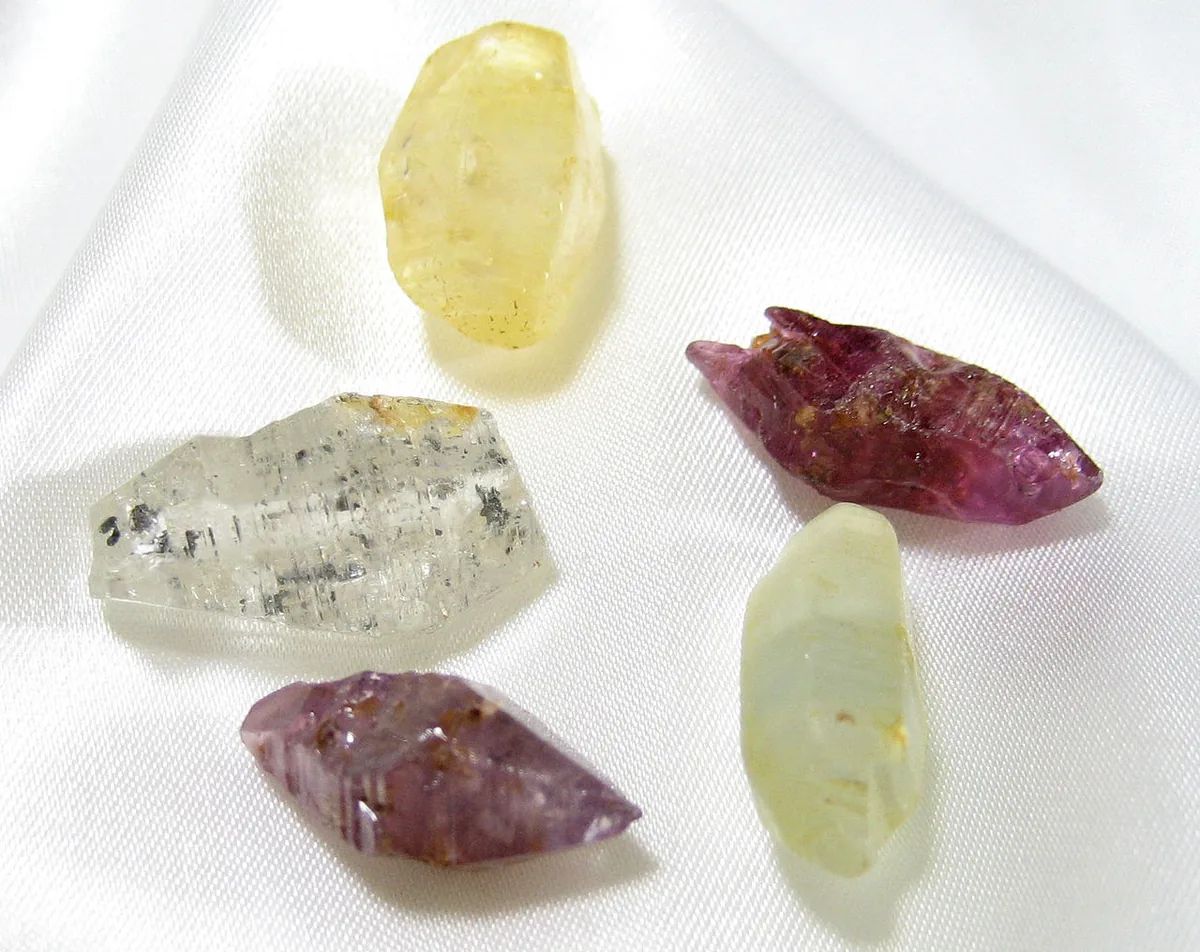
Corundum (Al₂O₃) is the parent species of two of the most prized gem minerals on Earth — ruby (red, chromium-colored) and sapphire (every other color: blue, pink, yellow, green, padparadscha). It is the second-hardest natural mineral after diamond, with a Mohs hardness of 9, and crystallizes in the trigonal system as hexagonal prisms, barrels, and tabular crystals.
Corundum (Al₂O₃) is the parent species of two of the most prized gem minerals on Earth — ruby (red, chromium-colored) and sapphire (every other color: blue, pink, yellow, green, padparadscha). It is the second-hardest natural mineral after diamond, with a Mohs hardness of 9, and crystallizes in the trigonal system as hexagonal prisms, barrels, and tabular crystals. Mogok (Myanmar) and Sri Lanka are the historical world standards; Yunnan hosts modest Chinese deposits.
Corundum is a parent species — the following named varieties differ in color or chemistry but share the same fundamental mineralogy.
Ruby(u7ea2u5b9du77f3)
red
Chromium-bearing red corundum variety; one of the four cardinal gems.
Sapphire(u84ddu5b9du77f3)
blue and other non-red colors
Iron- and titanium-bearing corundum, traditionally blue but also yellow, pink, green, etc.
Star Sapphire(u661fu5149u84ddu5b9du77f3)
asterism
Sapphire showing six-rayed star asterism due to oriented rutile inclusions.
Padparadscha(u5e15u5e15u62c9u6070)
pink-orange
Rare pink-orange sapphire variety; named after lotus blossom in Sinhalese.
About Corundum
Corundum belongs to the oxide class in the corundum group and has the chemical formula Al2O3. It crystallizes in the trigonal system and is one of the most visually varied minerals in the collector market.
Identification & care
Specimens usually show bipyramidal, tabular, barrel-shaped prisms; massive (emery). Its color range is broad, including colorless, gray, blue (sapphire), red (ruby), pink, yellow, orange, green, and purple. The luster is adamantine to vitreous, the streak is white, and specimens range from transparent to opaque. The cleavage is none (parting on {0001} and {1011}). The fracture is conchoidal, which aids identification.
Collector context
Collector notes
Among collectors of crystallized species, Corundum is a recognized reference. Corundum is widely represented across Chinese provinces, including Fujian, Anhui, Hebei, Guangxi.
Frequently asked questions
What is Corundum?
Corundum has the chemical formula Al2O3, crystallises in the Trigonal system, has a Mohs hardness of 9. Corundum is an oxide mineral prized by collectors for its exceptional color range, with known Chinese sources.
What is the chemical formula of Corundum?
The chemical formula of Corundum is Al2O3.
What crystal system does Corundum belong to?
Corundum crystallises in the Trigonal crystal system.
Our inventory is one-of-a-kind and turns over quickly. Tell us what you're after — species, size, budget — and we'll notify you when a matching Corundum arrives from our sourcing network.
We use a small set of cookies (analytics, checkout, chat) to keep the site working and understand how visitors use it. Checkout-essential cookies are always loaded. Privacy policy