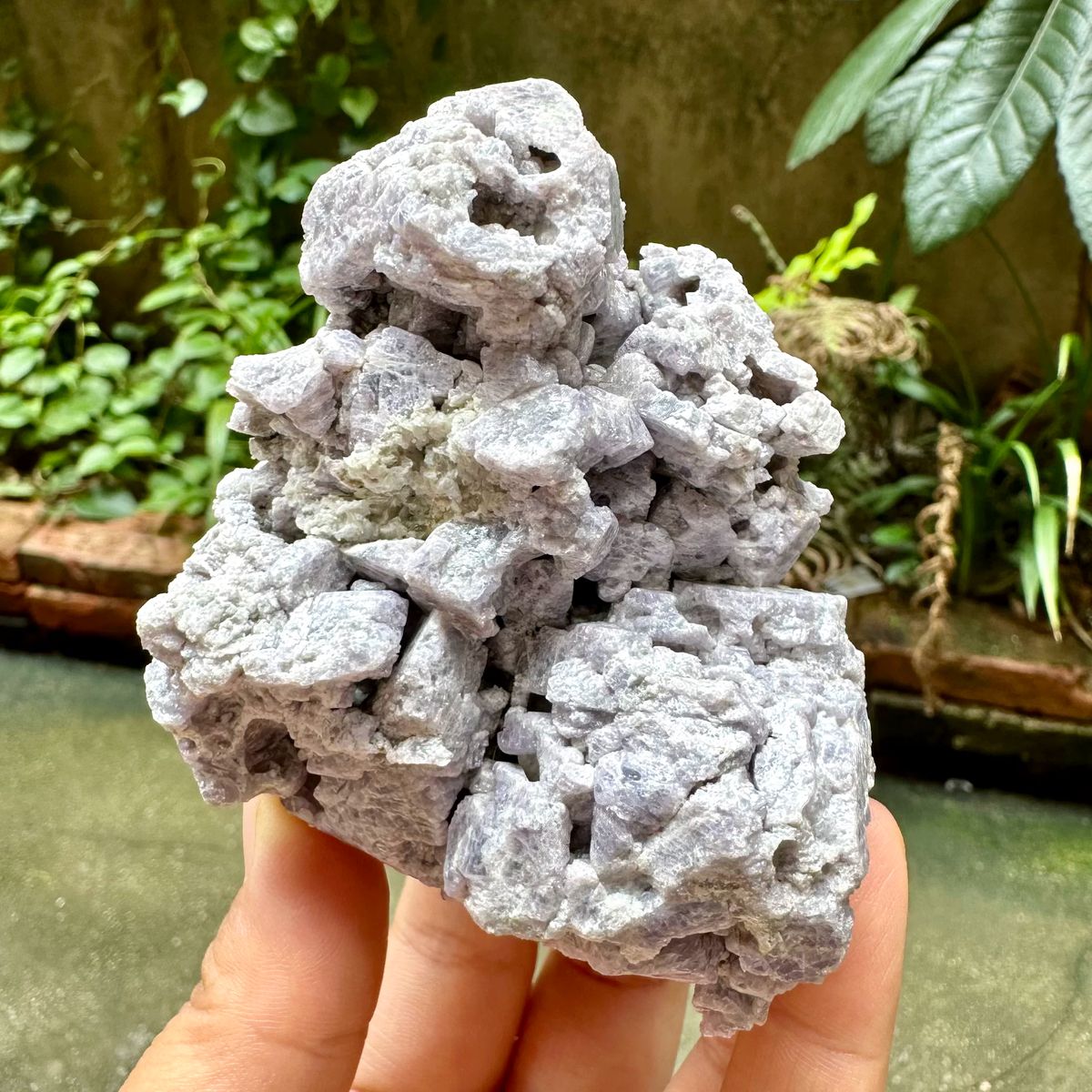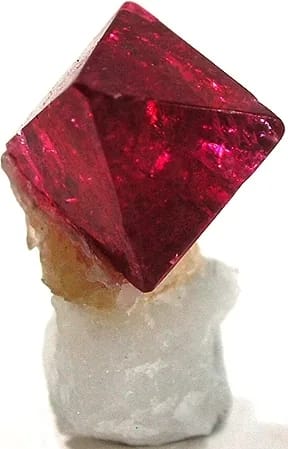
Crystal Structure
Cubic close-packed O²⁻; Mg in tetrahedral, Al in octahedral.
Elemental Composition (by mass)
| Element | Mass % | Visual |
|---|---|---|
| O Oxygen | 44.98% | |
| Al Aluminum | 37.93% | |
| Mg Magnesium | 17.08% |
Computed from simplified end-member formula. Solid-solution series, water content, and trace substitutions cause real-world variation.
IMA Abbreviation (Whitney-Evans 2010)
Spl
→ Spinel
Mg-Al oxide
Standard symbol from American Mineralogist (Whitney & Evans, 2010). Used in thin-section labeling, phase diagrams, and IMA-style species records.
Pronunciation
/spɪˈnɛl/
↔ spih-NELL
two syllables (Latin spinella)
Lapidary & Faceting Recommendations
Recommended cut:
cushion
Also seen:
oval, round brilliant, pear
Typical yield:
35% of rough
Isotropic — no pleochroism concerns. Singly refractive gives diamond-like brilliance.
Birthstone & Anniversary Gift Reference
August (zodiac) — zodiac: Leo / Virgo
› Full birthstones registry
UV Fluorescence
SW (254 nm)
—
none
LW (365 nm)
Red
strong
Cr-bearing red/pink spinel fluoresces strongly LW red.
SW = shortwave (germicidal lamp). LW = longwave (blacklight). Response varies with locality, trace impurities, and treatment.
Famous specimens of this species
Black Prince's Ruby — ~170 ct
Actually a red spinel, not a ruby. Set in the Imperial State Crown above Cullinan II.
Origin: Badakhshan, Afghanistan. Now at: British Crown Jewels. Recorded before 1367.
Timur Ruby — 352.5 ct
Another famous "ruby" that is actually red spinel. Bears Persian inscriptions of past owners.
Origin: Badakhshan, Afghanistan. Now at: British Crown Jewels. Recorded pre-1612.
› Browse all famous specimens
Tenacity
Behavior:
brittle
Under stress:
Shatters under blow
No cleavage; brittle fracture.
Luster
vitreous
Glass-like brightness.
Color Cause (Chromophore)
Chromophore:
Cr³⁺ / Fe³⁺
Mechanism:
idiochromatic
Color produced:
red / blue / pink
Red spinel: Cr (similar mechanism to ruby). Blue/black: Fe.
Diaphaneity (Transparency)
transparent
Highest-quality spinel rivals corundum in transparency.
Type Locality
Lake Manyara — Tanzania
Described 1546 by Latin "spinella"
› Browse all type localities
Specific Gravity
3.58–3.61
g/cm³
medium
Lighter than corundum — important separation tool.
For comparison: water = 1.00, glass ≈ 2.5, quartz = 2.65, corundum ≈ 4.00, galena ≈ 7.50, gold ≈ 19.3.
Synthetics & Imitations
Lab-grown methods
Verneuil flame fusion 1908 · Verneuil
Common in jewelry as birthstone simulant.
Flux growth 1965 · Chatham
Less common — rare to find as gem-grade flux spinel.
Common imitations
Glass
Color matches; lower RI, bubbles.
Synthetic corundum
Verneuil synthetic ruby/sapphire often sold as "spinel" colors.
Geological Setting
Mogok (Burma) red/pink spinel from contact-metamorphic marbles. Tajik and Vietnamese pink spinel similar.
Treatments & Enhancements
(generally untreated)—stable· detection: n/a
Spinel is one of the few important gems that is essentially never treated. Marketed as "natural untreated".
As a buyer: request written disclosure of treatments and confirm whether the price reflects treated or untreated material.
Characteristic Inclusions
Octahedral crystalssolid★ diagnostic
Smaller spinel octahedra arranged in trails or "fingerprints" — Burmese diagnostic.
Apatite needlessolid
Hexagonal apatite prisms common in pink/red spinel.
★ Diagnostic inclusions are characteristic enough to help identify origin or species under 10× loupe.
Twinning Laws
Spinel lawcontact
Twin plane {111} — flattened triangular crystals. Eponymous twin law for the cubic system.
Formation eraHigh-T metamorphic + magmatic; Burmese spinels Cenozoic uplift.
Cleavage & Fracture
Cleavage:
none — (parting on {111})
Fracture:
conchoidal
Parting can mimic cleavage in heavily twinned material.
Market availability: Uncommon
Found at major shows and select dealers. Quality varies by locality.
Collector tier: Cabinet Classic
Display species collected for cabinet presentation, with specimens recorded from named localities.
Mohs 7.5–8
Vickers (~) 1650 HV
Knoop (~) 1340 HK
Nickel–Strunz
4.BB.05Dana
07.02.01.01Geological setting
Placer
Element composition by mass
Formula: MgAl₂O₄ · molar mass: 142.27 g/mol
| O | 44.98% | |
| Al | 37.93% | |
| Mg | 17.08% |
Computed from atomic weights (IUPAC 2021). Site-occupancy groups (Fe,Mn) split equally.
Mohs Hardness
7.5–8
Spinel sits at 7.5–8 on the Mohs scale — very hard; only diamond or corundum scratches it.
Colors:
Streak
White
White
Crystal system
Isometric (Cubic)
Isometric (Cubic)
Type localitySri Lanka (Ceylon)
Discovery First described 1779 by Jean-Baptiste Romé de l'Isle
Oxides & HydroxidesOxides
TL;DR · 1 min read
Spinel (MgAl₂O₄) is the parent species of the spinel oxide group and a cherished gem mineral for centuries. Famous historical "rubies" turned out to be red spinels — including the "Black Prince's Ruby" in the British Crown Jewels and Russia's "Tamerlane Ruby.
Spinel (MgAl₂O₄) is the parent species of the spinel oxide group and a cherished gem mineral for centuries. Famous historical “rubies” turned out to be red spinels — including the “Black Prince’s Ruby” in the British Crown Jewels and Russia’s “Tamerlane Ruby.” Modern gem spinels come from Mogok (Myanmar) and Mahenge (Tanzania), with bright red, pink, and cobalt-blue varieties.