
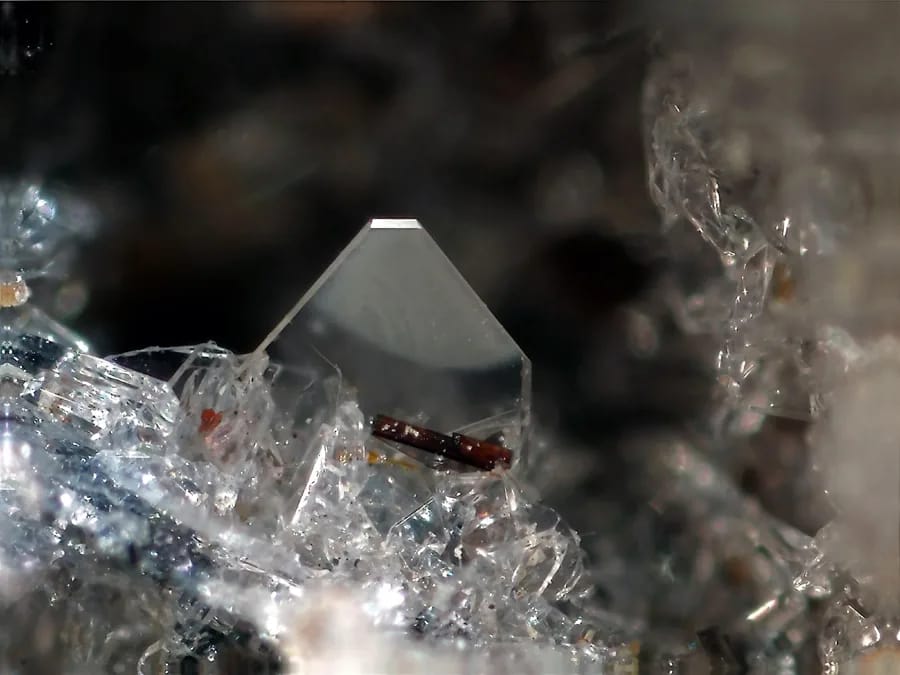
Crystal Structure
Mg end-member of olivine.
Elemental Composition (by mass)
| Element | Mass % | Visual |
|---|---|---|
| O Oxygen | 45.49% | |
| Mg Magnesium | 34.55% | |
| Si Silicon | 19.96% |
Computed from simplified end-member formula. Solid-solution series, water content, and trace substitutions cause real-world variation.
IMA Abbreviation (Whitney-Evans 2010)
Fo
→ Forsterite
Mg end-member
Standard symbol from American Mineralogist (Whitney & Evans, 2010). Used in thin-section labeling, phase diagrams, and IMA-style species records.
Pronunciation
/ˈfɔːrstəraɪt/
↔ FOR-stuh-rite
for J. Forster
Market availability: Uncommon
Found at major shows and select dealers. Quality varies by locality.
PolymorphsShares the formula
Mg2SiO4 with: Wadsleyite · Ringwoodite — same chemistry, different crystal structure.Mohs 6.5–7
Vickers (~) 1400 HV
Knoop (~) 1100 HK
Geological setting
VolcanicKimberlite
Element composition by mass
Formula: Mg₂SiO₄ · molar mass: 140.69 g/mol
| O | 45.49% | |
| Mg | 34.55% | |
| Si | 19.96% |
Computed from atomic weights (IUPAC 2021). Site-occupancy groups (Fe,Mn) split equally.
GroupOlivine Group
Related members: Fayalite
Mohs Hardness
6.5–7
Forsterite sits at 6.5–7 on the Mohs scale — harder than glass; scratches steel.
Colors:
Streak
White
White
Crystal system
Orthorhombic
Orthorhombic
Type localityMt. Vesuvius, Naples, Italy
Discovery First described 1824 by Armand Lévy (Italy)
SilicatesSilicates (Nesosilicates)
TL;DR · 1 min read
Forsterite (Mg₂SiO₄) is the magnesium end-member of the olivine group and one of the most abundant minerals in Earth's upper mantle. The gem variety peridot supplies the August birthstone.
Forsterite (Mg₂SiO₄) is the magnesium end-member of the olivine group and one of the most abundant minerals in Earth’s upper mantle. The gem variety peridot supplies the August birthstone. Forsterite is a diagnostic kimberlite indicator mineral — co-occurring with pyrope garnet and ilmenite as evidence of mantle-sourced magma at diamond-bearing localities like Mengyin (Shandong) and Wafangdian (Liaoning).