
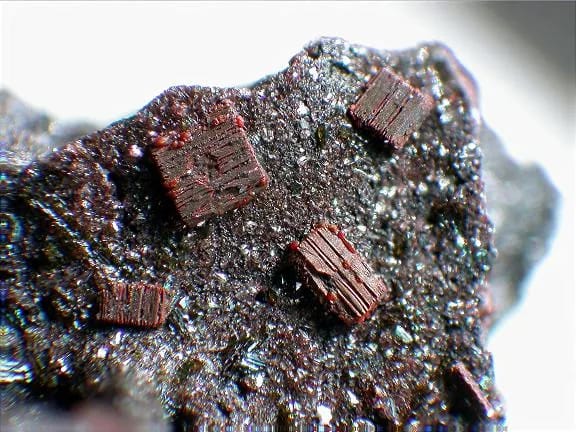
Crystal Structure
Fe end-member of olivine.
Elemental Composition (by mass)
| Element | Mass % | Visual |
|---|---|---|
| Fe Iron | 54.81% | |
| O Oxygen | 31.41% | |
| Si Silicon | 13.78% |
Computed from simplified end-member formula. Solid-solution series, water content, and trace substitutions cause real-world variation.
IMA Abbreviation (Whitney-Evans 2010)
Fa
→ Fayalite
Fe end-member
Standard symbol from American Mineralogist (Whitney & Evans, 2010). Used in thin-section labeling, phase diagrams, and IMA-style species records.
Pronunciation
/ˈfaɪəlaɪt/
↔ FY-uh-lite
for Fayal Island, Azores
Magnetism
Category:
weakly paramagnetic
Test result:
Strongest olivine response
Fe-end member of olivine.
Test with rare-earth magnet (N42 or N52 neodymium). Suspend specimen on thread for sensitive paramagnetic detection. Diamagnetic minerals are weakly repelled (visible only with strong magnets like bismuth).
Mohs 6.5–7
Vickers (~) 1400 HV
Knoop (~) 1100 HK
Geological setting
VolcanicPlutonic igneous
Element composition by mass
Formula: Fe₂SiO₄ · molar mass: 203.77 g/mol
| Fe | 54.81% | |
| O | 31.41% | |
| Si | 13.78% |
Computed from atomic weights (IUPAC 2021). Site-occupancy groups (Fe,Mn) split equally.
GroupOlivine Group
Related members: Forsterite
Mohs Hardness
6.5–7
Fayalite sits at 6.5–7 on the Mohs scale — harder than glass; scratches steel.
Colors:
Streak
White
White
Crystal system
Orthorhombic
Orthorhombic
Type localityFayal Island, Azores, Portugal
Discovery First described 1840 by Christian Gottlob Gmelin (Portugal)
SilicatesSilicates (Nesosilicates)
TL;DR · 1 min read
Fayalite (Fe₂SiO₄) is the iron end-member of the olivine group, completing the forsterite-fayalite series. Its dark green to brown color comes from divalent iron substituting for magnesium.
Fayalite (Fe₂SiO₄) is the iron end-member of the olivine group, completing the forsterite-fayalite series. Its dark green to brown color comes from divalent iron substituting for magnesium. Fayalite-rich olivines occur in Fe-rich igneous rocks (gabbros, anorthosites) and fayalitic slags from historical iron smelting. The Faial Island (Azores) type-locality and lunar mare basalts are classic occurrences.