
Elemental Composition (by mass)
| Element | Mass % | Visual |
|---|---|---|
| O Oxygen | 44.02% | |
| Al Aluminum | 29.05% | |
| Si Silicon | 13.44% | |
| Fe Iron | 13.36% | |
| H Hydrogen | 0.12% |
Computed from simplified end-member formula. Solid-solution series, water content, and trace substitutions cause real-world variation.
IMA Abbreviation (Whitney-Evans 2010)
St
→ Staurolite
Metamorphic index mineral
Standard symbol from American Mineralogist (Whitney & Evans, 2010). Used in thin-section labeling, phase diagrams, and IMA-style species records.
Pronunciation
/ˈstɔːrəlaɪt/
↔ STOR-uh-lite
Greek "cross stone"
Tenacity
Behavior:
brittle
Under stress:
Shatters
Hard twinned crystals.
Luster
vitreous→sub-vitreous
Twinned crystals often dull on weathered surfaces.
Diaphaneity (Transparency)
translucent-to-opaque
Twinned "fairy stones" typically opaque to subtranslucent.
Type Locality
St. Gotthard — Switzerland
Described 1792 by Saussure
› Browse all type localities
Specific Gravity
3.65–3.83
g/cm³
medium
Fairy stone twins — characteristic SG.
For comparison: water = 1.00, glass ≈ 2.5, quartz = 2.65, corundum ≈ 4.00, galena ≈ 7.50, gold ≈ 19.3.
Geological Setting
Famous Fairy Stones from Virginia and Russia.
Twinning Laws
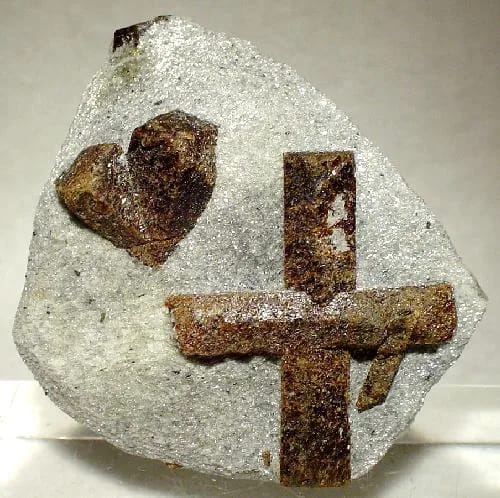
Cross twin (60°)penetration
St. Andrew's cross — two prisms at 60°. Less common.
Cross twin (90°)penetration
Latin cross — two prisms at 90°. Famous from Fairy Stones, Virginia.
Market availability: Uncommon
Found at major shows and select dealers. Quality varies by locality.
Collector tier: Solid Display
Reliable mid-tier display species. Easy to find in well-formed examples; broad locality diversity.
Mohs 7–7.5
Vickers (~) 1400 HV
Knoop (~) 1100 HK
Nickel–Strunz
9.AF.30Dana
52.02.09.01Geological setting
Metamorphic
Element composition by mass
Formula: Fe₂Al₉(Si,Al)₄O₂₂(OH)₂ · molar mass: 850.65 g/mol
| O | 45.14% | |
| Al | 34.89% | |
| Fe | 13.13% | |
| Si | 6.6% | |
| H | 0.24% |
Computed from atomic weights (IUPAC 2021). Site-occupancy groups (Fe,Mn) split equally.
Mohs Hardness
7–7.5
Staurolite sits at 7–7.5 on the Mohs scale — harder than glass; scratches steel.
Colors:
Streak
White to gray
White to gray
Crystal system
Monoclinic
Monoclinic
Pronunciation/ˈstɔːrəlaɪt/
Type localityMt. Saint-Yrieix, Limoges, France
SilicatesSilicates (Nesosilicates)
TL;DR · 1 min read
Staurolite (Fe₂Al₉(Si,Al)₄O₂₂(OH)₂) is a metamorphic iron-aluminum silicate famous for its cruciform "fairy cross" twin crystals — interpenetrating twin pairs at 90° (Greek cross) or 60° (St. Andrew's cross) angles.
Staurolite (Fe₂Al₉(Si,Al)₄O₂₂(OH)₂) is a metamorphic iron-aluminum silicate famous for its cruciform “fairy cross” twin crystals — interpenetrating twin pairs at 90° (Greek cross) or 60° (St. Andrew’s cross) angles. The name comes from Greek “stauros” (cross). Brittany (France) and the Russian Pestrik locality produce the most iconic crosses, while Fannin County (Georgia, USA) supplies abundant collector specimens. Staurolite is a diagnostic indicator of medium-grade regional metamorphism.