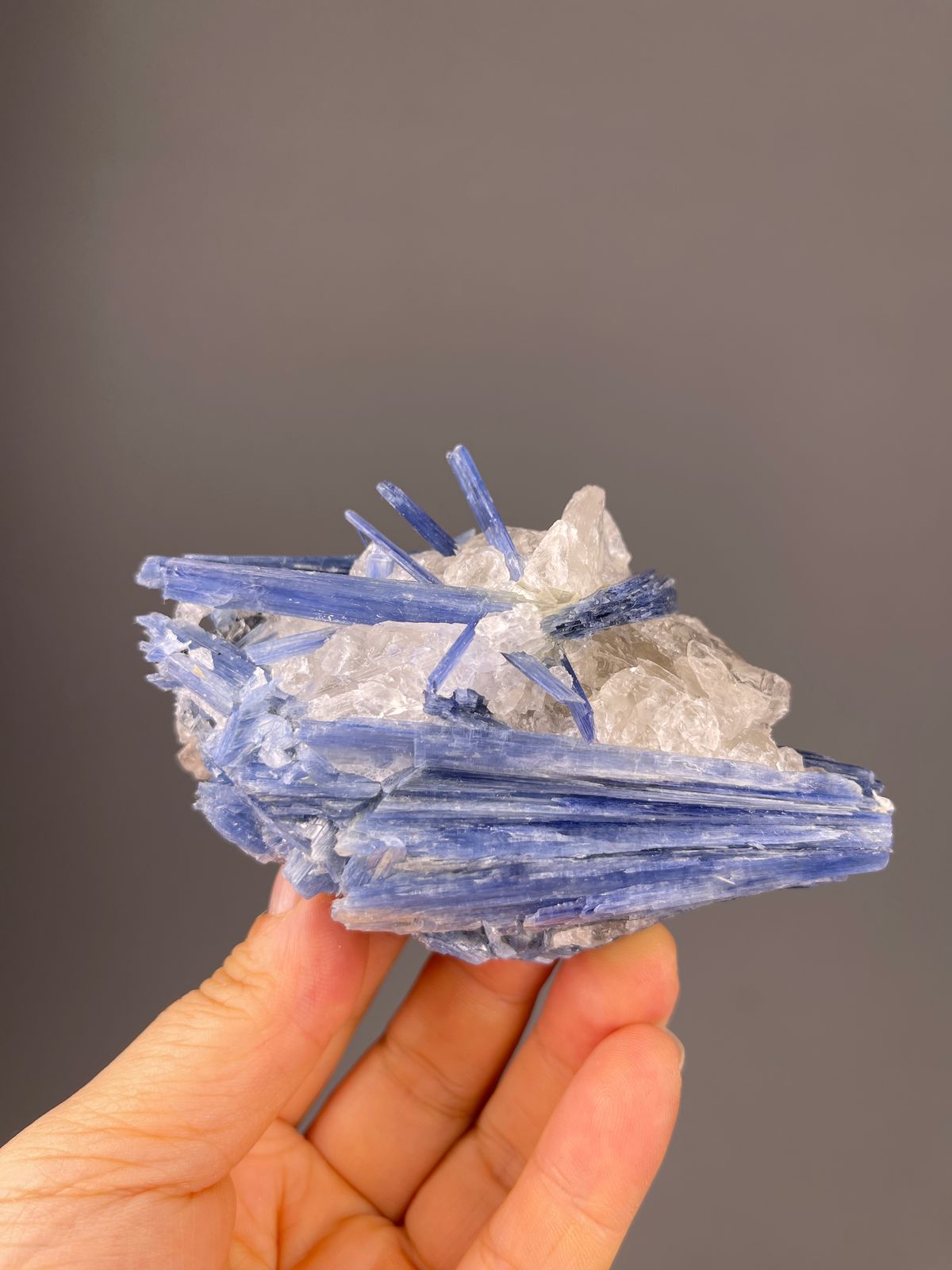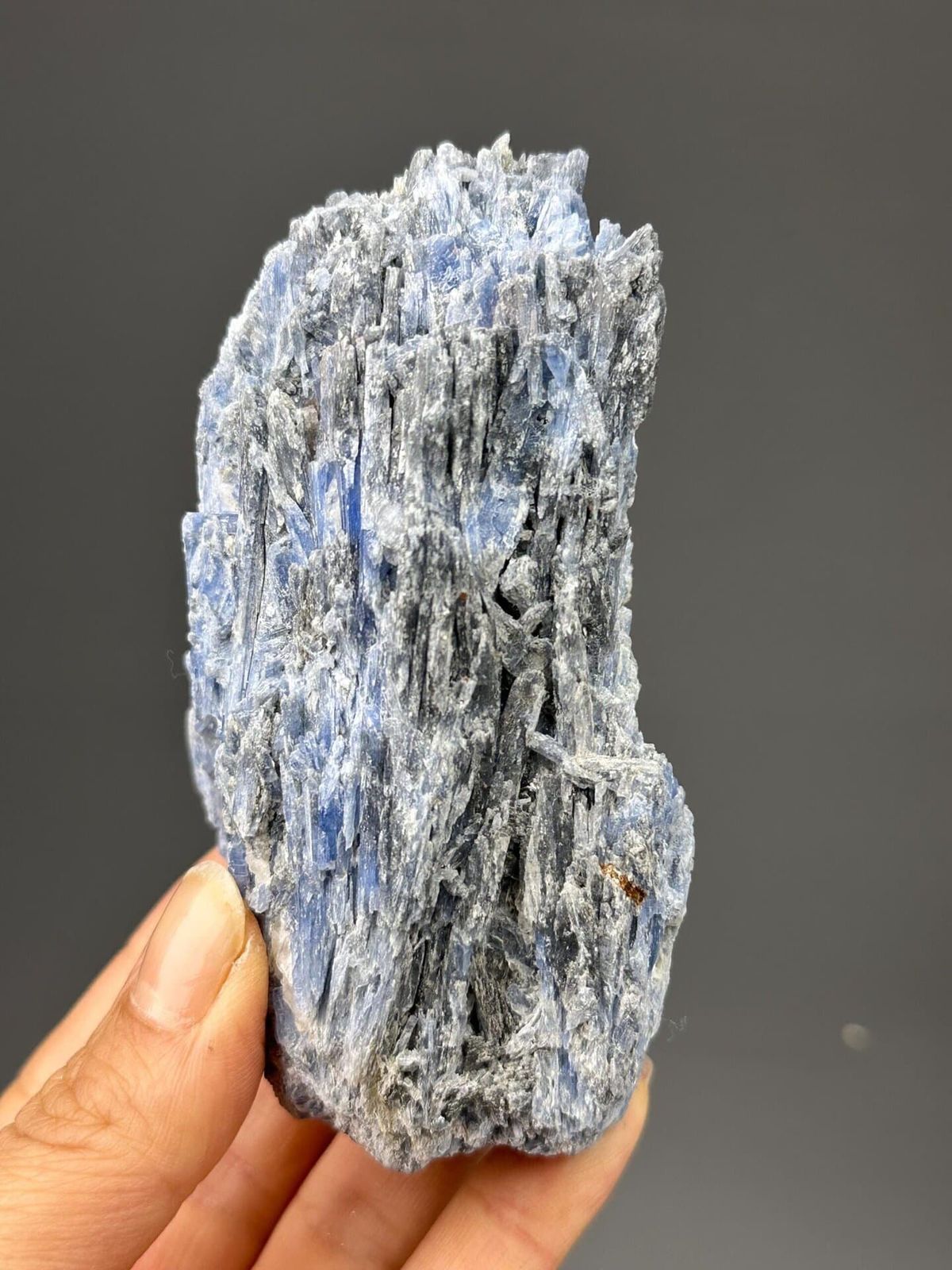
Crystal Structure
Triclinic Al₂SiO₅ — high-pressure polymorph.
Elemental Composition (by mass)
| Element | Mass % | Visual |
|---|---|---|
| O Oxygen | 49.37% | |
| Al Aluminum | 33.30% | |
| Si Silicon | 17.33% |
Computed from simplified end-member formula. Solid-solution series, water content, and trace substitutions cause real-world variation.
IMA Abbreviation (Whitney-Evans 2010)
Ky
→ Kyanite
Al₂SiO₅ polymorph
Standard symbol from American Mineralogist (Whitney & Evans, 2010). Used in thin-section labeling, phase diagrams, and IMA-style species records.
Pronunciation
/ˈkaɪənaɪt/
↔ KY-uh-nite
Greek "blue"
Tenacity
Behavior:
brittle
Under stress:
Splinters along blade
Distinct hardness in different directions (4-5 along, 6-7 across).
Luster
vitreous→pearly
Pearly along bladed cleavage.
Color Cause (Chromophore)
Chromophore:
Fe-Ti charge transfer
Mechanism:
intervalent CT
Color produced:
blue
Same blue mechanism as sapphire.
Diaphaneity (Transparency)
transparent-to-translucent
Bladed crystals; transparency varies along blade.
Type Locality
St. Gotthard — Switzerland
Described 1789 by Werner
› Browse all type localities
Specific Gravity
3.55–3.66
g/cm³
medium
High-pressure metamorphic Al silicate.
For comparison: water = 1.00, glass ≈ 2.5, quartz = 2.65, corundum ≈ 4.00, galena ≈ 7.50, gold ≈ 19.3.
Geological Setting
Environment:
metamorphic
Host rock:
mica schist, gneiss, eclogite
Companions:
Indicator of high-pressure metamorphism. Brazilian kyanite is the gem-quality material.
Characteristic Inclusions
Color zoninggrowth-pattern
Sharp blue/colorless zoning along blade length.
★ Diagnostic inclusions are characteristic enough to help identify origin or species under 10× loupe.
Pleochroism (trichroic)
Axis a
colorless
Axis b
violet-blue
Axis c
cobalt blue
Strength: strong
Bladed habit makes the strongest color visible along {010}.
Cleavage & Fracture
Cleavage:
perfect 2 directions {100}/{010}
Fracture:
splintery
Bladed crystals; perfect cleavage along length.
Market availability: Uncommon
Found at major shows and select dealers. Quality varies by locality.
Collector tier: Solid Display
Reliable mid-tier display species. Easy to find in well-formed examples; broad locality diversity.
PolymorphsShares the formula
Al2SiO5 with: Andalusite · Sillimanite — same chemistry, different crystal structure.Mohs 4.5–7 (anisotropic)
Vickers (~) 820 HV
Knoop (~) 870 HK
Nickel–Strunz
9.AF.15Dana
52.02.02c.04Geological setting
PegmatiteMetamorphic
Element composition by mass
Formula: Al₂SiO₅ · molar mass: 162.04 g/mol
| O | 49.37% | |
| Al | 33.3% | |
| Si | 17.33% |
Computed from atomic weights (IUPAC 2021). Site-occupancy groups (Fe,Mn) split equally.
Mohs Hardness
4.5–7 (anisotropic)
Kyanite sits at 4.5–7 (anisotropic) on the Mohs scale — just hard enough to scratch glass.
Colors:
Streak
White
White
Crystal system
Triclinic
Triclinic
Pronunciation/ˈkaɪənaɪt/
Type localityPizzo Forno, Ticino, Switzerland
SilicatesSilicates (Nesosilicates)
TL;DR · 1 min read
Kyanite (Al₂SiO₅) is a triclinic aluminum silicate famous for its bladed habit and intense blue color, ranging from sky-blue to deep sapphire-blue. It is one of three Al₂SiO₅ polymorphs (with andalusite and sillimanite) — each forming at different metamorphic pressure-temperature conditions.
Kyanite (Al₂SiO₅) is a triclinic aluminum silicate famous for its bladed habit and intense blue color, ranging from sky-blue to deep sapphire-blue. It is one of three Al₂SiO₅ polymorphs (with andalusite and sillimanite) — each forming at different metamorphic pressure-temperature conditions. Kyanite is the diagnostic high-pressure indicator. Its anisotropic hardness (4.5 along the c-axis, 7 across) is unusual among minerals and earned it the historical name “disthene” (two strengths).