
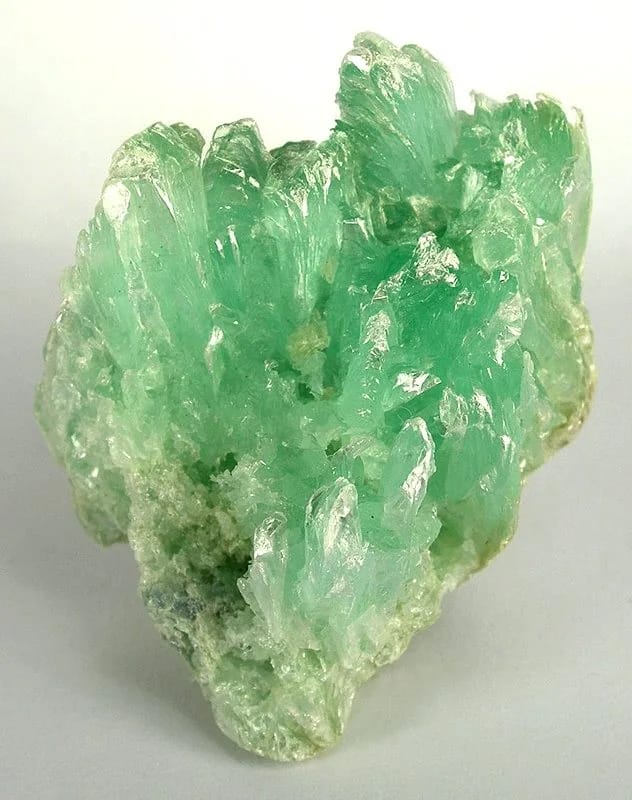
Crystal Structure
2:1 phyllosilicate — no interlayer cations (hence softness).
Elemental Composition (by mass)
| Element | Mass % | Visual |
|---|---|---|
| O Oxygen | 46.07% | |
| Si Silicon | 32.35% | |
| Mg Magnesium | 21.00% | |
| H Hydrogen | 0.58% |
Computed from simplified end-member formula. Solid-solution series, water content, and trace substitutions cause real-world variation.
IMA Abbreviation (Whitney-Evans 2010)
Tlc
→ Talc
Soft phyllosilicate
Standard symbol from American Mineralogist (Whitney & Evans, 2010). Used in thin-section labeling, phase diagrams, and IMA-style species records.
Pronunciation
/tælk/
↔ talk
Arabic talq
Tenacity
Behavior:
flexible
Under stress:
Soft, soapy
Mohs 1 — softest mineral; bends and crumbles.
Luster
pearly→greasy
Soapy feel; pearly to greasy.
Diagnostic Field Tests
Hardness→ Mohs 1 — softest mineral; greasy feel
Marks paper; soapy feel.
⚠ Use dilute HCl (~10%) only on inconspicuous spots; rinse promptly. Smell-tests should be brief and ventilated. Taste-test ONLY halite/sylvite — never lead, arsenic, or sulfur minerals.
Mohs 1
Vickers (~) 1 HV
Knoop (~) 32 HK
Geological setting
Hydrothermal
Element composition by mass
Formula: Mg₃Si₄O₁₀(OH)₂ · molar mass: 379.26 g/mol
| O | 50.62% | |
| Si | 29.62% | |
| Mg | 19.23% | |
| H | 0.53% |
Computed from atomic weights (IUPAC 2021). Site-occupancy groups (Fe,Mn) split equally.
Mohs Hardness
1
Talc sits at 1 on the Mohs scale — soft enough to be scratched by a fingernail.
Colors:
Streak
White
White
Crystal system
Monoclinic
Monoclinic
SilicatesSilicates (Phyllosilicates)
TL;DR · 1 min read
Talc (Mg₃Si₄O₁₀(OH)₂) is the softest mineral on the Mohs scale (1) — defining the bottom of the hardness reference. Its greasy feel and white color are diagnostic.
Talc (Mg₃Si₄O₁₀(OH)₂) is the softest mineral on the Mohs scale (1) — defining the bottom of the hardness reference. Its greasy feel and white color are diagnostic. Talc forms by hydrothermal alteration of magnesium-rich rocks (peridotite, dolomite). Massive talc (“steatite” or “soapstone”) has been carved since prehistory. Major industrial source for cosmetics, ceramics, paper.