
Crystal Structure
Monoclinic feldspar with K in 9-coord channel sites.
Elemental Composition (by mass)
| Element | Mass % | Visual |
|---|---|---|
| O Oxygen | 45.99% | |
| Si Silicon | 30.27% | |
| K Potassium | 14.05% | |
| Al Aluminum | 9.69% |
Computed from simplified end-member formula. Solid-solution series, water content, and trace substitutions cause real-world variation.
IMA Abbreviation (Whitney-Evans 2010)
Or
→ Orthoclase
K-feldspar; also Kfs
Standard symbol from American Mineralogist (Whitney & Evans, 2010). Used in thin-section labeling, phase diagrams, and IMA-style species records.
Pronunciation
/ˈɔːrθəkleɪs/
↔ OR-thuh-clays
Greek "straight break"
Pseudomorph Relationships
Replaced by — this mineral commonly becomes:
→ Cassiterite replacement
Tin replaces K-feldspar in greisen — preserves euhedral feldspar crystals as cassiterite.
Cornwall; Erzgebirge.
A pseudomorph (Greek "false form") is a mineral with the external shape of another species — the chemistry has changed but the crystal habit is inherited.
Tenacity
Behavior:
brittle
Under stress:
Cleaves perpendicular
K-feldspar.
Luster
vitreous→pearly
Pearly schiller in adularia/moonstone.
Diaphaneity (Transparency)
translucent
Gem moonstone is translucent.
Type Locality
Karlsbad / Carlsbad — Czech Republic
Described 1801 by Haüy / Breithaupt 1823
› Browse all type localities
Specific Gravity
2.55–2.58
g/cm³
light
K-feldspar, lower end of group.
For comparison: water = 1.00, glass ≈ 2.5, quartz = 2.65, corundum ≈ 4.00, galena ≈ 7.50, gold ≈ 19.3.
Twinning Laws
Carlsbad lawpenetration
Most common K-feldspar twin. Classic prismatic twins from Karlovy Vary (Carlsbad), Bohemia.
Baveno lawcontact
"Knee" twin — Baveno granite quarries, Italy.
Manebach lawcontact
Diamond-shaped flat twins along basal plane.
Cleavage & Fracture
Cleavage:
good 2 directions 90° {001}/{010}
Fracture:
uneven / conchoidal
Cleavages are perpendicular — distinguishes from plagioclase.
Market availability: Common
Widely available in most dealer stocks. Specimens span all price tiers.
Collector tier: Solid Display
Reliable mid-tier display species. Easy to find in well-formed examples; broad locality diversity.
PolymorphsShares the formula
KAlSi3O8 with: Microcline · Sanidine — same chemistry, different crystal structure.Mohs 6–6.5
Vickers (~) 820 HV
Knoop (~) 870 HK
Nickel–Strunz
9.FA.30Dana
76.01.03.02Geological setting
Plutonic igneousAlpine cleft
Element composition by mass
Formula: KAlSi₃O₈ · molar mass: 278.33 g/mol
| O | 45.99% | |
| Si | 30.27% | |
| K | 14.05% | |
| Al | 9.69% |
Computed from atomic weights (IUPAC 2021). Site-occupancy groups (Fe,Mn) split equally.
GroupFeldspar Group
Mohs Hardness
6–6.5
Orthoclase sits at 6–6.5 on the Mohs scale — just hard enough to scratch glass.
Colors:
Streak
White
White
Crystal system
Monoclinic
Monoclinic
Pronunciation/ˈɔːrθəkleɪs/
Type localityPfitsch valley, Tyrol, Austria
Discovery First described 1801 by Haüy (France)
SilicatesSilicates (Tectosilicates — Feldspars)
TL;DR · 1 min read
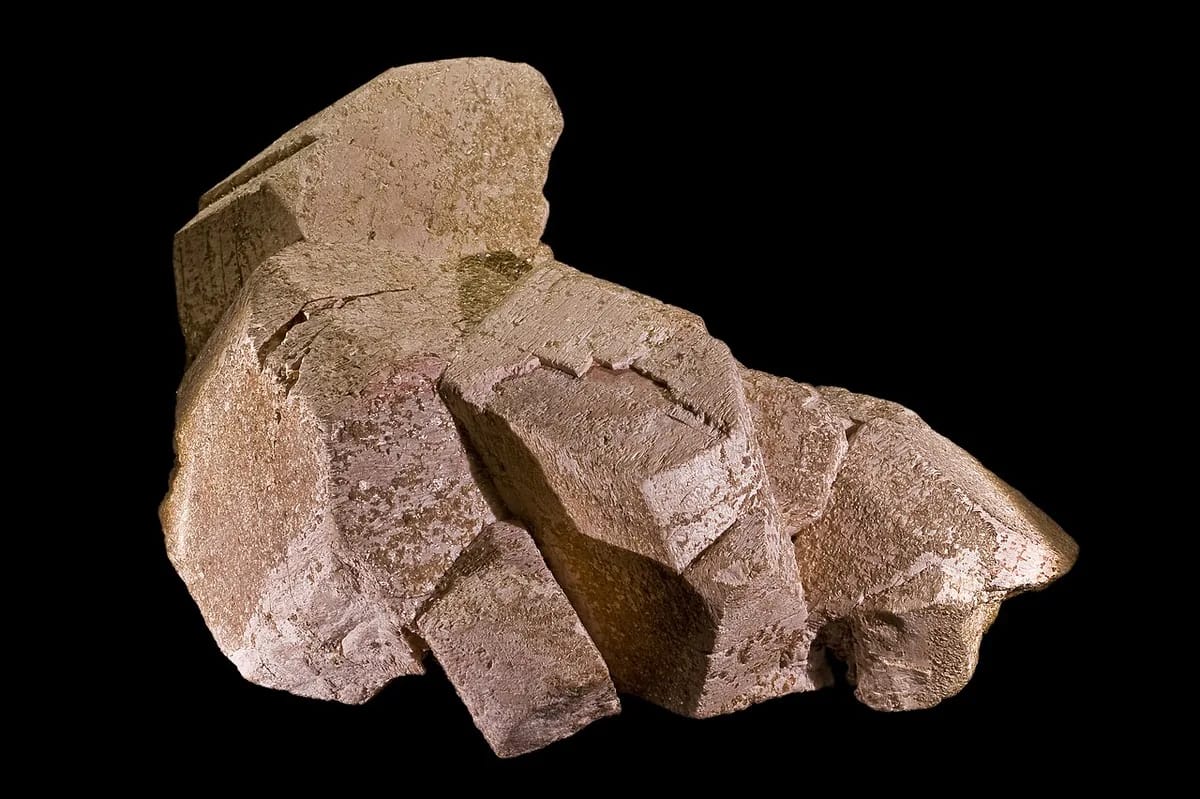
Orthoclase (KAlSi₃O₈) is the monoclinic potassium feldspar, isochemical with microcline but stable at higher temperatures. Pink Orthoclase is a defining color in Capitol Reef and Pikes Peak granites.
Orthoclase (KAlSi₃O₈) is the monoclinic potassium feldspar, isochemical with microcline but stable at higher temperatures. Pink Orthoclase is a defining color in Capitol Reef and Pikes Peak granites. Adularia (transparent variety from Alpine clefts) and moonstone (with adularescent schiller) are prized collector forms.