
Elemental Composition (by mass)
| Element | Mass % | Visual |
|---|---|---|
| O Oxygen | 45.99% | |
| Si Silicon | 30.27% | |
| K Potassium | 14.05% | |
| Al Aluminum | 9.69% |
Computed from simplified end-member formula. Solid-solution series, water content, and trace substitutions cause real-world variation.
IMA Abbreviation (Whitney-Evans 2010)
Sa
→ Sanidine
K-feldspar high-T
Standard symbol from American Mineralogist (Whitney & Evans, 2010). Used in thin-section labeling, phase diagrams, and IMA-style species records.
Pronunciation
/ˈsænɪdiːn/
↔ SAN-ih-deen
Greek sanis (board)
PolymorphsShares the formula
KAlSi3O8 with: Orthoclase · Microcline — same chemistry, different crystal structure.Mohs 6
Vickers (~) 820 HV
Knoop (~) 870 HK
Geological setting
VolcanicMetamorphic
Element composition by mass
Formula: KAlSi₃O₈ · molar mass: 278.33 g/mol
| O | 45.99% | |
| Si | 30.27% | |
| K | 14.05% | |
| Al | 9.69% |
Computed from atomic weights (IUPAC 2021). Site-occupancy groups (Fe,Mn) split equally.
GroupFeldspar Group
Mohs Hardness
6
Sanidine sits at 6 on the Mohs scale — just hard enough to scratch glass.
Colors:
Streak
White
White
Crystal system
Monoclinic
Monoclinic
SilicatesSilicates (Tectosilicates — Feldspars)
TL;DR · 1 min read
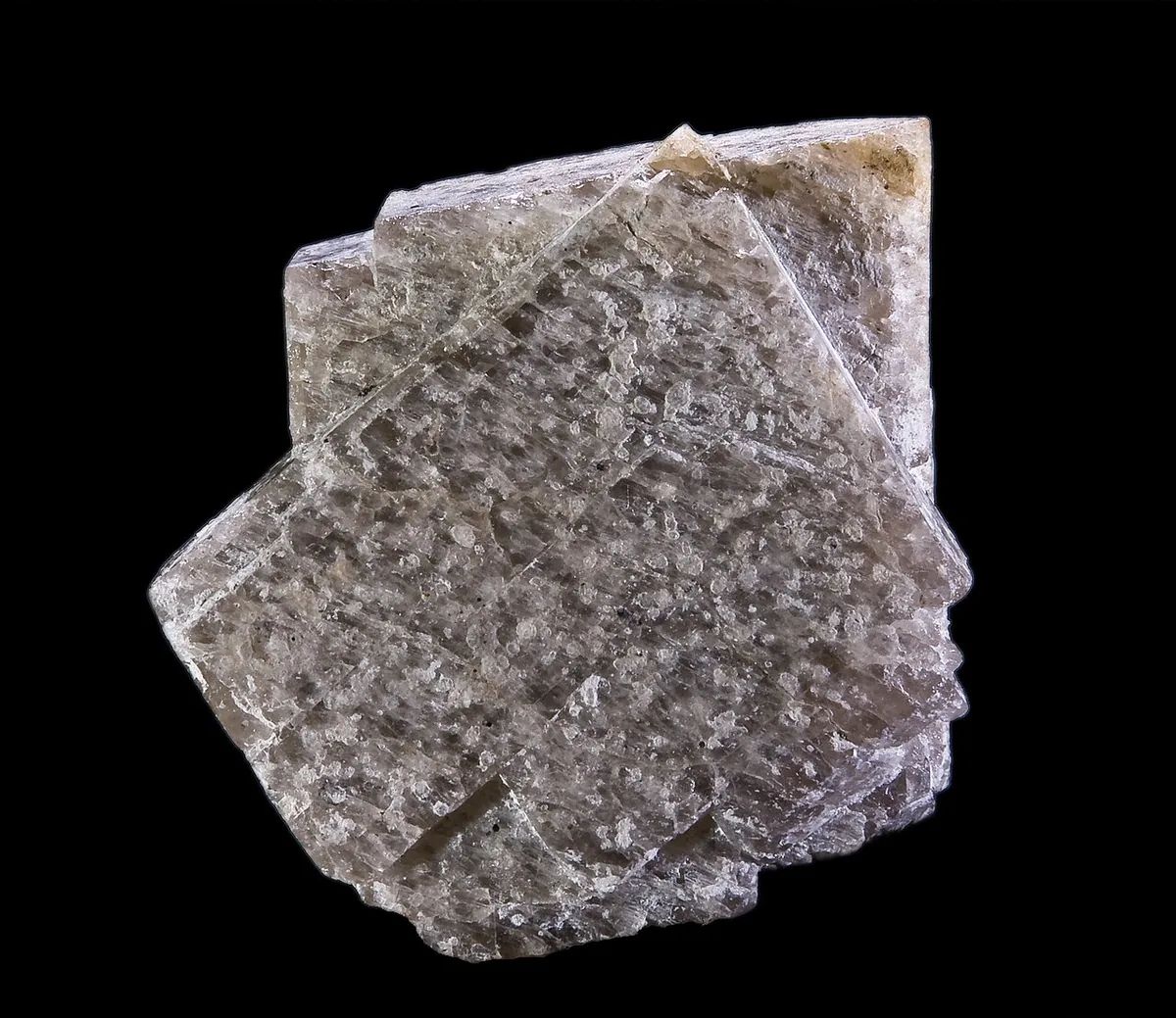
Sanidine (KAlSi₃O₈) is the high-temperature monoclinic K-feldspar polymorph that quenches into volcanic and rapidly-cooled metamorphic rocks. It typically forms glassy, transparent, tabular phenocrysts in trachyte, rhyolite, and obsidian — including the famous Drachenfels (Germany) Sanidine in trachyte and Eifel volcanic ejecta crystals.
Sanidine (KAlSi₃O₈) is the high-temperature monoclinic K-feldspar polymorph that quenches into volcanic and rapidly-cooled metamorphic rocks. It typically forms glassy, transparent, tabular phenocrysts in trachyte, rhyolite, and obsidian — including the famous Drachenfels (Germany) Sanidine in trachyte and Eifel volcanic ejecta crystals.