
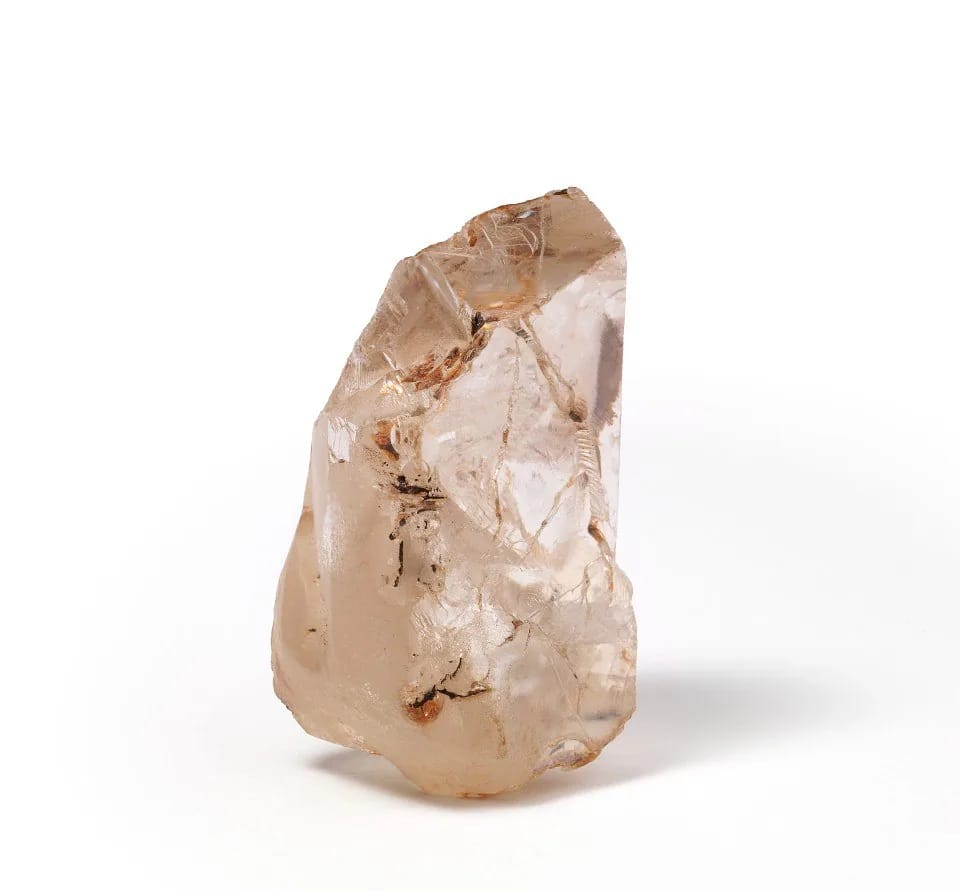
Crystal Structure
Cubic — diamond cubic lattice; sp³ C-C bonds.
Elemental Composition (by mass)
| Element | Mass % | Visual |
|---|---|---|
| C Carbon | 100.00% |
Computed from simplified end-member formula. Solid-solution series, water content, and trace substitutions cause real-world variation.
IMA Abbreviation (Whitney-Evans 2010)
Dia
→ Diamond
Carbon polymorph
Standard symbol from American Mineralogist (Whitney & Evans, 2010). Used in thin-section labeling, phase diagrams, and IMA-style species records.
Pronunciation
/ˈdaɪəmənd/
↔ DYE-uh-mund
Greek adamas (invincible)
Lapidary & Faceting Recommendations
Recommended cut:
brilliant
Also seen:
princess, emerald, oval, pear, marquise, cushion
Typical yield:
50% of rough
Maximum brilliance from RI 2.42 + dispersion 0.044 demands 57-facet round brilliant or modified versions. Octahedral rough naturally yields 2 brilliants per crystal.
Birthstone & Anniversary Gift Reference
April (modern, traditional, zodiac) — zodiac: Aries / Taurus
August (mystical) — zodiac: Leo / Virgo
Anniversary years: 10th (diamond), 60th (diamond), 75th (diamond (diamond+gold))
› Full birthstones registry
UV Fluorescence
SW (254 nm)
Blue
variable
LW (365 nm)
Blue / yellow
variable
⏱ Phosphorescence: some
~30% of diamonds fluoresce blue under LW. Type Ia diamonds with N3 centers.
SW = shortwave (germicidal lamp). LW = longwave (blacklight). Response varies with locality, trace impurities, and treatment.
Famous specimens of this species
Hope Diamond — 45.52 ct
Deep blue Type IIb diamond. Believed to be from the original Tavernier Blue. Famously associated with a "curse" of bad luck.
Origin: Kollur Mine, India. Now at: Smithsonian NMNH, Washington DC. Recorded 1666 (recorded).
Cullinan I (Great Star of Africa) — 530.4 ct
The largest of nine major stones cut from the 3106-ct rough Cullinan. Pear-shaped; set in the Sovereign's Sceptre.
Origin: Premier Mine, South Africa. Now at: British Crown Jewels (Tower of London). Recorded 1905.
Cullinan II (Second Star of Africa) — 317.4 ct
Cushion cut; set in the Imperial State Crown.
Origin: Premier Mine, South Africa. Now at: British Crown Jewels. Recorded 1905.
Koh-i-Noor — 105.6 ct
Persian "mountain of light". Recut from 186 ct original. Heavy disputed provenance.
Origin: Kollur Mine, India. Now at: British Crown Jewels. Recorded before 1304.
L'Incomparable Diamond — 407.48 ct
World's largest internally-flawless yellow diamond. Found in mine tailings by a child.
Origin: Mbuji-Mayi, DRC. Now at: Private. Recorded 1980s.
Centenary Diamond — 273.85 ct
D-Flawless. Cut by Gabi Tolkowsky over 154 days.
Origin: Premier Mine, South Africa. Now at: De Beers (custody). Recorded 1986.
Pink Star Diamond — 59.60 ct
Fancy Vivid Pink. Sold for $71.2M (Sotheby's Hong Kong) — auction record per carat.
Origin: South Africa. Now at: Sold 2017. Recorded 1999.
Oppenheimer Blue — 14.62 ct
Fancy Vivid Blue. Sold for $57.5M at Christie's Geneva.
Origin: South Africa. Now at: Private. Recorded sold 2016.
Mountain of Light (Daria-i-Noor) — ~182 ct
Persian "sea of light"; pink diamond mounted in a setting from 1837.
Origin: Kollur Mine, India. Now at: Tehran (Iranian Crown Jewels). Recorded pre-1739.
Lichtenburg Octahedron — ~616 ct rough
Largest known octahedral diamond crystal at the time.
Origin: Lichtenburg, South Africa. Now at: Smithsonian NMNH (related crystal). Recorded 1934.
Jonker Diamond — 726 ct rough
Originally cut into 12 separate stones, the largest 125.65 ct.
Origin: Elandsfontein, South Africa. Now at: Cut into 12 stones. Recorded 1934.
Wittelsbach-Graff Diamond — 31.06 ct
Fancy Deep Blue. Recut from 35.56 ct (post-recutting controversy).
Origin: India. Now at: Private (sold 2010). Recorded pre-1664.
› Browse all famous specimens
Tenacity
Behavior:
brittle
Under stress:
Cleaves cleanly along {111}
Despite being the hardest, diamond is brittle; can shatter under a sharp blow.
Luster
adamantine
The reference for "adamantine" luster — from Greek "adamas".
Color Cause (Chromophore)
Chromophore:
N/B impurities + lattice
Mechanism:
various defects
Color produced:
multiple
Type Ia (yellow): N aggregates. Type IIb (blue): B substitution. Type IIa (colorless or pink/brown): lattice defects.
Diaphaneity (Transparency)
transparent
Highly transparent when free of inclusions; "spectroscopic" diamonds are the most transparent.
Magnetism
Category:
diamagnetic
Test result:
Slight repulsion
Pure carbon — diamagnetic.
Test with rare-earth magnet (N42 or N52 neodymium). Suspend specimen on thread for sensitive paramagnetic detection. Diamagnetic minerals are weakly repelled (visible only with strong magnets like bismuth).
Diagnostic Field Tests
Hardness→ Mohs 10 — scratches everything
Only diamond scratches diamond.
Thermal conductivity→ Very high — feels cold but conducts heat away
Diamond testers exploit this; CVD/HPHT synthetic also conducts.
Glycerin / water test→ Repels water — drop spreads
Old "drop test" — diamond is hydrophobic.
⚠ Use dilute HCl (~10%) only on inconspicuous spots; rinse promptly. Smell-tests should be brief and ventilated. Taste-test ONLY halite/sylvite — never lead, arsenic, or sulfur minerals.
Specific Gravity
3.51–3.52
g/cm³
medium
C; characteristic 3.52 SG.
For comparison: water = 1.00, glass ≈ 2.5, quartz = 2.65, corundum ≈ 4.00, galena ≈ 7.50, gold ≈ 19.3.
Synthetics & Imitations
Lab-grown methods
HPHT (high-pressure-high-temp) 1954 · GE / De Beers
Cubo-octahedral growth; metallic flux inclusions; phosphorescence under SWUV.
CVD (chemical vapor deposition) 1980 · Apollo / Element Six
Tabular crystals; strain patterns; brown overtone (improved by HPHT post-treatment).
Common imitations
Cubic zirconia (CZ)
Higher dispersion (more "fire"), lower hardness; settles at bottom of methylene iodide.
Moissanite (SiC)
Doubly refractive — strong "doubling" of pavilion facets seen through table.
White sapphire
Lower brilliance, doubly refractive, lower hardness (Mohs 9 vs 10).
White topaz / quartz
Lower RI/dispersion than diamond; easily distinguished by refractometer.
Geological Setting
Environment:
mantle
Host rock:
kimberlite, lamproite, placer
Companions:
Cratonic kimberlite pipes (South Africa, Botswana, Siberia) deliver diamond from mantle depths >150 km.
Treatments & Enhancements
HPHT (high-pressure-high-temp)commonstable· detection: hard
Color-improvement of type IIa/IIb stones; removes brown tints. Stable but disclosure required.
Laser drillingcommonstable· detection: moderate
Laser channel to a dark inclusion + acid bleaching to remove it.
Fracture fillingoccasionalstable-care· detection: moderate
Lead-glass filler in surface-reaching feathers. Detected by flash effect.
Irradiation + heatcommonstable· detection: hard
Produces blue, green, yellow, pink colors. Accepted with disclosure.
As a buyer: request written disclosure of treatments and confirm whether the price reflects treated or untreated material.
Characteristic Inclusions
Mineral inclusionssolid★ diagnostic
Garnet, olivine, chromite, sulfides — indicate mantle parageneses (peridotitic/eclogitic).
Nitrogen aggregatesgrowth-pattern
Not visible, but the platelets affect color (cape series) and type classification (Ia/Ib/IIa/IIb).
★ Diagnostic inclusions are characteristic enough to help identify origin or species under 10× loupe.
Twinning Laws
Spinel law (macle)contact
Triangular flattened octahedral twin known as a "macle".
Formation eraMantle-derived; 1-3.5 Ga age range. Most gem diamonds 1-3 Ga.
Cleavage & Fracture
Cleavage:
perfect 4 directions {111} — octahedral
Fracture:
conchoidal
Octahedral cleavage exploited in cutting.
Collector tier: Cabinet Classic
Display species collected for cabinet presentation, with specimens recorded from named localities.
PolymorphsShares the formula
C with: Graphite · Lonsdaleite — same chemistry, different crystal structure.Mohs 10
Vickers (~) 10000 HV
Knoop (~) 7000 HK
Nickel–Strunz
1.CB.10aDana
01.03.06.01Geological setting
Kimberlite
Diagnostic properties
Hardness 10High dispersion
Optical Effects
High dispersion
Mohs Hardness
10
Diamond sits at 10 on the Mohs scale — one of the hardest natural materials known.
Colors:
Streak
White
White
Crystal system
Isometric (Cubic)
Isometric (Cubic)
Type localityGolconda, India (classical)
Native ElementsNative Elements
TL;DR · 1 min read
Diamond (C) is the hardest natural mineral on the Mohs scale (10) and the densest carbon polymorph. Formed at >100 km depth in upper-mantle peridotites, diamonds reach the surface in kimberlite and lamproite pipes.
Diamond (C) is the hardest natural mineral on the Mohs scale (10) and the densest carbon polymorph. Formed at >100 km depth in upper-mantle peridotites, diamonds reach the surface in kimberlite and lamproite pipes. Mengyin (Shandong) and Wafangdian (Liaoning) host China’s only confirmed kimberlite diamond fields. The Cullinan (South Africa, 1905) and Hope (India) diamonds are among the most famous historical specimens.