Elemental Composition (by mass)
| Element | Mass % | Visual |
|---|---|---|
| S Sulfur | 100.00% |
Computed from simplified end-member formula. Solid-solution series, water content, and trace substitutions cause real-world variation.
IMA Abbreviation (Whitney-Evans 2010)
S
→ Sulfur
Native element
Standard symbol from American Mineralogist (Whitney & Evans, 2010). Used in thin-section labeling, phase diagrams, and IMA-style species records.
⏳ Long-term Aging & Care Timeline
thermal expansion crackinginstant
Trigger: thermal shock (body heat)
Intervention: Holding sulfur in hand can crack crystal — coefficient of expansion is high. Handle with gloves or tongs.
Tenacity
Behavior:
brittle
Under stress:
Cracks audibly
When held in hand, sometimes cracks from thermal stress.
Luster
resinous→adamantine
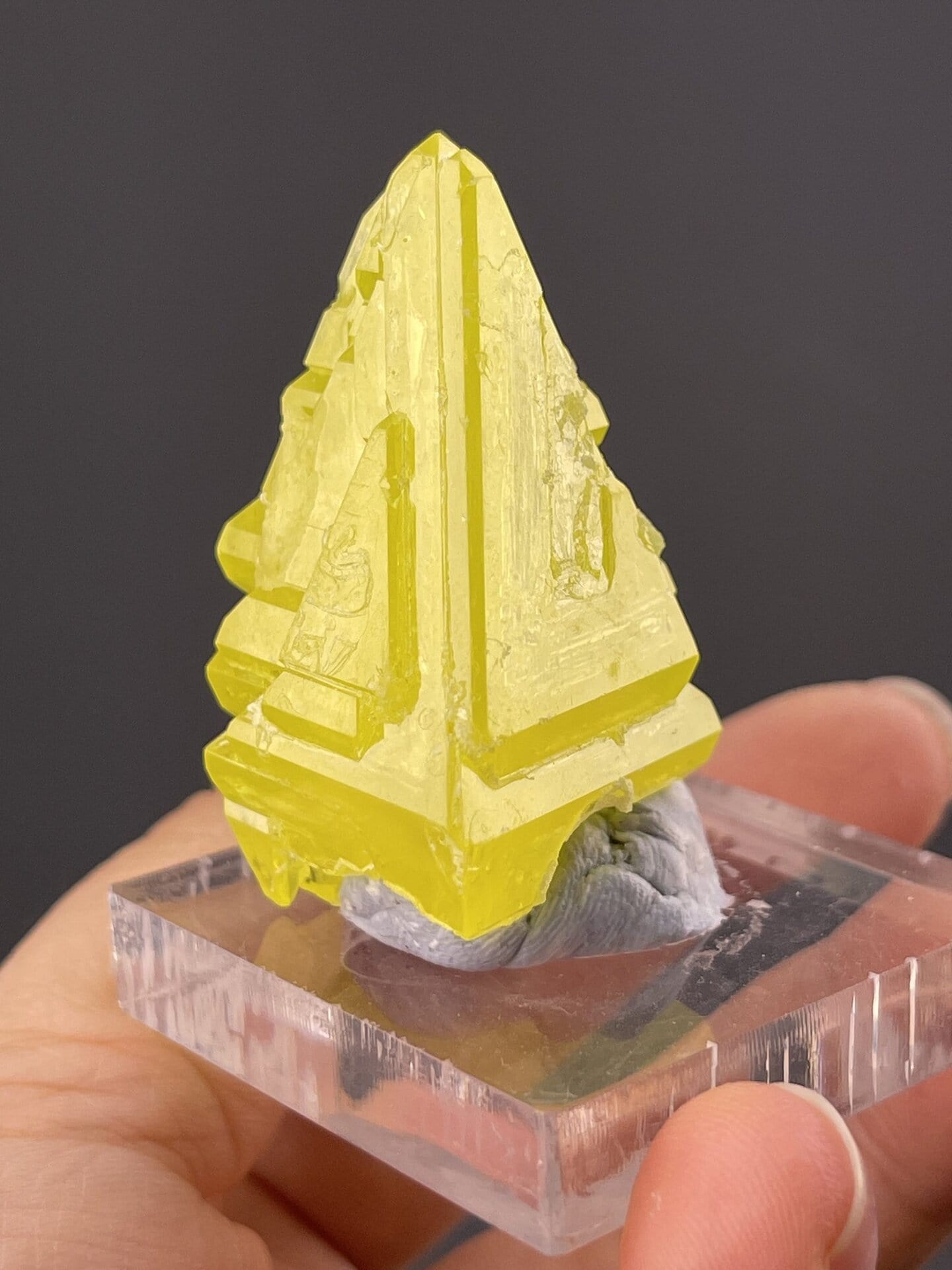
Bright yellow with resinous luster; some crystals adamantine.
Diaphaneity (Transparency)
transparent-to-translucent
Sicilian crystals are transparent gem-quality.
Type Locality
(ancient native element) — Sicily, Italy
Source: Antiquity
› Browse all type localities
Diagnostic Field Tests
Flame test→ Burns with blue flame; pungent SO₂ smell
Diagnostic. Outdoors only — SO₂ is irritating.
Friction→ Negative charge — picks up tissue paper
Triboelectric effect.
⚠ Use dilute HCl (~10%) only on inconspicuous spots; rinse promptly. Smell-tests should be brief and ventilated. Taste-test ONLY halite/sylvite — never lead, arsenic, or sulfur minerals.
Specific Gravity
2.05–2.09
g/cm³
very light
Native sulfur; brittle, pale yellow.
For comparison: water = 1.00, glass ≈ 2.5, quartz = 2.65, corundum ≈ 4.00, galena ≈ 7.50, gold ≈ 19.3.
Streak Test
pale yellow
Lemon-yellow streak; melts easily.
Streak = color of the powdered mineral. Drag specimen across unglazed white porcelain plate (Mohs 6.5). For minerals harder than the plate, crush a small flake into powder and observe color.
Collector tier: Solid Display
Reliable mid-tier display species. Easy to find in well-formed examples; broad locality diversity.
Mohs 1.5–2.5
Vickers (~) 75 HV
Knoop (~) 85 HK
Nickel–Strunz
1.CC.05Dana
01.03.05.01Geological setting
VolcanicSedimentaryEvaporite
Mohs Hardness
1.5–2.5
Sulfur sits at 1.5–2.5 on the Mohs scale — soft enough to be scratched by a fingernail.
Colors:
Streak
White to pale yellow
White to pale yellow
Crystal system
Orthorhombic
Orthorhombic
Type localityMt. Etna / Sicily volcanic district, Italy
Discovery Known since antiquity
Native ElementsNative Elements
TL;DR · 1 min read
Native sulfur (S₈) is one of the most visually striking native elements in mineralogy — pure crystals glow vivid lemon-yellow and form sharp dipyramidal forms. Sulfur is found in volcanic vents, fumaroles, hot springs, and sedimentary evaporite deposits where bacterial reduction of sulfates creates pure deposits.
Native sulfur (S₈) is one of the most visually striking native elements in mineralogy — pure crystals glow vivid lemon-yellow and form sharp dipyramidal forms. Sulfur is found in volcanic vents, fumaroles, hot springs, and sedimentary evaporite deposits where bacterial reduction of sulfates creates pure deposits.
Notable Chinese Localities
Tengchong volcanic field (Yunnan) is China’s most active sulfur-producing site, with crystals deposited around fumaroles. Specimens are typically smaller than Sicilian but vivid yellow.
Cite this entry
APA
MyMineralBox Editorial Team. (2026). Sulfur. My Mineral Box. Retrieved May 23, 2026, from https://mymineralbox.com/mineral-encyclopedia/minerals/sulfur/
MLA
MyMineralBox Editorial Team. "Sulfur." My Mineral Box, 2026, https://mymineralbox.com/mineral-encyclopedia/minerals/sulfur/. Accessed May 23, 2026.
Chicago
MyMineralBox Editorial Team. "Sulfur." My Mineral Box. Last modified May 4, 2026. https://mymineralbox.com/mineral-encyclopedia/minerals/sulfur/.
BibTeX
@misc{mmb_sulfur,
 author = {{MyMineralBox Editorial Team}},
 title = {{Sulfur}},
 year = {2026},
 publisher = {My Mineral Box},
 url = {https://mymineralbox.com/mineral-encyclopedia/minerals/sulfur/},
 urldate = {2026-05-23}
}