
Elemental Composition (by mass)
| Element | Mass % | Visual |
|---|---|---|
| Bi Bismuth | 100.00% |
Computed from simplified end-member formula. Solid-solution series, water content, and trace substitutions cause real-world variation.
IMA Abbreviation (Whitney-Evans 2010)
Bi
→ Bismuth
Symbol = element
Standard symbol from American Mineralogist (Whitney & Evans, 2010). Used in thin-section labeling, phase diagrams, and IMA-style species records.
⏳ Long-term Aging & Care Timeline
oxide film deepeningyears
Trigger: air
Intervention: Iridescent oxide film deepens slowly. Generally desirable patina; specimens become more colorful.
Pronunciation
/ˈbɪzməθ/
↔ BIZ-muth
German wismut
Color Cause (Chromophore)
Chromophore:
thin-film interference
Mechanism:
iridescent hopper crystals
Color produced:
rainbow
Tarnish layer is bismuth oxide; thin-film interference produces colors.
Type Locality
Schneeberg — Germany
Described 1450 by Native element — known since antiquity
› Browse all type localities
Magnetism
Category:
diamagnetic
Test result:
Strongest diamagnet — visibly repelled by strong magnet
Native Bi — strongest diamagnet among common minerals.
Test with rare-earth magnet (N42 or N52 neodymium). Suspend specimen on thread for sensitive paramagnetic detection. Diamagnetic minerals are weakly repelled (visible only with strong magnets like bismuth).
Streak Test
silver white
Hopper-form native crystals; iridescent tarnish.
Streak = color of the powdered mineral. Drag specimen across unglazed white porcelain plate (Mohs 6.5). For minerals harder than the plate, crush a small flake into powder and observe color.
Mohs 2–2.5
Vickers (~) 75 HV
Knoop (~) 85 HK
Geological setting
Hydrothermal
Mohs Hardness
2–2.5
Bismuth (Native) sits at 2–2.5 on the Mohs scale — soft enough to be scratched by a fingernail.
Colors:
Streak
Silver-pink
Silver-pink
Crystal system
Trigonal
Trigonal
Native ElementsNative Elements
TL;DR · 1 min read
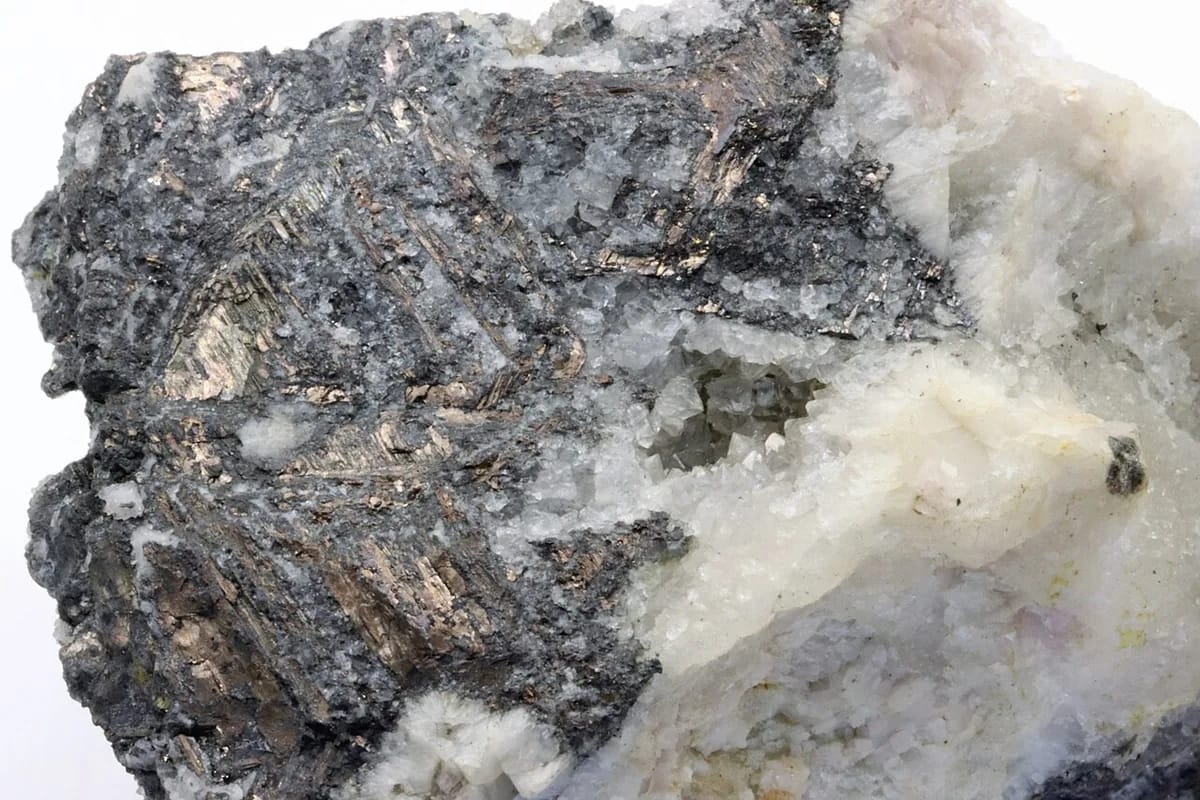
Native bismuth (Bi) is metallic bismuth in its pure crystalline form, famous for the laboratory-grown rainbow-colored "hopper crystals" — but natural specimens are also collector classics. It forms in hydrothermal Sn-W-Bi vein deposits and Co-Ni-Ag-As "five-element" assemblages.
Native bismuth (Bi) is metallic bismuth in its pure crystalline form, famous for the laboratory-grown rainbow-colored “hopper crystals” — but natural specimens are also collector classics. It forms in hydrothermal Sn-W-Bi vein deposits and Co-Ni-Ag-As “five-element” assemblages. Australian and Bolivian deposits supply native specimens.