
Crystal Structure
Mg-mica end-member.
Elemental Composition (by mass)
| Element | Mass % | Visual |
|---|---|---|
| O Oxygen | 41.53% | |
| Si Silicon | 21.87% | |
| Mg Magnesium | 18.93% | |
| K Potassium | 10.15% | |
| Al Aluminum | 7.00% | |
| H Hydrogen | 0.52% |
Computed from simplified end-member formula. Solid-solution series, water content, and trace substitutions cause real-world variation.
IMA Abbreviation (Whitney-Evans 2010)
Phl
→ Phlogopite
Mg-mica
Standard symbol from American Mineralogist (Whitney & Evans, 2010). Used in thin-section labeling, phase diagrams, and IMA-style species records.
Pronunciation
/ˈflɒɡəpaɪt/
↔ FLOG-uh-pite
Greek "like fire"
Mohs 2–2.5
Vickers (~) 75 HV
Knoop (~) 85 HK
Geological setting
KimberliteMetamorphicSedimentary
Element composition by mass
Formula: KMg₃(AlSi₃O₁₀)(OH,F)₂ · molar mass: 419.25 g/mol
| O | 41.98% | |
| Si | 20.1% | |
| Mg | 17.39% | |
| K | 9.33% | |
| Al | 6.44% | |
| F | 4.53% | |
| H | 0.24% |
Computed from atomic weights (IUPAC 2021). Site-occupancy groups (Fe,Mn) split equally.
GroupMica Group
Mohs Hardness
2–2.5
Phlogopite sits at 2–2.5 on the Mohs scale — soft enough to be scratched by a fingernail.
Colors:
Streak
White
White
Crystal system
Monoclinic
Monoclinic
SilicatesSilicates (Phyllosilicates — Micas)
TL;DR · 1 min read
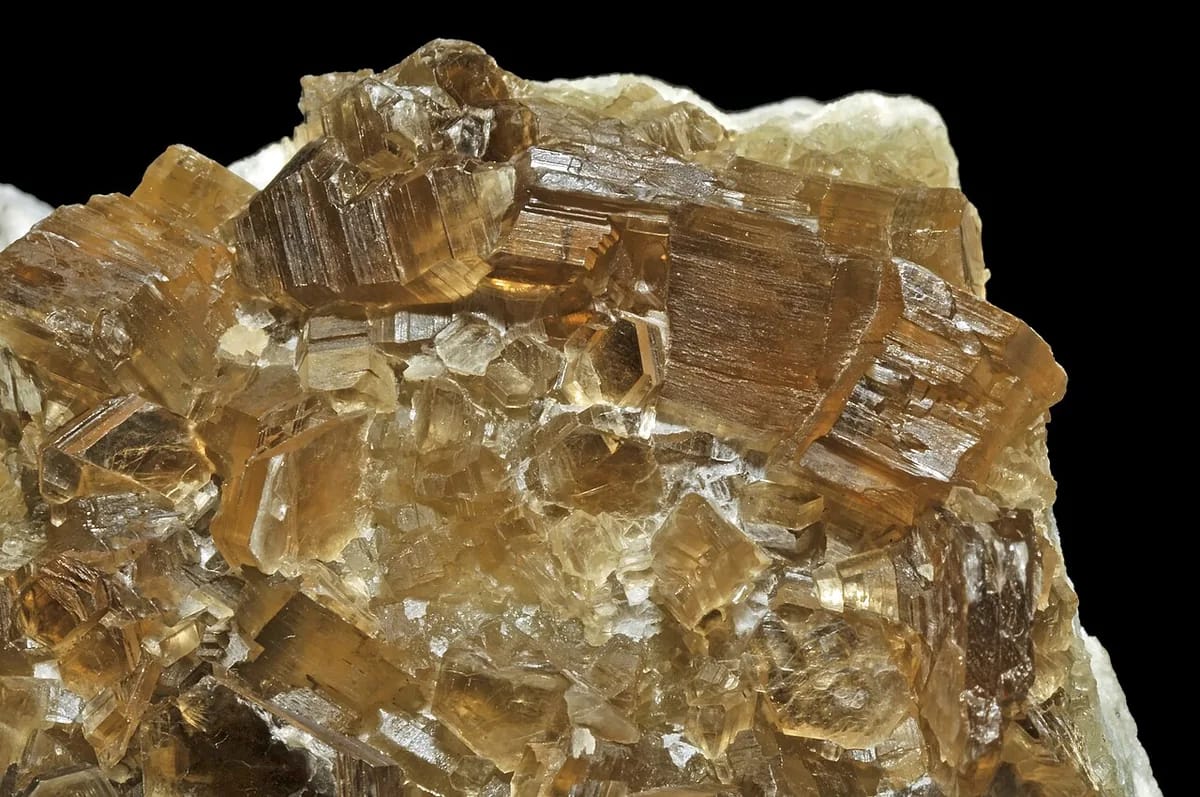
Phlogopite (KMg₃(AlSi₃O₁₀)(OH,F)₂) is the magnesium end-member of the biotite series and the distinctive bronze-yellow to brown mica. It forms in metamorphosed dolomitic limestones and ultramafic rocks, often as large transparent honey-colored books.
Phlogopite (KMg₃(AlSi₃O₁₀)(OH,F)₂) is the magnesium end-member of the biotite series and the distinctive bronze-yellow to brown mica. It forms in metamorphosed dolomitic limestones and ultramafic rocks, often as large transparent honey-colored books. Mg-rich phlogopite is a refractory mineral that survives in mantle xenoliths and kimberlite pipes.
More minerals to explore
Other Members of the Mica Group
云母族
- Biotite (黑云母)
- Muscovite (白云母)
- Lepidolite (锂云母)