
Crystal Structure
Li-mica.
Elemental Composition (by mass)
| Element | Mass % | Visual |
|---|---|---|
| O Oxygen | 40.99% | |
| Si Silicon | 28.78% | |
| K Potassium | 10.02% | |
| F Fluorine | 9.74% | |
| Al Aluminum | 6.91% | |
| Li Lithium | 3.56% |
Computed from simplified end-member formula. Solid-solution series, water content, and trace substitutions cause real-world variation.
IMA Abbreviation (Whitney-Evans 2010)
Lpd
→ Lepidolite
Li-mica
Standard symbol from American Mineralogist (Whitney & Evans, 2010). Used in thin-section labeling, phase diagrams, and IMA-style species records.
Pronunciation
/lɪˈpɪdəlaɪt/
↔ lih-PID-uh-lite
Greek lepis (scale)
Tenacity
Behavior:
elastic
Under stress:
Springs back
Same.
Luster
pearly
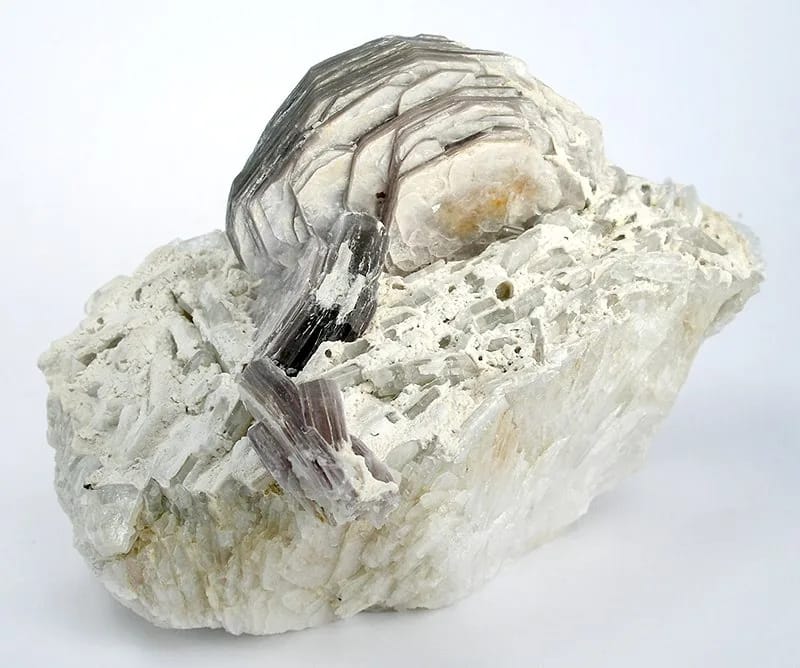
Lavender-pink sheets.
Diaphaneity (Transparency)
translucent
Pinkish-violet lithium mica.
Type Locality
Rožná — Czech Republic
Described 1792 by Klaproth
› Browse all type localities
Magnetism
Category:
diamagnetic
Test result:
Slight repulsion possible
Li-rich mica — diamagnetic baseline.
Test with rare-earth magnet (N42 or N52 neodymium). Suspend specimen on thread for sensitive paramagnetic detection. Diamagnetic minerals are weakly repelled (visible only with strong magnets like bismuth).
Specific Gravity
2.80–2.90
g/cm³
light
Li-rich mica.
For comparison: water = 1.00, glass ≈ 2.5, quartz = 2.65, corundum ≈ 4.00, galena ≈ 7.50, gold ≈ 19.3.
Geological Setting
Environment:
pegmatite
Host rock:
lithium-rich pegmatite
Companions:
Diagnostic mineral of lithium-rich pegmatite environments.
Cleavage & Fracture
Cleavage:
perfect 1 direction {001} — basal
Fracture:
uneven
Pinkish-lavender sheets.
Collector tier: Solid Display
Reliable mid-tier display species. Easy to find in well-formed examples; broad locality diversity.
Mohs 2.5–4
Vickers (~) 170 HV
Knoop (~) 185 HK
Geological setting
Pegmatite
Element composition by mass
Formula: K(Li,Al)₃(Si,Al)₄O₁₀(F,OH)₂ · molar mass: 396.11 g/mol
| O | 44.43% | |
| Al | 23.84% | |
| Si | 14.18% | |
| K | 9.87% | |
| F | 4.8% | |
| Li | 2.63% | |
| H | 0.25% |
Computed from atomic weights (IUPAC 2021). Site-occupancy groups (Fe,Mn) split equally.
GroupMica Group
Mohs Hardness
2.5–4
Lepidolite sits at 2.5–4 on the Mohs scale — can be scratched by a steel knife.
Colors:
Streak
White
White
Crystal system
Monoclinic
Monoclinic
SilicatesSilicates (Phyllosilicates — Micas)
TL;DR · 1 min read
Lepidolite (K(Li,Al)₃(Si,Al)₄O₁₀(F,OH)₂) is the lithium-bearing mica, distinctive for its lavender to pink color and book-like aggregates of glittering scales. It is a major lithium ore mineral and the most-collected lithium mica.
Lepidolite (K(Li,Al)₃(Si,Al)₄O₁₀(F,OH)₂) is the lithium-bearing mica, distinctive for its lavender to pink color and book-like aggregates of glittering scales. It is a major lithium ore mineral and the most-collected lithium mica. Pegmatites at Coronel Murta (Brazil), Pala (California), and Madagascar produce iconic specimens, often paired with rubellite tourmaline.
More minerals to explore
Other Members of the Mica Group
云母族
- Biotite (黑云母)
- Muscovite (白云母)
- Phlogopite (金云母)