
Crystal Structure
Monoclinic single-chain pyroxene with Li.
Elemental Composition (by mass)
| Element | Mass % | Visual |
|---|---|---|
| O Oxygen | 51.59% | |
| Si Silicon | 30.18% | |
| Al Aluminum | 14.50% | |
| Li Lithium | 3.73% |
Computed from simplified end-member formula. Solid-solution series, water content, and trace substitutions cause real-world variation.
IMA Abbreviation (Whitney-Evans 2010)
Spd
→ Spodumene
Li pyroxene
Standard symbol from American Mineralogist (Whitney & Evans, 2010). Used in thin-section labeling, phase diagrams, and IMA-style species records.
Pronunciation
/ˈspɒdʒəmiːn/
↔ SPOJ-uh-meen
Greek "burnt to ashes"
UV Fluorescence
SW (254 nm)
—
none
LW (365 nm)
Orange (kunzite)
moderate
Kunzite shows orange LW; pure spodumene inert.
SW = shortwave (germicidal lamp). LW = longwave (blacklight). Response varies with locality, trace impurities, and treatment.
Tenacity
Behavior:
brittle
Under stress:
Prismatic cleavage
Same as kunzite.
Luster
vitreous
Same.
Diaphaneity (Transparency)
transparent
Including kunzite and hiddenite.
Type Locality
Utö Island — Sweden
Described 1800 by d'Andrada
› Browse all type localities
Specific Gravity
3.15–3.21
g/cm³
medium
Lithium pyroxene.
For comparison: water = 1.00, glass ≈ 2.5, quartz = 2.65, corundum ≈ 4.00, galena ≈ 7.50, gold ≈ 19.3.
Geological Setting
Environment:
pegmatite
Host rock:
lithium-rich pegmatite
Companions:
Major Li ore; gemmy variants are kunzite (pink) and hiddenite (green).
Cleavage & Fracture
Cleavage:
perfect 2 directions {110} ~87°
Fracture:
subconchoidal
Perfect prismatic cleavage; brittle.
Market availability: Uncommon
Found at major shows and select dealers. Quality varies by locality.
Collector tier: Solid Display
Reliable mid-tier display species. Easy to find in well-formed examples; broad locality diversity.
Named varieties — color spectrum
Mohs 6.5–7
Vickers (~) 1400 HV
Knoop (~) 1100 HK
Geological setting
Pegmatite
Element composition by mass
Formula: LiAlSi₂O₆ · molar mass: 186.09 g/mol
| O | 51.59% | |
| Si | 30.18% | |
| Al | 14.5% | |
| Li | 3.73% |
Computed from atomic weights (IUPAC 2021). Site-occupancy groups (Fe,Mn) split equally.
GroupPyroxene Group
Optical Effects
Pleochroic
Mohs Hardness
6.5–7
Spodumene sits at 6.5–7 on the Mohs scale — harder than glass; scratches steel.
Colors:
Streak
White
White
Crystal system
Monoclinic
Monoclinic
Pronunciation/ˈspɒdjuːmiːn/
Discovery First described 1800 by D'Andrada (Sweden)
SilicatesSilicates (Inosilicates — Pyroxenes)
TL;DR · 1 min read
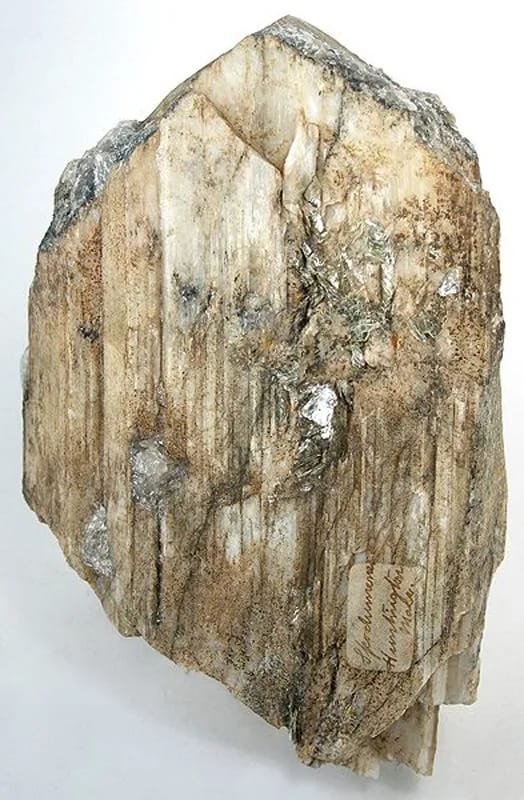
Spodumene (LiAlSi₂O₆) is the lithium-bearing pyroxene and the principal lithium ore mineral worldwide. Two gem varieties make Spodumene a collector classic: kunzite (pink-violet, Mn-bearing) and hiddenite (emerald-green, Cr-bearing).
Spodumene (LiAlSi₂O₆) is the lithium-bearing pyroxene and the principal lithium ore mineral worldwide. Two gem varieties make Spodumene a collector classic: kunzite (pink-violet, Mn-bearing) and hiddenite (emerald-green, Cr-bearing). Pegmatites at Pala (California), Minas Gerais (Brazil), and Afghanistan supply gem material.