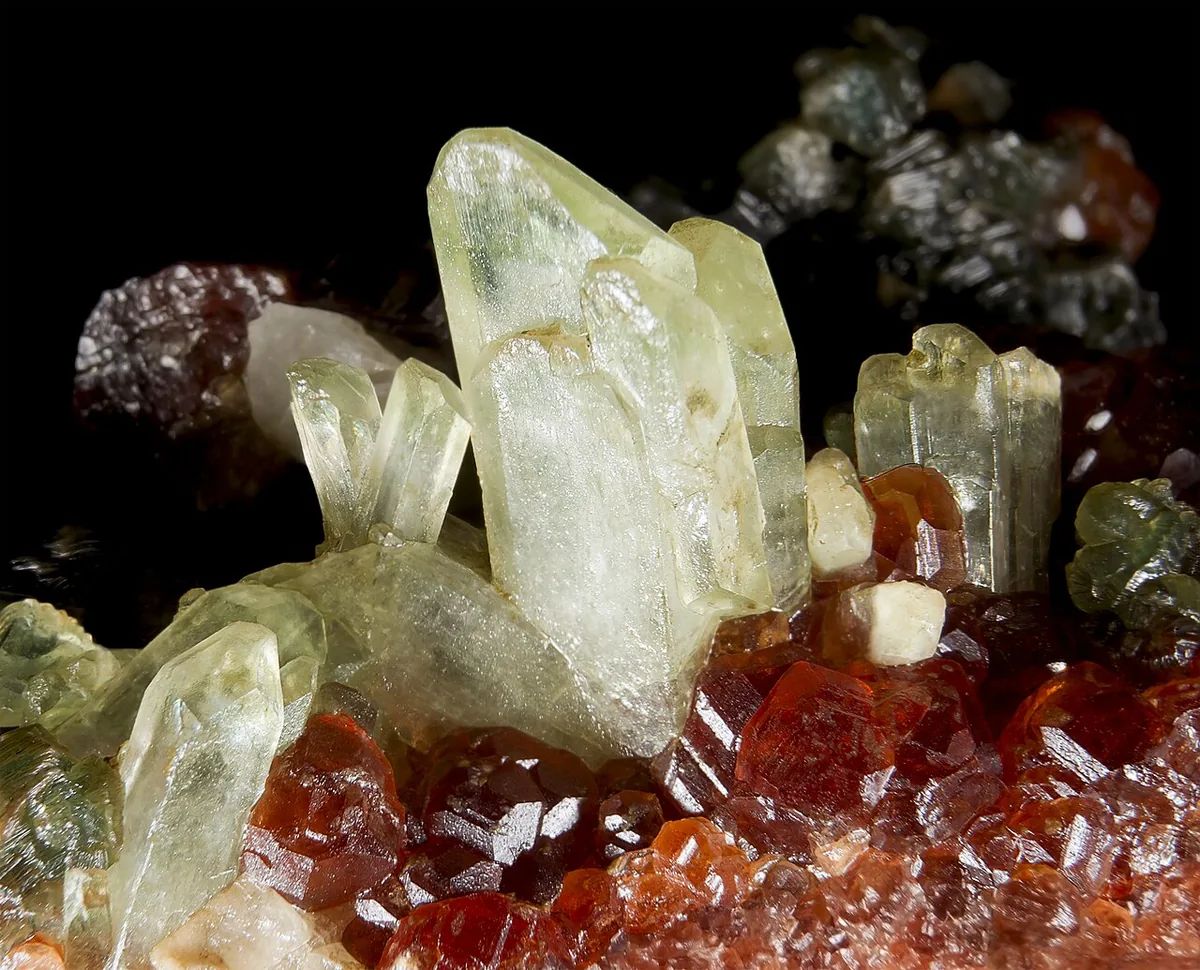
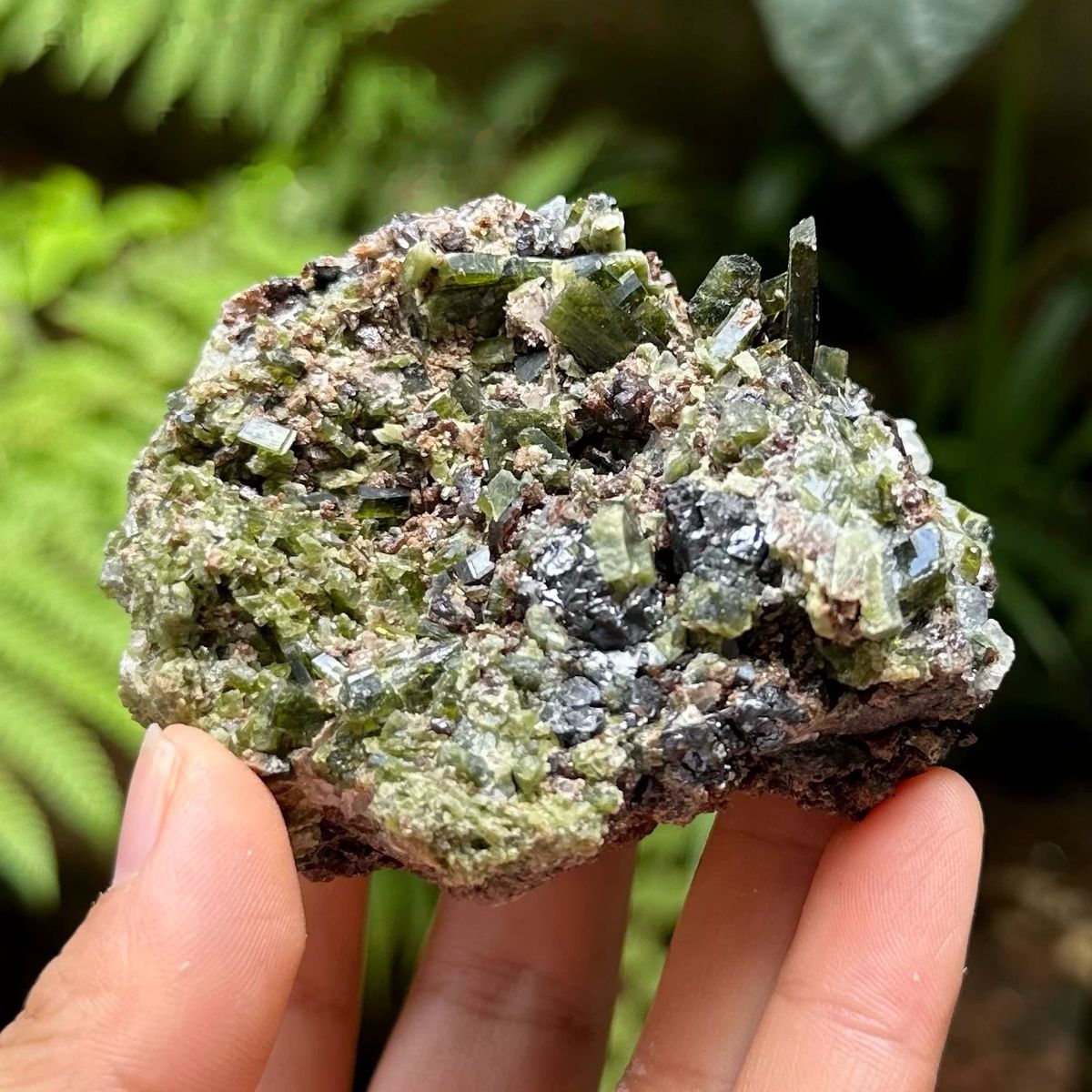
Diopside sits at 5.5–6.5 on the Mohs scale —
just hard enough to scratch glass.
Colors:
Streak White
Crystal system Monoclinic
SilicatesSilicates (Inosilicates — Pyroxenes)
TL;DR · 1 min read
Diopside (CaMgSi₂O₆) is the calcium-magnesium end-member of the pyroxene group, one of the most abundant mineral families in Earth's crust and mantle. It forms in contact-metamorphic skarns, regional metamorphic rocks, and peridotite xenoliths brought up by volcanic eruptions.
Diopside (CaMgSi₂O₆) is the calcium-magnesium end-member of the pyroxene group, one of the most abundant mineral families in Earth’s crust and mantle. It forms in contact-metamorphic skarns, regional metamorphic rocks, and peridotite xenoliths brought up by volcanic eruptions. Crystallographic-quality Diopside specimens favor sharp prismatic crystals on white calcite-marble matrix; chrome diopside (with Cr³⁺) yields brilliant emerald-green gem material from Siberia and East Africa. China hosts notable skarn-type Diopside in Sichuan and Liaoning.
Notable Chinese Localities
Sichuan skarn deposits and Liaoning contact-metamorphic zones produce collector specimens. Outokumpu (Finland) yields chrome diopside; De Kalb (NY) supplies American material.
Cite this entry
APA
MyMineralBox Editorial Team. (2026). Diopside. My Mineral Box. Retrieved May 23, 2026, from https://mymineralbox.com/mineral-encyclopedia/minerals/diopside/
MLA
MyMineralBox Editorial Team. "Diopside." My Mineral Box, 2026, https://mymineralbox.com/mineral-encyclopedia/minerals/diopside/. Accessed May 23, 2026.
Chicago
MyMineralBox Editorial Team. "Diopside." My Mineral Box. Last modified May 5, 2026. https://mymineralbox.com/mineral-encyclopedia/minerals/diopside/.
BibTeX
@misc{mmb_diopside,
 author = {{MyMineralBox Editorial Team}},
 title = {{Diopside}},
 year = {2026},
 publisher = {My Mineral Box},
 url = {https://mymineralbox.com/mineral-encyclopedia/minerals/diopside/},
 urldate = {2026-05-23}
}
About Diopside
Diopside is a silicate mineral in the pyroxene group (clinopyroxene subgroup) and has the chemical formula CaMgSi2O6. It crystallizes in the monoclinic system and is one of the most visually varied minerals in the collector market. Its combination of structural character and global distribution make it a recognized species in both systematic and aesthetic collections.
Identification & care
Crystals commonly develop as short to long prismatic crystals, often square cross-section; granular, massive. Its color range is broad, including colorless, white, pale green, grey, vivid emerald-green (chrome diopside — cr-bearing), blue (violane), and black (augite-rich). The luster is vitreous, sub-vitreous, the streak is white to very pale grey, and specimens range from transparent to opaque. The cleavage is good on {110} in two directions at ~87° (typical pyroxene cleavage). The fracture is uneven, conchoidal, which aids identification.
Collector context
How it forms
Diopside forms in common rock-forming mineral in mafic and ultramafic igneous rocks; widespread in metamorphic calc-silicate skarns and marbles; also in eclogites and granulites. It is commonly found in association with tremolite, grossular, wollastonite, calcite, forsterite, epidote, vesuvianite, phlogopite.
Classic Chinese localities
Documented Chinese occurrences are recorded at Shangbao Mine, Jiama Cu-polymetallic deposit and Xianghualing Sn-polymetallic ore field, among others.
Why collectors care
Diopside is a frequently-sought species in serious collections because its habit is recognizable, its color often strong, and its best examples unmistakable even at a distance. Chinese material has driven much of the recent visual shift in the species — sharper crystals, deeper colors, cleaner matrix.
What affects value
Value in Diopside is assessed, in typical order of weight, against: (1) locality provenance; (2) size relative to the species norm; (3) crystal form and termination sharpness; (4) color saturation and zoning; (5) transparency and internal clarity; (6) matrix quality and aesthetic balance; (7) condition (absence of damage, chips, or repair). Cleaning quality and verified locality documentation act as multipliers across the above.
Frequently asked questions
What is Diopside?
Diopside has the chemical formula CaMgSi2O6, crystallises in the Monoclinic system. Diopside is a silicate mineral prized by collectors for its exceptional color range, with several world-class Chinese localities.
What is the chemical formula of Diopside?
The chemical formula of Diopside is CaMgSi2O6.
What crystal system does Diopside belong to?
Diopside crystallises in the Monoclinic crystal system.
We use a small set of cookies (analytics, checkout, chat) to keep the site working and understand how visitors use it. Checkout-essential cookies are always loaded. Privacy policy