
Elemental Composition (by mass)
| Element | Mass % | Visual |
|---|---|---|
| O Oxygen | 44.33% | |
| Si Silicon | 25.94% | |
| Ca Calcium | 18.51% | |
| Mg Magnesium | 11.22% |
Computed from simplified end-member formula. Solid-solution series, water content, and trace substitutions cause real-world variation.
IMA Abbreviation (Whitney-Evans 2010)
Aug
→ Augite
Most common pyroxene
Standard symbol from American Mineralogist (Whitney & Evans, 2010). Used in thin-section labeling, phase diagrams, and IMA-style species records.
Pronunciation
/ˈɔːɡaɪt/
↔ AW-jite
Greek auge (luster)
Type Locality
Mt. Etna lavas — Italy
Described 1792 by Werner
› Browse all type localities
Magnetism
Category:
weakly paramagnetic
Test result:
Detectable
Fe/Mg pyroxene.
Test with rare-earth magnet (N42 or N52 neodymium). Suspend specimen on thread for sensitive paramagnetic detection. Diamagnetic minerals are weakly repelled (visible only with strong magnets like bismuth).
Twinning Laws
Simple twin {100}contact
Hour-glass and sector zoning often accompany twinning.
Cleavage & Fracture
Cleavage:
good 2 directions ~87°/93°
Fracture:
uneven
Typical pyroxene 90° cleavage.
Collector tier: Micromount / Niche
Best appreciated at thumbnail or smaller scale — often dull-colored, sub-millimeter, or radioactive. Specialist appeal.
Mohs 5.5–6
Vickers (~) 820 HV
Knoop (~) 870 HK
Geological setting
VolcanicPlutonic igneous
Element composition by mass
Formula: (Ca,Na)(Mg,Fe,Al,Ti)(Si,Al)₂O₆ · molar mass: 221.34 g/mol
| O | 43.37% | |
| Al | 15.24% | |
| Si | 12.69% | |
| Ca | 9.05% | |
| Fe | 6.31% | |
| Ti | 5.41% | |
| Na | 5.19% | |
| Mg | 2.75% |
Computed from atomic weights (IUPAC 2021). Site-occupancy groups (Fe,Mn) split equally.
GroupPyroxene Group
Mohs Hardness
5.5–6
Augite sits at 5.5–6 on the Mohs scale — just hard enough to scratch glass.
Colors:
Streak
Gray-green to brown
Gray-green to brown
Crystal system
Monoclinic
Monoclinic
Type localityMt. Vesuvius, Naples, Italy
SilicatesSilicates (Inosilicates — Pyroxenes)
TL;DR · 1 min read
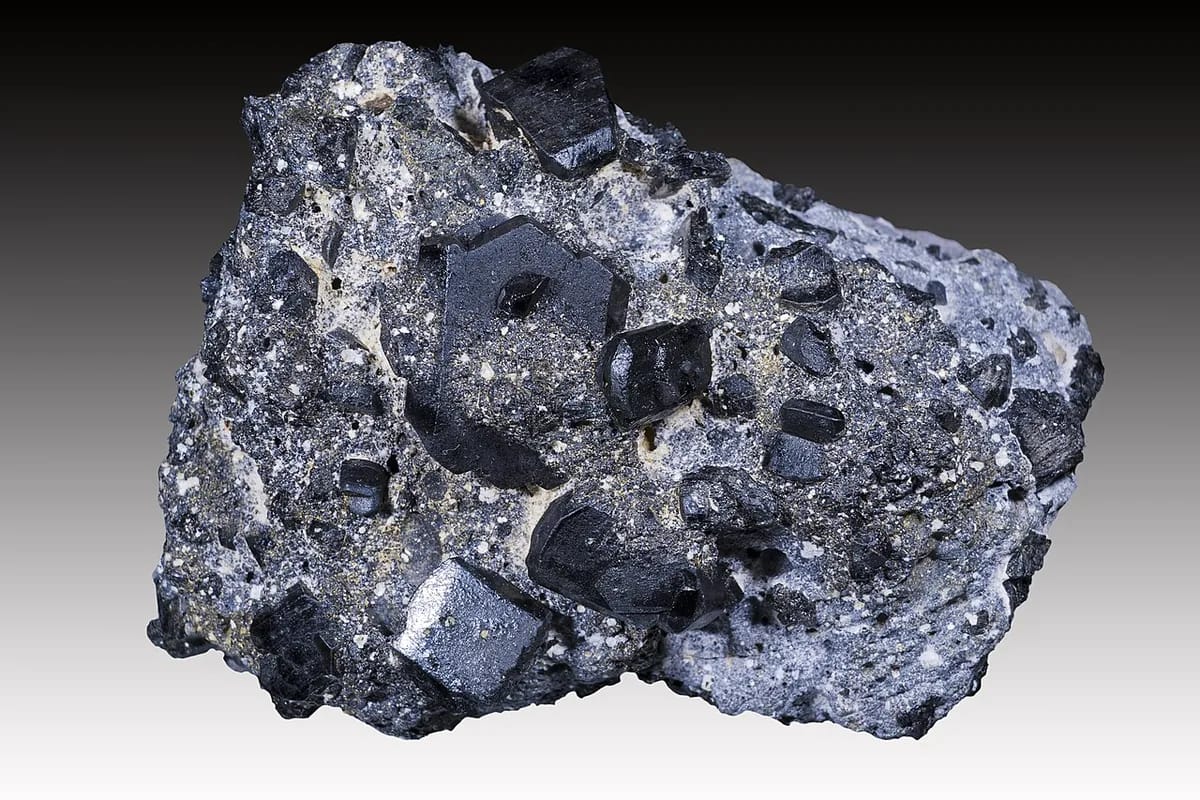
Augite ((Ca,Na)(Mg,Fe,Al,Ti)(Si,Al)₂O₆) is the most common pyroxene-group mineral and a primary constituent of basalt, gabbro, and mantle peridotite. Its name from Greek "auge" (luster) reflects the bright vitreous gleam on freshly broken faces.
Augite ((Ca,Na)(Mg,Fe,Al,Ti)(Si,Al)₂O₆) is the most common pyroxene-group mineral and a primary constituent of basalt, gabbro, and mantle peridotite. Its name from Greek “auge” (luster) reflects the bright vitreous gleam on freshly broken faces. Augite forms short prismatic crystals with the characteristic ~87° pyroxene cleavage angles, distinguishing pyroxenes from amphiboles (which have ~60°/120°). Mt. Vesuvius (Italy) is the type locality, with classic black columnar Augite specimens from volcanic ejecta.