
Elemental Composition (by mass)
| Element | Mass % | Visual |
|---|---|---|
| O Oxygen | 47.49% | |
| Si Silicon | 27.79% | |
| Al Aluminum | 13.35% | |
| Na Sodium | 11.37% |
Computed from simplified end-member formula. Solid-solution series, water content, and trace substitutions cause real-world variation.
IMA Abbreviation (Whitney-Evans 2010)
Jd
→ Jadeite
Na-Al pyroxene; jade
Standard symbol from American Mineralogist (Whitney & Evans, 2010). Used in thin-section labeling, phase diagrams, and IMA-style species records.
Pronunciation
/ˈdʒeɪdaɪt/
↔ JADE-ite
from "jade" (Spanish)
Lapidary & Faceting Recommendations
Recommended cut:
cabochon
Also seen:
bead, carving
Typical yield:
50% of rough
Imperial jadeite traditionally cabbed to highlight translucency. Bead strands and carvings are equally important markets.
Birthstone & Anniversary Gift Reference
Anniversary years: 35th (jade)
› Full birthstones registry
UV Fluorescence
SW (254 nm)
—
none
LW (365 nm)
—
none
Untreated jadeite inert. B-jade (polymer impregnated) shows blue-white LW — diagnostic.
SW = shortwave (germicidal lamp). LW = longwave (blacklight). Response varies with locality, trace impurities, and treatment.
Tenacity
Behavior:
tough (interlocked)
Under stress:
Resists breaking
Microcrystalline interlocked texture gives extreme toughness — among toughest natural materials.
Luster
vitreous→waxy
Polished jadeite vitreous; unpolished often waxy.
Diaphaneity (Transparency)
translucent-to-opaque
"Imperial jade" is highly translucent; lower grades opaque.
Type Locality
Tawmaw — Burma
Described 1863 by Damour
› Browse all type localities
Magnetism
Category:
diamagnetic
Test result:
Null or very slight repulsion
Na-Al pyroxene — no transition metal in pure form.
Test with rare-earth magnet (N42 or N52 neodymium). Suspend specimen on thread for sensitive paramagnetic detection. Diamagnetic minerals are weakly repelled (visible only with strong magnets like bismuth).
Diagnostic Field Tests
Click test→ Bell-like sound when struck
Hung pieces of jadeite ring; nephrite also rings but lower.
UV test→ B-jade fluoresces blue-white (LW UV)
Detects polymer impregnation.
SG check→ ~3.34 — heavier than nephrite
Hydrostatic test separates jadeite from nephrite.
⚠ Use dilute HCl (~10%) only on inconspicuous spots; rinse promptly. Smell-tests should be brief and ventilated. Taste-test ONLY halite/sylvite — never lead, arsenic, or sulfur minerals.
Specific Gravity
3.30–3.38
g/cm³
medium
Heavier than nephrite; one diagnostic test.
For comparison: water = 1.00, glass ≈ 2.5, quartz = 2.65, corundum ≈ 4.00, galena ≈ 7.50, gold ≈ 19.3.
Synthetics & Imitations
Lab-grown methods
High-pressure synthesis 1984 · General Electric
Lab jadeite never reached gem grade commercially.
Common imitations
Nephrite
Different mineral (Ca-Mg-Fe amphibole) often sold as "jade".
Serpentine ("new jade")
Softer (Mohs 3); waxy not vitreous.
Aventurine quartz
Sparkle from fuchsite inclusions; sold as "Indian jade".
Glass / dyed marble
Common in tourist markets.
Treatments & Enhancements
Acid bleaching + polymercommonstable-care· detection: moderate
"B-jade" — acid-leached then resin-impregnated. Trade-categorized B and B+C. Disclosure mandatory.
Dyeing (C-jade)occasionalstable-care· detection: easy
Dyed green imitation; UV fluorescence orange-red under longwave reveals dye.
As a buyer: request written disclosure of treatments and confirm whether the price reflects treated or untreated material.
Care notesVery tough; light water + neutral detergent OK. Avoid ultrasonic if untreated detection is needed (filled jade reveals under UV). Full cleaning guide →
Formation eraHigh-P metamorphic; Burmese type formed 70-90 Ma at subduction zone.
Cleavage & Fracture
Cleavage:
good 2 directions ~87°/93°
Fracture:
splintery / tough
Tough due to interlocked microcrystals — jade.
Market availability: Uncommon
Found at major shows and select dealers. Quality varies by locality.
Collector tier: Cabinet Classic
Display species collected for cabinet presentation, with specimens recorded from named localities.
Mohs 6.5–7
Vickers (~) 1400 HV
Knoop (~) 1100 HK
Nickel–Strunz
9.DA.25Dana
65.01.03a.04Geological setting
Metamorphic
Element composition by mass
Formula: NaAlSi₂O₆ · molar mass: 202.14 g/mol
| O | 47.49% | |
| Si | 27.79% | |
| Al | 13.35% | |
| Na | 11.37% |
Computed from atomic weights (IUPAC 2021). Site-occupancy groups (Fe,Mn) split equally.
GroupPyroxene Group
Mohs Hardness
6.5–7
Jadeite sits at 6.5–7 on the Mohs scale — harder than glass; scratches steel.
Colors:
Streak
White
White
Crystal system
Monoclinic
Monoclinic
Pronunciation/ˈdʒeɪdaɪt/
Type localityTawmaw, Kachin State, Myanmar (Burma)
SilicatesSilicates (Inosilicates — Pyroxenes)
TL;DR · 1 min read
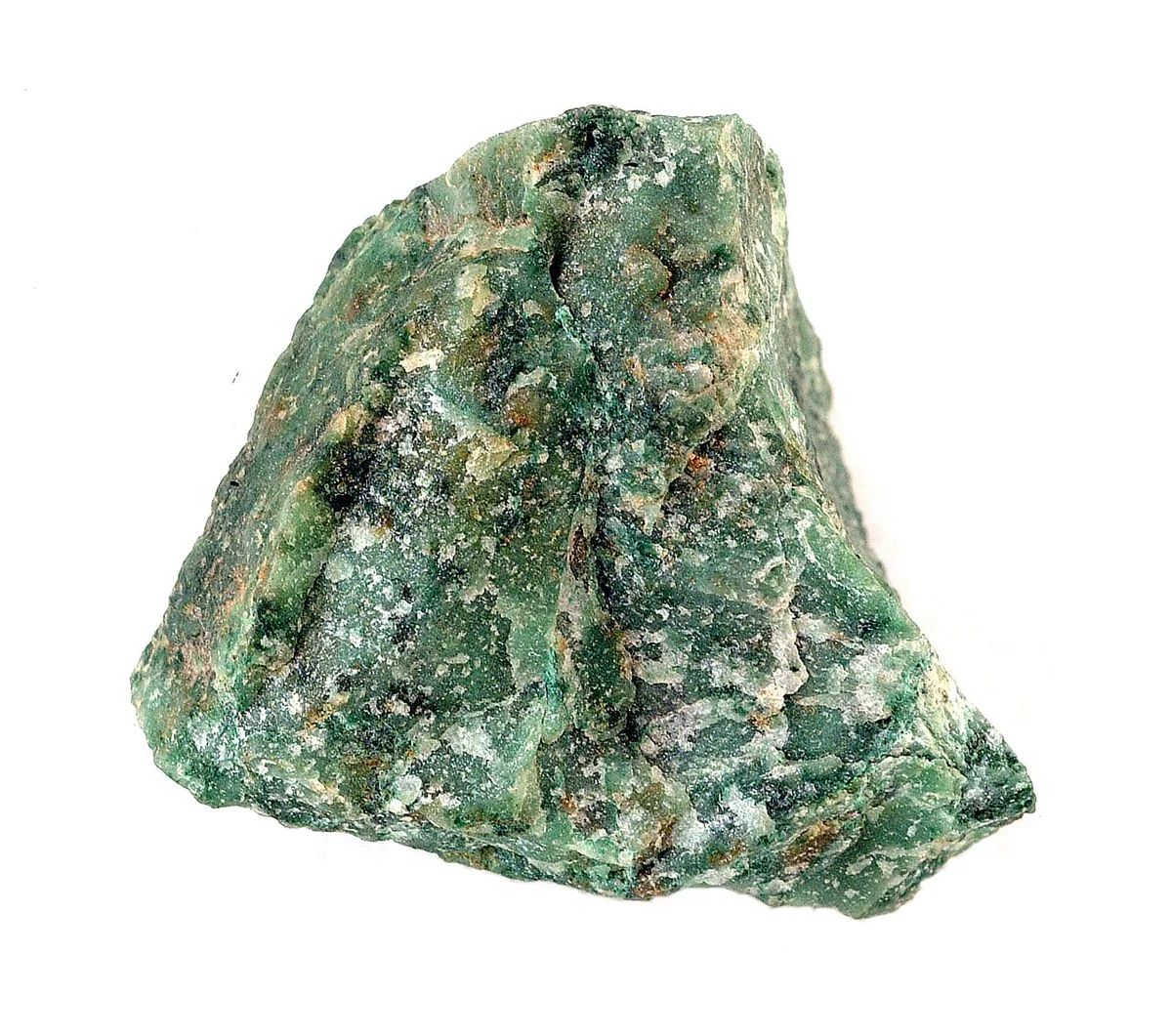
Jadeite (NaAlSi₂O₆) is the sodium-aluminum pyroxene and one of the two distinct minerals sold as "jade" (the other being nephrite, an amphibole). Imperial green jadeite from Myanmar (Burma) is a prominent gem and carving material in the jade trade.
Jadeite (NaAlSi₂O₆) is the sodium-aluminum pyroxene and one of the two distinct minerals sold as “jade” (the other being nephrite, an amphibole). Imperial green jadeite from Myanmar (Burma) is a prominent gem and carving material in the jade trade. Jadeite forms in high-pressure low-temperature metamorphic environments — subducted oceanic crust and serpentinite-hosted blocks.