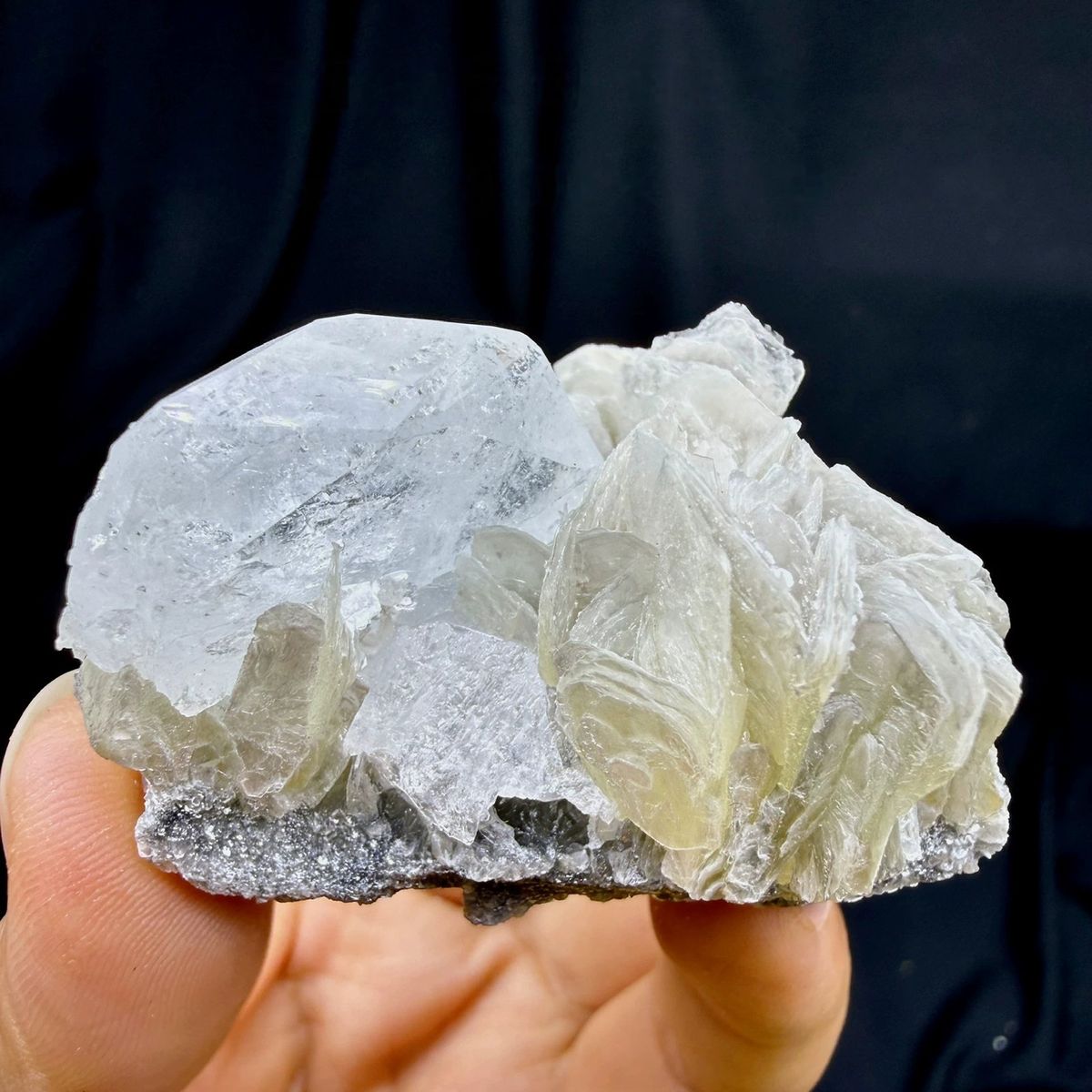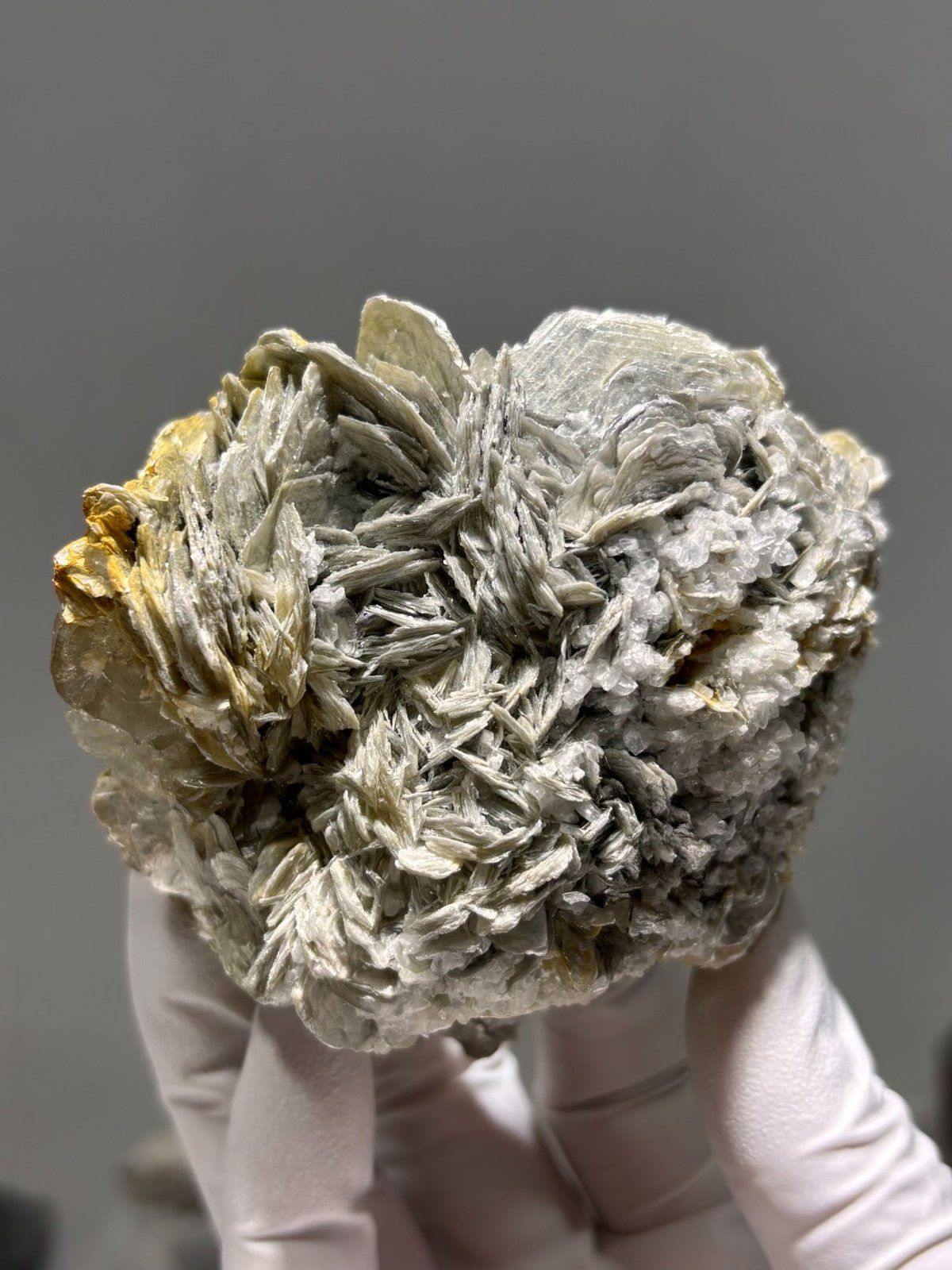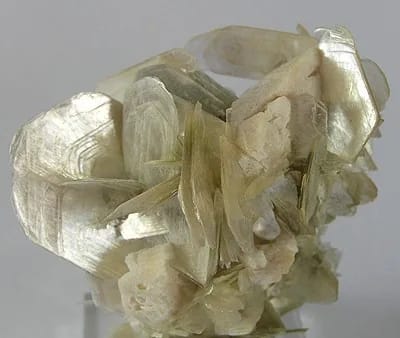
Muscovite is the common pale mica — a potassium-aluminium sheet silicate that splits into thin, flexible, transparent sheets.
About Muscoviteextended article
Crystal Structure
KAl₂(Si₃Al)O₁₀(OH)₂.
Elemental Composition (by mass)
Element
Mass %
Visual
OOxygen
43.68%
SiSilicon
23.00%
AlAluminum
22.10%
KPotassium
10.67%
HHydrogen
0.55%
Computed from simplified end-member formula. Solid-solution series, water content, and trace substitutions cause real-world variation.
IMA Abbreviation (Whitney-Evans 2010)
Ms
→ Muscovite
White mica
Standard symbol from American Mineralogist (Whitney & Evans, 2010). Used in thin-section labeling, phase diagrams, and IMA-style species records.
Pronunciation
/ˈmʌskəvaɪt/
↔ MUSS-kuh-vite
from Muscovy
Tenacity
Behavior:
elastic
Under stress:
Springs back
Same as mica family.
Luster
pearly
Pearly sheen on sheets.
Diaphaneity (Transparency)
transparent-to-translucent
Thin sheets are transparent (historical "Muscovy glass").
Type Locality
(historical Russian "Muscovy glass")
Described 1850 by Dana
› Browse all type localities
Magnetism
Category:
diamagnetic
Test result:
Null or slight repulsion
K-Al mica, no transition metal.
Test with rare-earth magnet (N42 or N52 neodymium). Suspend specimen on thread for sensitive paramagnetic detection. Diamagnetic minerals are weakly repelled (visible only with strong magnets like bismuth).
Specific Gravity
2.77–2.88
g/cm³
light
Light-colored mica.
For comparison: water = 1.00, glass ≈ 2.5, quartz = 2.65, corundum ≈ 4.00, galena ≈ 7.50, gold ≈ 19.3.
Cleavage & Fracture
Cleavage:
perfect1 direction {001} — basal
Fracture:
uneven
Splits into thin elastic colorless sheets.
🟢
Market availability: Common
Widely available in most dealer stocks. Specimens span all price tiers.
Muscovite sits at 2–2.5 on the Mohs scale —
soft enough to be scratched by a fingernail.
Colors:
Streak White
Crystal system Monoclinic
SilicatesSilicates (Phyllosilicates — Micas)
TL;DR · 1 min read
Muscovite (KAl₂(AlSi₃O₁₀)(OH)₂) is the most common mica species and a defining sheet silicate. Its name comes from "Muscovy glass" — large transparent Muscovite plates from Russia historically used as windowpanes.
Muscovite (KAl₂(AlSi₃O₁₀)(OH)₂) is the most common mica species and a defining sheet silicate. Its name comes from “Muscovy glass” — large transparent Muscovite plates from Russia historically used as windowpanes. Muscovite forms in granitic pegmatites, schists, and gneisses, where it grows as flexible elastic books reaching meter-scale dimensions.
Muscovite belongs to the silicate class in the mica group (muscovite subgroup) and has the chemical formula KAl2(AlSi3O10)(OH)2. It crystallizes in the monoclinic system and is one of the most visually varied minerals in the collector market. Its combination of structural character and global distribution make it a recognized species in both systematic and aesthetic collections.
Identification & care
Muscovite typically forms tabular pseudo-hexagonal crystals; lamellar, scaly, foliated; 'books' of mica sheets; rosettes. Its color range is broad, including colorless, silvery-white, pale yellow, pale green, pale rose/pink (lepidolite is the li-bearing variant), and in books: 'white mica'. The luster is vitreous, pearly, silky, the streak is white, and specimens range from transparent to translucent. The cleavage is perfect basal on {001} — thin, elastic, flexible sheets. The fracture is not applicable (cleavage dominates); micaceous, which aids identification.
Collector context
How it forms
Muscovite forms in extremely widespread — granitic pegmatites (largest crystals), granites, schists, phyllites, metamorphic rocks; also in hydrothermal veins and as a secondary mineral in altered igneous rocks. It is commonly found in association with quartz, feldspar, tourmaline, garnet, beryl, apatite, lepidolite.
Classic Chinese localities
Documented Chinese occurrences are recorded at Shangbao Mine, Jiama Cu-polymetallic deposit and Jinduicheng Mine, among others.
Why collectors care
Collectors pursue Muscovite for the clarity of its crystal form and, in good material, saturated color that reads instantly across a display case. A well-terminated muscovite on clean matrix photographs well, identifies quickly, and anchors a cabinet piece. Top Chinese specimens over the last two decades have reset the bar for what muscovite looks like at collector grade.
What affects value
Value in Muscovite is assessed, in typical order of weight, against: (1) locality provenance; (2) size relative to the species norm; (3) crystal form and termination sharpness; (4) color saturation and zoning; (5) transparency and internal clarity; (6) matrix quality and aesthetic balance; (7) condition (absence of damage, chips, or repair). Cleaning quality and verified locality documentation act as multipliers across the above.
Naming history
Muscovite is short for "Muscovy glass." Large transparent sheets of the mica were exported from Russia and used as window panes across northern Europe before affordable glass — cheap, and unlike glass, they did not shatter in the cold. The mineral kept the trade name.
Frequently asked questions
What is Muscovite?
Muscovite has the chemical formula KAl2(AlSi3O10)(OH)2, crystallises in the Monoclinic system, has a Mohs hardness of 2–2.5. Muscovite is a silicate mineral prized by collectors for its exceptional color range, with several world-class Chinese localities.
What is the chemical formula of Muscovite?
The chemical formula of Muscovite is KAl2(AlSi3O10)(OH)2.
What crystal system does Muscovite belong to?
Muscovite crystallises in the Monoclinic crystal system.
Is Muscovite rare?
As a collector mineral, Muscovite is generally considered common.
Our inventory is one-of-a-kind and turns over quickly. Tell us what you're after — species, size, budget — and we'll notify you when a matching Muscovite arrives from our sourcing network.
We use a small set of cookies (analytics, checkout, chat) to keep the site working and understand how visitors use it. Checkout-essential cookies are always loaded. Privacy policy