
Crystal Structure
Mg-Fe analog of muscovite — K(Mg,Fe)₃(Si₃Al)O₁₀(OH)₂.
Elemental Composition (by mass)
| Element | Mass % | Visual |
|---|---|---|
| O Oxygen | 41.53% | |
| Si Silicon | 21.87% | |
| Mg Magnesium | 18.93% | |
| K Potassium | 10.15% | |
| Al Aluminum | 7.00% | |
| H Hydrogen | 0.52% |
Computed from simplified end-member formula. Solid-solution series, water content, and trace substitutions cause real-world variation.
IMA Abbreviation (Whitney-Evans 2010)
Bt
→ Biotite
Dark mica
Standard symbol from American Mineralogist (Whitney & Evans, 2010). Used in thin-section labeling, phase diagrams, and IMA-style species records.
Pronunciation
/ˈbaɪətaɪt/
↔ BYE-uh-tite
for J.B. Biot
Pseudomorph Relationships
Replaced by — this mineral commonly becomes:
→ Chlorite replacement
Hydrothermal alteration of biotite → chlorite. Common in altered granites.
Worldwide.
A pseudomorph (Greek "false form") is a mineral with the external shape of another species — the chemistry has changed but the crystal habit is inherited.
Tenacity
Behavior:
elastic
Under stress:
Springs back
Same.
Luster
pearly→sub-metallic
Darker mica with sub-metallic sheen.
Diaphaneity (Transparency)
translucent-to-opaque
Thicker sheets opaque.
Type Locality
Vesuvius — Italy
Described 1847 by Hausmann (named for J.B. Biot)
› Browse all type localities
Magnetism
Category:
weakly paramagnetic
Test result:
Detectable
Fe-rich dark mica.
Test with rare-earth magnet (N42 or N52 neodymium). Suspend specimen on thread for sensitive paramagnetic detection. Diamagnetic minerals are weakly repelled (visible only with strong magnets like bismuth).
Specific Gravity
2.70–3.10
g/cm³
light
Iron-rich dark mica.
For comparison: water = 1.00, glass ≈ 2.5, quartz = 2.65, corundum ≈ 4.00, galena ≈ 7.50, gold ≈ 19.3.
Cleavage & Fracture
Cleavage:
perfect 1 direction {001} — basal
Fracture:
uneven
Splits into thin elastic dark sheets.
Market availability: Common
Widely available in most dealer stocks. Specimens span all price tiers.
Mohs 2.5–3
Vickers (~) 170 HV
Knoop (~) 185 HK
Geological setting
Plutonic igneousPegmatiteMetamorphic
Element composition by mass
Formula: K(Mg,Fe)₃(AlSi₃O₁₀)(OH,F)₂ · molar mass: 466.56 g/mol
| O | 37.72% | |
| Si | 18.06% | |
| Fe | 17.95% | |
| K | 8.38% | |
| Mg | 7.81% | |
| Al | 5.78% | |
| F | 4.07% | |
| H | 0.22% |
Computed from atomic weights (IUPAC 2021). Site-occupancy groups (Fe,Mn) split equally.
GroupMica Group
Mohs Hardness
2.5–3
Biotite sits at 2.5–3 on the Mohs scale — can be scratched by a steel knife.
Colors:
Streak
White to pale gray
White to pale gray
Crystal system
Monoclinic
Monoclinic
SilicatesSilicates (Phyllosilicates — Micas)
TL;DR · 1 min read
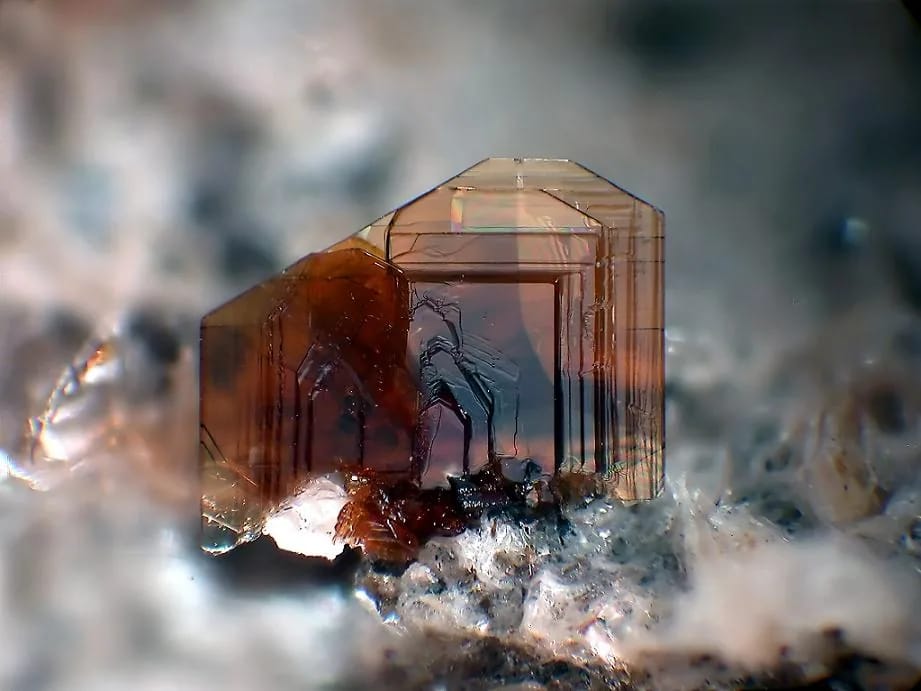
Biotite (K(Mg,Fe)₃(AlSi₃O₁₀)(OH,F)₂) is the dark iron-magnesium mica, named after physicist Jean-Baptiste Biot. It is one of the most abundant rock-forming minerals in granites, gneisses, and schists, where it forms flexible elastic black to brown plates.
Biotite (K(Mg,Fe)₃(AlSi₃O₁₀)(OH,F)₂) is the dark iron-magnesium mica, named after physicist Jean-Baptiste Biot. It is one of the most abundant rock-forming minerals in granites, gneisses, and schists, where it forms flexible elastic black to brown plates. The IMA reclassified Biotite in 1998 as a series rather than a discrete species, but the historical name remains in widespread use.
More minerals to explore
Other Members of the Mica Group
云母族
- Muscovite (白云母)
- Phlogopite (金云母)
- Lepidolite (锂云母)