
Crystal Structure
Ca₃Cr₂(SiO₄)₃.
Elemental Composition (by mass)
| Element | Mass % | Visual |
|---|---|---|
| O Oxygen | 38.36% | |
| Ca Calcium | 24.02% | |
| Cr Chromium | 20.78% | |
| Si Silicon | 16.84% |
Computed from simplified end-member formula. Solid-solution series, water content, and trace substitutions cause real-world variation.
IMA Abbreviation (Whitney-Evans 2010)
Uv
→ Uvarovite
Garnet
Standard symbol from American Mineralogist (Whitney & Evans, 2010). Used in thin-section labeling, phase diagrams, and IMA-style species records.
Pronunciation
/uˈvɑːrəvaɪt/
↔ oo-VAH-ruh-vite
for Count Uvarov
Diaphaneity (Transparency)
translucent-to-opaque
Crystals usually small; translucent at edges.
Type Locality
Saranovskoye, Ural — Russia
Described 1832 by Hess (named for Count S.S. Uvarov)
› Browse all type localities
Mohs 6.5–7.5
Vickers (~) 1400 HV
Knoop (~) 1100 HK
Element composition by mass
Formula: Ca₃Cr₂(SiO₄)₃ · molar mass: 500.47 g/mol
| O | 38.36% | |
| Ca | 24.02% | |
| Cr | 20.78% | |
| Si | 16.84% |
Computed from atomic weights (IUPAC 2021). Site-occupancy groups (Fe,Mn) split equally.
GroupGarnet Group
Mohs Hardness
6.5–7.5
Uvarovite sits at 6.5–7.5 on the Mohs scale — harder than glass; scratches steel.
Colors:
Streak
White
White
Crystal system
Isometric (Cubic)
Isometric (Cubic)
SilicatesSilicates (Nesosilicates)
TL;DR · 1 min read
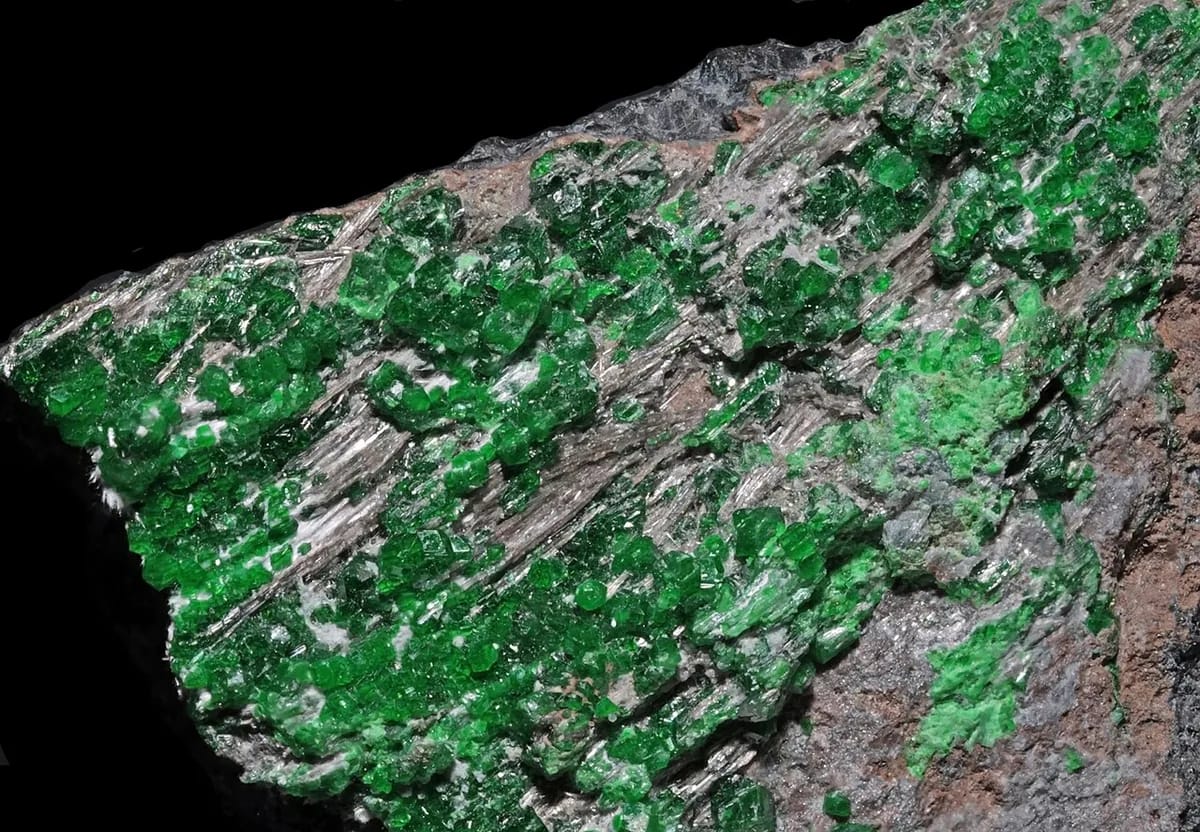
Uvarovite (Ca₃Cr₂(SiO₄)₃) is the chromium end-member of the garnet group and one of the rarest collector garnets. Its brilliant emerald-green color comes from chromium substitution in the garnet structure, and unlike most garnets it almost always occurs as small druzy microcrystal coatings on chromite host rock rather than as large solo crystals.
Uvarovite (Ca₃Cr₂(SiO₄)₃) is the chromium end-member of the garnet group and one of the rarest collector garnets. Its brilliant emerald-green color comes from chromium substitution in the garnet structure, and unlike most garnets it almost always occurs as small druzy microcrystal coatings on chromite host rock rather than as large solo crystals. The Saranovskii Mine in the Ural Mountains of Russia is a major source, supplying iconic emerald-green druzy plates that are display centerpieces in major mineral collections.
More minerals to explore
Staurolite (十字石)
Monoclinic
Andalusite (红柱石)
Orthorhombic
Sillimanite (夕线石)
Orthorhombic
Euclase (蓝柱石)
Monoclinic
Grossular (钙铝榴石)
Isometric (Cubic)
Andradite (钙铁榴石)
Isometric (Cubic)
Other Members of the Garnet Group
石榴石族
- Almandine (铁铝榴石)
- Andradite (钙铁榴石)
- Grossular (钙铝榴石)
- Pyrope (镁铝榴石)
- Spessartine (锰铝榴石)