
Crystal Structure
Orthorhombic BeAl₂O₄ — closely related to olivine structure.
Elemental Composition (by mass)
| Element | Mass % | Visual |
|---|---|---|
| O Oxygen | 50.40% | |
| Al Aluminum | 42.50% | |
| Be Beryllium | 7.10% |
Computed from simplified end-member formula. Solid-solution series, water content, and trace substitutions cause real-world variation.
IMA Abbreviation (Whitney-Evans 2010)
Cbr
→ Chrysoberyl
BeAl₂O₄
Standard symbol from American Mineralogist (Whitney & Evans, 2010). Used in thin-section labeling, phase diagrams, and IMA-style species records.
Pronunciation
/ˌkrɪsəˈbɛrəl/
↔ kris-uh-BEH-ril
Greek "gold beryl"
Lapidary & Faceting Recommendations
Recommended cut:
oval / round brilliant
Also seen:
cushion, pear, cabochon (cat's eye)
Typical yield:
35% of rough
Cat's-eye variety cabbed; clean rough faceted oval or round.
Diaphaneity (Transparency)
transparent
Including alexandrite and cat's eye.
Type Locality
Vyborg / Finland
Described 1789 by Werner
› Browse all type localities
Specific Gravity
3.70–3.78
g/cm³
medium
Heavier than beryl despite similar composition.
For comparison: water = 1.00, glass ≈ 2.5, quartz = 2.65, corundum ≈ 4.00, galena ≈ 7.50, gold ≈ 19.3.
Characteristic Inclusions
Silk (parallel fibers)solid★ diagnostic
Causes cat's eye (chatoyancy) when oriented and cut as cabochon.
★ Diagnostic inclusions are characteristic enough to help identify origin or species under 10× loupe.
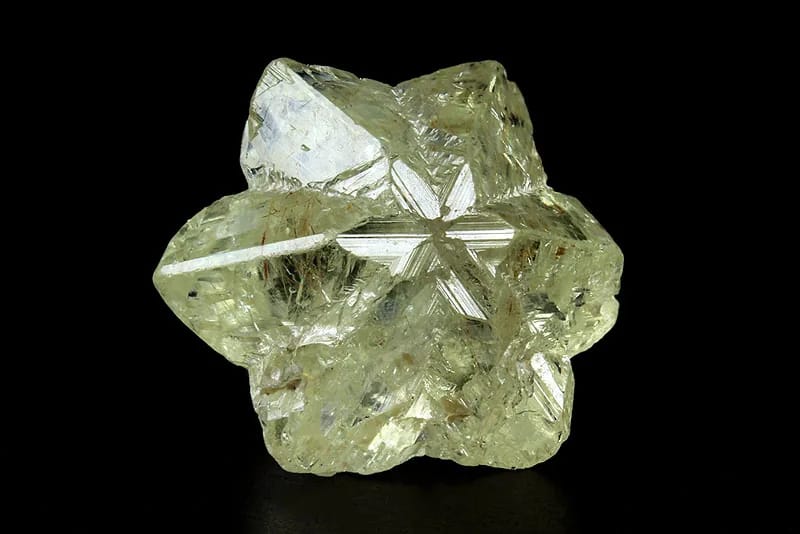
Twinning Laws
Trilling (cyclic)contact
Three crystals related by 120° — produces pseudo-hexagonal "wheels".
Pleochroism (trichroic)
Axis a
red
Axis b
orange
Axis c
yellow-green
Strength: strong
Alexandrite variety: the color-change phenomenon is reinforced by trichroism.
PolymorphsShares the formula
BeAl2O4 with: Alexandrite — same chemistry, different crystal structure.Mohs 8.5
Vickers (~) 1650 HV
Knoop (~) 1340 HK
Geological setting
PegmatiteMetamorphic
Element composition by mass
Formula: BeAl₂O₄ · molar mass: 126.97 g/mol
| O | 50.4% | |
| Al | 42.5% | |
| Be | 7.1% |
Computed from atomic weights (IUPAC 2021). Site-occupancy groups (Fe,Mn) split equally.
Mohs Hardness
8.5
Chrysoberyl sits at 8.5 on the Mohs scale — very hard; only diamond or corundum scratches it.
Colors:
Streak
White
White
Crystal system
Orthorhombic
Orthorhombic
Pronunciation/ˈkrɪsəˌbɛrɪl/
Oxides & HydroxidesOxides
TL;DR · 1 min read
Chrysoberyl (BeAl₂O₄) is the third-hardest natural mineral (Mohs 8. 5) after diamond and corundum.
Chrysoberyl (BeAl₂O₄) is the third-hardest natural mineral (Mohs 8.5) after diamond and corundum. Its three gem varieties are iconic: alexandrite (color-change green-to-red, Cr-bearing), cymophane (chatoyant cat’s-eye), and yellow-green chrysoberyl. Russia, Sri Lanka, and Brazil supply gem material; cyclic twinning produces the distinctive “trilling” hexagonal pseudosymmetry.
More minerals to explore
Brookite (板钛矿)
Orthorhombic
Corundum (刚玉)
Trigonal
Spinel (尖晶石)
Isometric (Cubic)
Ilmenite (钛铁矿)
Trigonal
Anatase (锐钛矿)
Tetragonal
Rutile (金红石)
Tetragonal
Varieties of Chrysoberyl
Chrysoberyl is a parent species — the following named varieties differ in color or chemistry but share the same fundamental mineralogy.
- Alexandrite (u53d8u77f3)color-change green-redChromium-bearing chrysoberyl with strong color change: green in daylight, red under incandescent.
- Cymophane (Cat's Eye) (u91d1u7effu732bu773c)cat's eye chatoyancyCat's-eye chrysoberyl variety with strong chatoyant band.