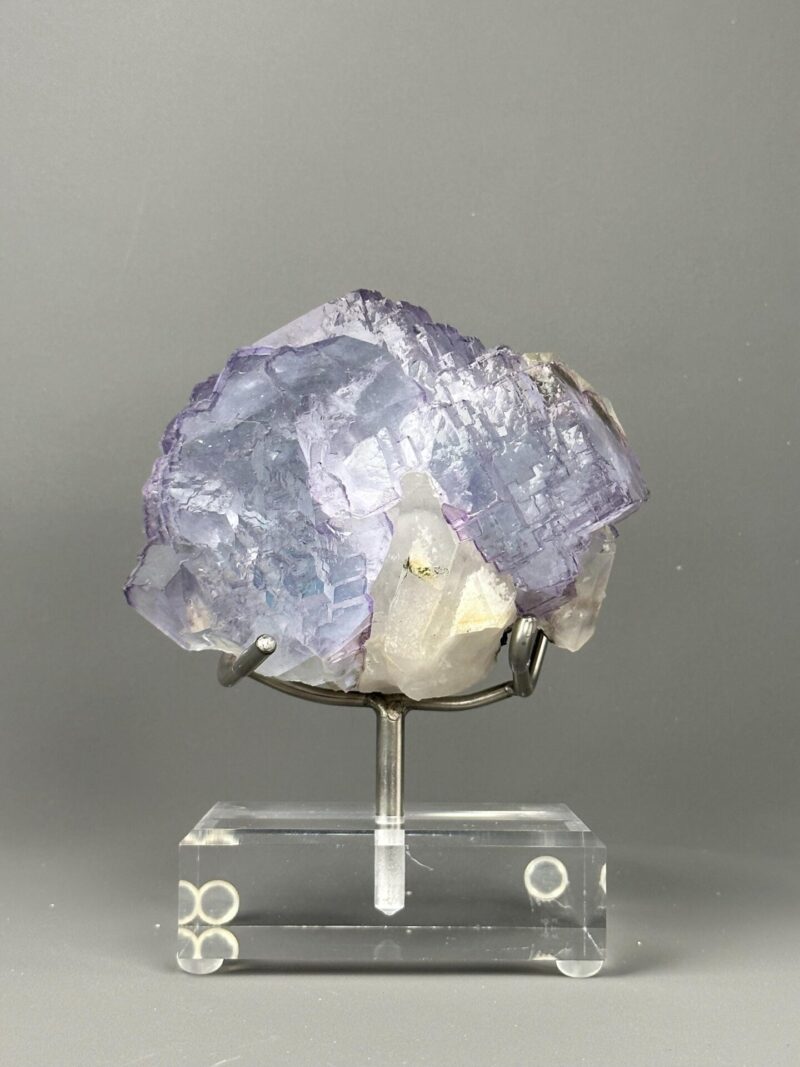
Anhydrite (CaSO₄) is the anhydrous calcium sulfate, the dehydration counterpart of gypsum (CaSO₄·2H₂O). It forms in evaporite basins by precipitation from saturated brines and as a primary phase in marine evaporite sequences. Anhydrite hydrates to gypsum at the surface, expanding by ~63% — a problem in salt-mining and tunneling.
Key Facts
- Mohs hardness 3–3.5.
- Orthorhombic; rectangular tabular crystals with three perpendicular cleavages.
- Specific gravity 2.97 — heavier than gypsum (2.32).
- “Angelite” is the pale-blue trade name for massive Anhydrite gem material.
- Common in deep evaporite sequences and salt-dome cap rocks.
Notable Localities
Naica (Mexico) yields gem-grade transparent crystals. Faraday Mine (Bancroft, Ontario) and Wieliczka (Poland) salt mines yield collector specimens.
Found at these Localities
- Naica Mine, Chihuahua (纳伊卡矿(奇瓦瓦州))
- Searles Lake (瑟尔斯湖蒸发岩)