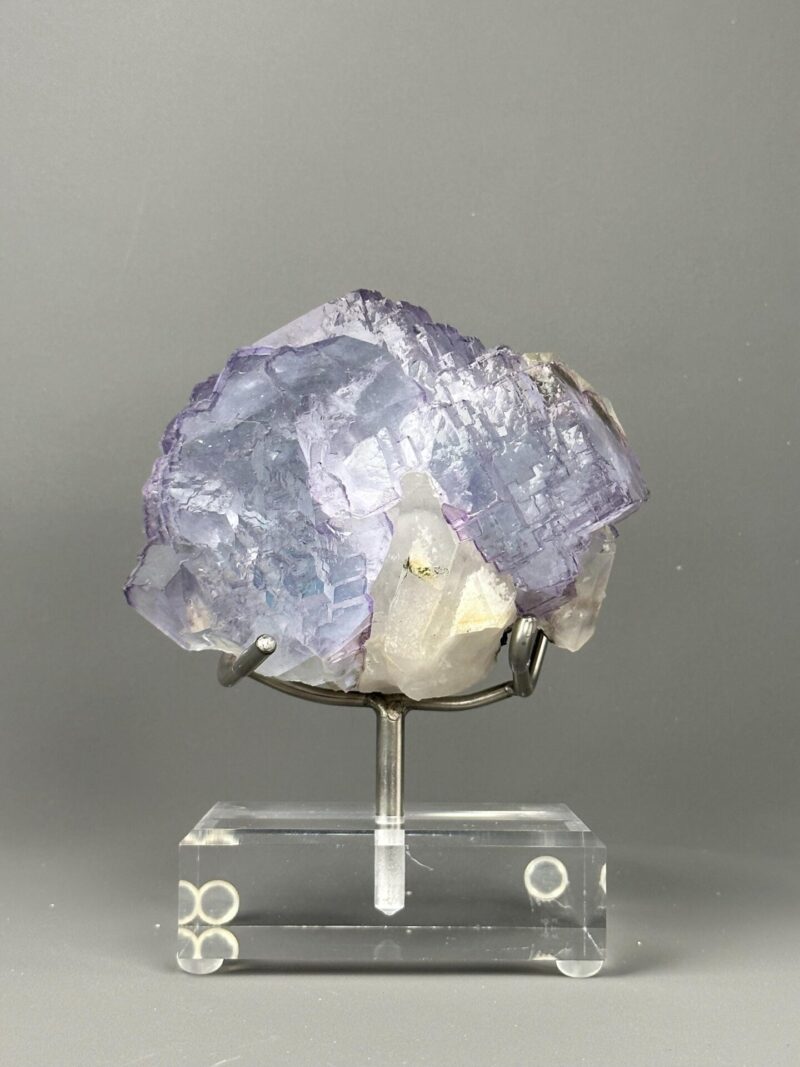
Calaverite is a gold telluride and one of the only common natural compounds of gold (alongside sylvanite and native gold itself). It is a primary ore mineral in epithermal gold-telluride deposits.
Properties
- Formula: AuTe2
- Crystal system: Monoclinic
- Hardness: 2.5
- Color: Brass-yellow to silver-white, tarnishing duller
- Streak: Greenish-gray to yellow-gray
- Luster: Metallic
- Cleavage: None
- Density: 9.0 – 9.4 g/cm³
Occurrence
Discovered at Calaveras County (California). The world’s premier sources: Cripple Creek (Colorado), Kalgoorlie (Western Australia), and Săcărâmb/Nagyág (Romania). Chinese occurrences are minor and not in collector grade.
Identification
Brass-yellow color similar to gold but harder edge + extremely high density + brittle (gold is malleable). Distinguish from sylvanite (similar, but contains Ag) by chemistry. Often striated tabular crystals.
Collector Notes
Cripple Creek and Kalgoorlie calaverite blades are historic gold-mining classics. Pair with sylvanite for the complete Au-telluride pair. Note: famous for its non-rational crystal faces — a lattice-incommensurate structure that historically baffled crystallographers.
Found at these Localities
- Kalgoorlie–Boulder (卡尔古利金碲矿)
- Săcărâmb (Nagyág) (萨卡拉姆布金碲矿)
- Cripple Creek District (克里普尔克里克金矿区)