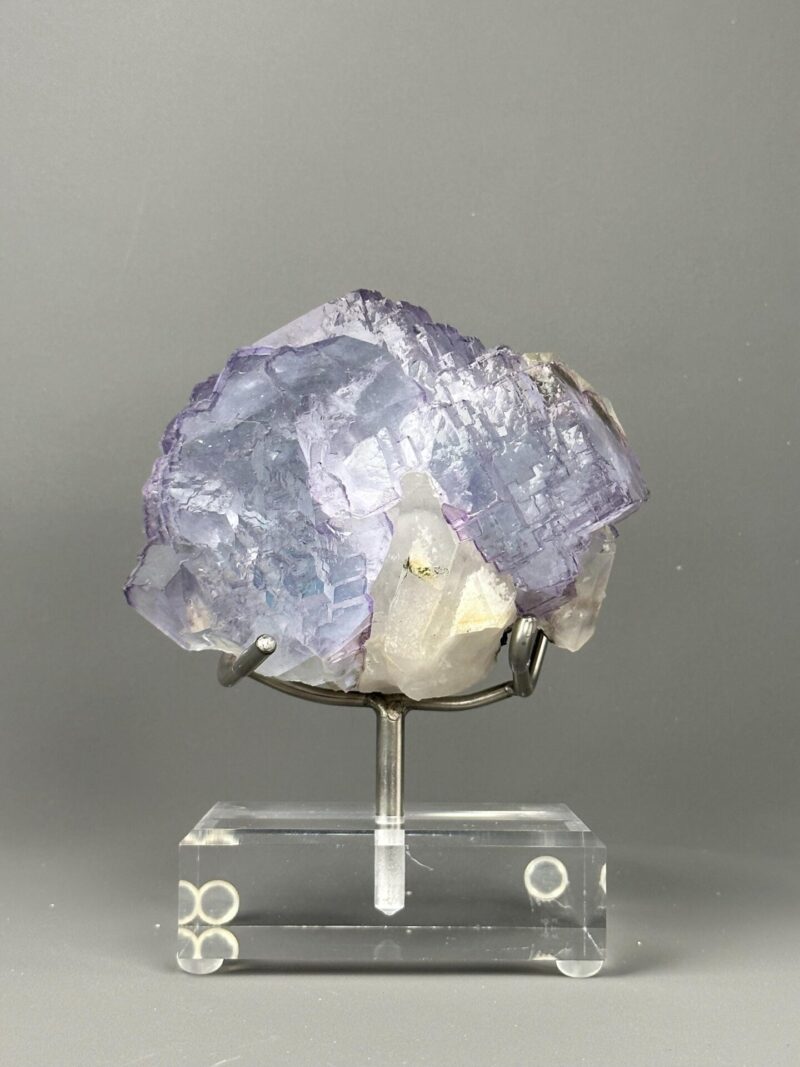
Charoite is an extremely rare lilac-to-violet potassium-sodium calcium silicate found at exactly one locality on Earth: the Murun massif in Sakha Republic (eastern Russia). Its swirling fibrous purple color makes it one of the most distinctive gem materials of the late 20th century.
Properties
- Formula: (K,Sr)(Ca,Na)2Si4O10(OH,F)·H2O
- Crystal system: Monoclinic
- Hardness: 5 – 6
- Color: Lilac, violet, lavender, sometimes with white, black or orange swirls
- Streak: White
- Luster: Vitreous to silky (fibrous)
- Cleavage: Three directions
- Density: 2.5 – 2.8 g/cm³
Occurrence
Unique locality: Murun complex (Chara River, Sakha, Russia) — a potassium-rich syenite intrusion. No other source on Earth produces gem-grade charoite. Often associated with tinaksite (orange), aegirine (black), and white feldspar.
Identification
Swirling lilac fibrous color + Russian pedigree + occasional orange tinaksite or black aegirine inclusions. Distinguish from sugilite (more solid color, hexagonal not fibrous) and dyed howlite/quartz imitations by SG and texture.
Collector Notes
Charoite is sold mostly as cabochons, slabs, and carvings. Pieces with swirling “purple dragon” patterns command premium prices. Asian markets refer to it as 紫龙晶 (purple dragon crystal). Murun extraction is sporadic — supply is genuinely limited.
Found at these Localities
- Murun Massif (穆伦碱性杂岩(西伯利亚))