
Ruby
Curated by Maggie Liu · Updated:
Ruby is an oxide mineral valued for its hardness and gem potential, with known Chinese sources.
About Rubyextended article
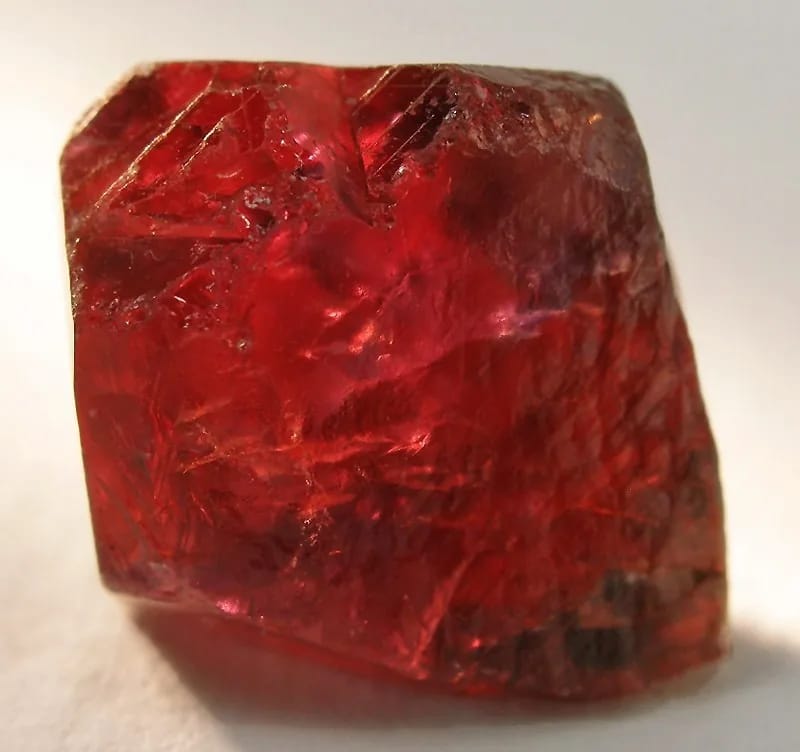
Ruby is the red gem variety of corundum, aluminium oxide. Its red comes from traces of chromium, the same element that fluoresces under ultraviolet light and gives the finest rubies their glowing 'pigeon's blood' colour. Any corundum that is not red is classed instead as sapphire.
Properties
Corundum is trigonal and, at 9 on the Mohs scale, is the hardest natural material after diamond, which makes ruby exceptionally durable. Crystals are typically tabular or barrel-shaped; rutile inclusions ('silk') can produce a six-rayed star in cabochon-cut stones.
Occurrence
The historic source is the Mogok Stone Tract of Myanmar; Mong Hsu (Myanmar), Mozambique, Thailand, Sri Lanka and Madagascar are major modern producers. Most rubies on the market are heat-treated to improve colour and clarity.
About Ruby
Ruby belongs to the oxide class in the corundum group and has the chemical formula Al₂O₃. It crystallizes in the trigonal system and ranks among the harder species, with lasting durability. Its combination of structural character and global distribution make it a recognized species in both systematic and aesthetic collections.
Identification & care
Crystals commonly develop as tabular to prismatic hexagonal crystals; barrel-shaped; massive. Its color is typically red. The luster is vitreous, adamantine, the streak is white, and specimens range from transparent to opaque. The cleavage is none — parting on {0001} and {1011}. The fracture is conchoidal, which aids identification.
Collector context
How it forms
In terms of geology, Ruby forms in metamorphic rocks (marble), alluvial deposits; also basaltic intrusions. It is commonly found in association with spinel, calcite, dolomite, graphite, phlogopite.
Classic Chinese localities
Ruby has known Chinese occurrences in Yunnan.
Why collectors care
Ruby occupies a rare position: it matters equally to specimen collectors and to the gem trade. Crisp natural crystals with saturated color and good clarity command premium pricing and are among the highest-prestige targets in any systematic collection.
What affects value
Value in Ruby is assessed, in typical order of weight, against: (1) locality provenance; (2) crystal size; (3) transparency and internal clarity; (4) color intensity and saturation; (5) crystal form and termination sharpness; (6) matrix and associated-species aesthetics; (7) gem-cutting potential. Verified locality documentation and cutting potential further elevate collector demand.
Frequently asked questions
What is Ruby?
Ruby has the chemical formula Al2O3, crystallises in the Trigonal system, has a Mohs hardness of 9. Ruby is an oxide mineral valued for its hardness and gem potential, with known Chinese sources.
What is the chemical formula of Ruby?
The chemical formula of Ruby is Al2O3.
What crystal system does Ruby belong to?
Ruby crystallises in the Trigonal crystal system.
Where is Ruby found?
Notable localities for Ruby include Mogok Valley, Mogok.
Related minerals
Looking for a Ruby specimen?
Our inventory is one-of-a-kind and turns over quickly. Tell us what you're after — species, size, budget — and we'll notify you when a matching Ruby arrives from our sourcing network.
Request this mineralExternal references
Ruby on Wikidata.