
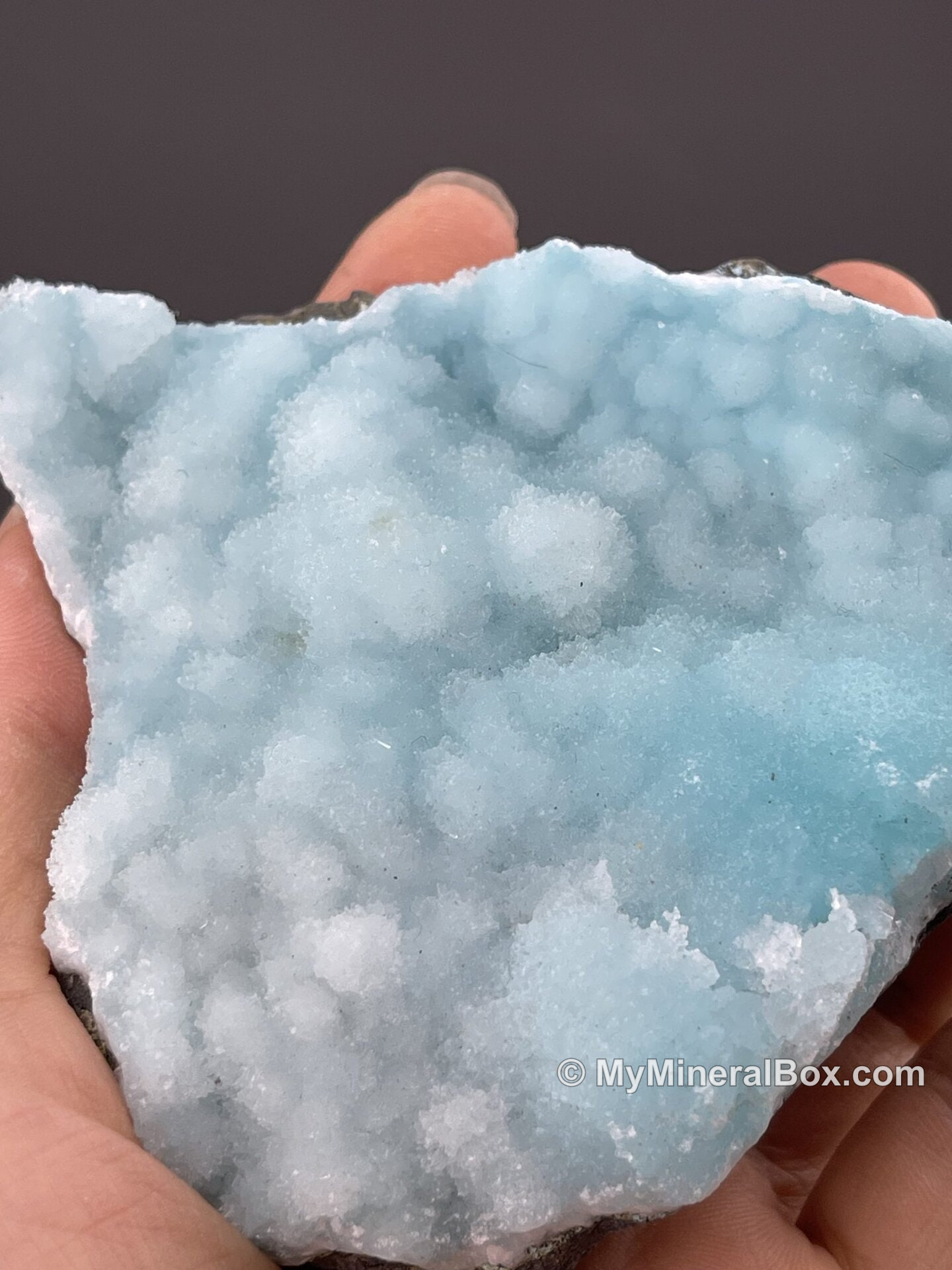
Where the blue comes from
Hemimorphite is the hydrated zinc silicate Zn₄Si₂O₇(OH)₂·H₂O and forms in oxidized zinc deposits. The Handbook of Mineralogy lists colorless, white, pale-blue and pale-green material. A 2005 crystal-chemistry study of blue and white hemimorphite from the Jinding Pb-Zn deposit in Yunnan found the same crystal structure and concluded that partial Cu²⁺ substitution for Zn²⁺ may cause the blue color. Color alone does not establish a mine or treatment history; rely on a label and specimen record.
The Chinese localities that matter
Wenshan, Yunnan is the modern standard-setter. The zinc workings around Wenshan City produce the botryoidal sky-blue crusts most collectors picture when they hear the species name — rounded, grape-like surfaces with a silky luster over earthy brown matrix, occasionally accompanied by aragonite or aurichalcite. The deepest-blue Wenshan material has come in distinct waves rather than steady production, which is why exceptional old pieces resurface at strong prices.
Gejiu and the Laochang ore field, also in Yunnan, add a different style: crystallized sprays and crusts, sometimes in company with the rare violet-blue copper phosphate veszelyite — a combination piece serious collectors chase.
Guizhou's carbonate-hosted zinc deposits contribute the sleeper of the category: glassy hemimorphite with rose-pink manganoan calcite. Blue-on-pink, all natural — few associations photograph better.
Judging a specimen: four things we check
Color saturation first: pale blue is pretty; deep robin's-egg blue is valuable. Judge in neutral daylight — the color is real, but warm shop lighting flatters it.
Crust continuity second: a botryoidal surface should roll unbroken across the display face. Dings expose the white interior and are instantly visible — one of the few minerals where damage announces itself in color.
Luster third: top Wenshan material has a soft satin-to-pearly sheen. Dull, chalky patches signal weathered or ground-contact surfaces.
Association last: aragonite sprays, aurichalcite tufts, pink calcite or veszelyite lift a piece from good to special. So does honest matrix — a crust standing proud of dark limonite reads far better in a cabinet than a trimmed flat.
Hemimorphite vs. Caribbean calcite
Search for blue botryoidal minerals and you will meet Caribbean calcite — polished pastel-blue towers and palm stones, heavily marketed in the metaphysical trade. The two get confused constantly, and more than one buyer has paid hemimorphite money for calcite.
The differences are decisive. Hemimorphite is a zinc silicate sold as natural botryoidal specimens from China, Mexico and Congo, hardness 4.5–5, with the color in the crust surface itself. Caribbean calcite is a trade name for banded blue calcite with white aragonite from Pakistan, on the market only since around 2019, almost always carved and polished, hardness 3, with the color running in bands through the stone.
Neither is fake — but only one is a collector's specimen with a locality, a formation story, and a track record at mineral shows. If a listing shows a polished free-form and says hemimorphite, ask questions.
A note on metaphysical interest
Many of our customers first meet hemimorphite through the crystal-healing world, where the blue material is associated with calm and communication. We do not make healing claims — what we can promise is the part science backs: this is a genuinely uncommon natural blue, formed by copper and zinc chemistry in a Yunnan hillside, and every specimen is one of a kind. Buyers who arrive for the meaning tend to stay for the mineralogy.
What to expect to pay
Yunnan hemimorphite is available across entry and mid-market price bands. As of 2026, small but well-colored botryoidal miniatures start around US$30–60; hand-sized cabinet pieces with strong color and clean crusts run roughly $100–300; and combination pieces — rhodochrosite or manganocalcite pairings, veszelyite associations, or exceptional deep-blue old-find material — command $300 and up.
Deep-blue material appears intermittently, so compare condition, color, associations, and locality documentation when examples are available.
Sources & evidence limits
These references support the specific points described below. A trade name, colour, photograph, price, or seller statement alone cannot prove treatment status or origin.
Frequently asked questions
Why is Chinese hemimorphite blue?
A Yunnan crystal-chemistry study found that blue and white hemimorphite share the same structure and concluded that partial Cu²⁺ substitution for Zn²⁺ may cause the blue color. The color is compatible with natural hemimorphite, but it does not by itself prove a specific mine or treatment history.
Is blue hemimorphite dyed or treated?
Blue color can occur naturally in hemimorphite, and Yunnan research links it to partial copper substitution. Color alone does not prove origin or treatment. Check the listing's locality evidence, surface consistency, matrix contacts, and repair disclosure, and do not assume every bright-blue botryoidal specimen is Yunnan material.
Is hemimorphite the same as Caribbean calcite?
No. Caribbean calcite is a trade name for polished blue calcite-aragonite rock from Pakistan. Hemimorphite is a zinc silicate sold as natural specimens with a locality pedigree.
Is hemimorphite safe to handle and clean?
Yes — it is stable and non-toxic. Clean with lukewarm water and a soft brush only; at hardness 4.5–5 it tolerates gentle handling, but botryoidal crusts chip if knocked. Never use acids: like many zinc minerals, it reacts.
Does hemimorphite fluoresce?
Some specimens fluoresce under UV light, and a few of our Yunnan pieces show it. It varies pocket to pocket — check individual listings.